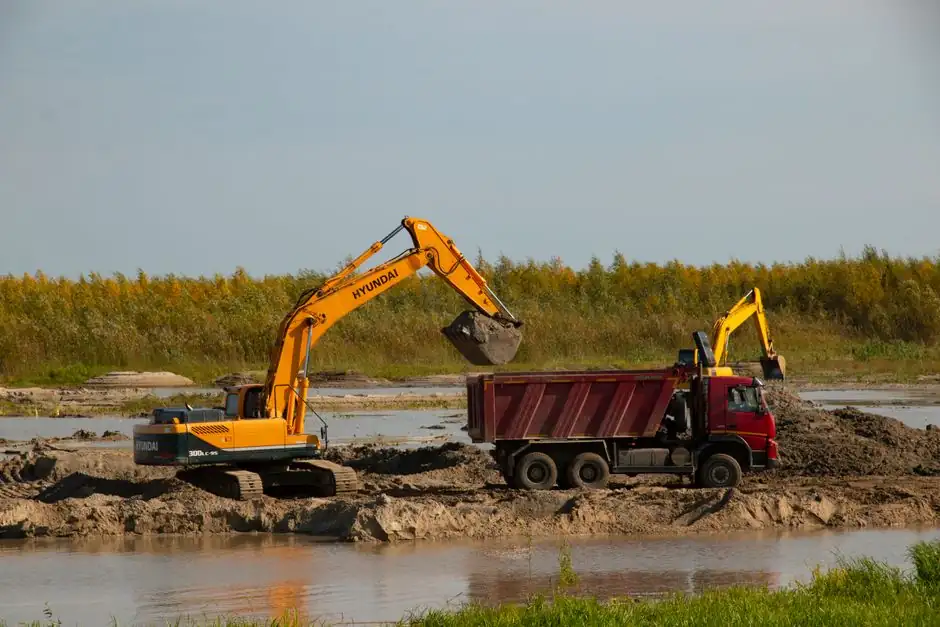
Single-axle (4x2) dump trucks typically haul 6–8 tons, with a 5–8 yd³ steel body and 20–22 ft overall length; tandem (10-wheeler, 6x4) models carry 12–18 tons across 10–14 yd³ at 22–26 ft; tri-axle configurations reach 18–25 tons in a 12–16 yd³ body and 24–28 ft footprint [S5].
Quad-axle dumps stretch to 26–30 ft and 20–25 tons, while semi end-dump or belly-dump trailers push 18–26+ yd³ and 25–40 tons over a 30–45 ft wheelbase [S5][S8]. Payload is gated less by body length than by axle count, axle spacing, and the federal bridge-formula, which together determine legal GVWR for a given chassis [S2].
Single-Axle (4x2) and Pickup-Scale Dumps
The 4x2 dump has a single steered front axle and a single rear axle, weighs roughly 15,100 lb empty with a steel body, and posts a 32,000 lb gross load rating for an 8-ton / 6 yd³ maximum [S3]. Body lengths run 10–14 ft on a 20–22 ft overall chassis, with width held to 2.3–2.55 m and a 3.0–3.4 m (10.5–11 ft) wheelbase for tight urban and residential work [S5].
Below the 4x2 sits the pickup- or light dump class, with 1–5 yd³ bodies, 1–5 tons payload, and 18–21 ft overall length; these are typically built on Class 3–5 chassis for landscaping and small contractor work [S4][S5]. Within the broader dump truck family, this is the entry tier where maneuverability and lower tire/fuel cost outweigh payload [S4].
Tandem (10-Wheeler, 6x4) and Super-Dump Variants
The tandem dump, also called the 10-wheeler, is the dominant configuration on North American job sites: two rear axles under a 10–14 yd³ body, 22–26 ft overall length, and 12–18 tons legal payload [S5]. A 14 ft steel body loaded with 15 yd³ of wet gravel crosses 22 tons, which will exceed a 33K GVWR chassis and trigger DOT bridge-law exposure [S2].
The super dump adds a lift axle ahead of the rear tandem group, raising payload roughly 5–7 tons over a standard tandem without length growth; combined with the pusher axle, overall length still sits in the 24–28 ft band used by tri-axles, but axle spacing rises to meet the federal bridge formula cleanly [S4]. For spec’ing the body itself, the working guide at Dump Truck Box Dimensions vs Payload Capacity maps steel vs aluminum body sizing onto chassis GVWR. For comparison against larger mining dump truck classes, the 10-wheeler is the smallest rigid frame routinely used on aggregate and paving work, and is what most DOT paving bids implicitly require [S2].
Tri-Axle and Quad-Axle Rigid Dumps
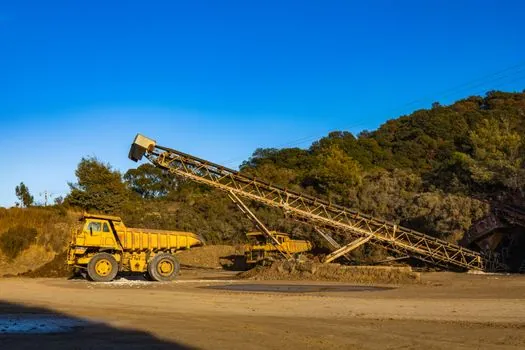
Tri-axle (6x4 or 6x6) rigs run 12–16 yd³, 24–28 ft overall, and 18–25 tons legal; the steel-body empty weight is about 25,380 lb, the aluminum equivalent 22,600 lb, against a 68,000 lb gross chassis rating [S3][S5]. On stone, asphalt, and millings a tri-axle hits 18–22 tons, the standard for many municipal paving contracts; for hot-mix asphalt at roughly 2 tons per cubic yard, a 15 yd³ tri-axle approaches its legal ceiling in a single load [S2].
Quad-axle configurations add a fourth rear axle to spread the load and meet bridge-formula inner-axle spacing; payload rises to 20–25 tons and overall length to 26–30 ft, with body volumes of 14–18 yd³ [S5]. Four-axle (8x4) chassis with aluminum bodies are widely used for long-distance aggregate haul because the 25–50% payload bump over a tri-axle materially improves ton-mile economics on interstate runs [S3][S4]. Wheelbase on these rigid configurations runs 4.0–4.5 m, and a raised dump box can extend 15–18 ft, so operators must confirm 14 ft overhead clearances before tipping [S5].
Semi End-Dump, Belly-Dump, and Side-Dump Trailers
Semi end-dump trailers hold 18–26+ yd³ and 25–40 tons at 30–45 ft overall; the end-dump is the common highway/legal configuration because the tractor’s drive axles plus three trailer axles routinely sit at 80,000 lb GCW under federal limits [S5][S6]. A 32 ft end-dump semi with 18 yd³ at aggregate density lands near 22 tons, well inside the 25–30 ton asphalt envelope cited for semi dumps in paving work [S2][S8].
Belly-dump trailers dump through a bottom gate and run as pup trains for aggregate spreading, typically 18+ yd³ per trailer; side-dump configurations are used in confined urban sites where a traditional end-dump cannot tip without spillage across lanes [S8]. The FHWA Truck Characteristics Analysis classifies 5-, 6-, and 7-or-more-axle combinations separately, since the axle-count split is the primary signal used to identify trailer and straight-truck categories in weigh-in-motion and traffic monitoring [S1].
Multi-Axle and Off-Road Rigid Mining Dumps

Beyond quad-axle rigs, multi-axle highway dumps use two front axles and three or four rear axles to push the GVWR to roughly 80,000 lb; a seven-axle configuration is the upper end of what remains road-legal in most U.S. states [S3]. Multi-axle (six-axle and up) configurations can haul up to 80,000 lb, rivaling some dump trailer types when the bridge formula is satisfied [S6].
Off-road mining dump truck classes (Cat 793, 797, Komatsu 930E, BelAZ 75710) sit outside the FHWA straight-truck classification and use two to four front axles plus two rear axles with 56.00R63 or larger tires, payload ratings of 240–400 short tons, and overall lengths of 14–15 m with bodies of 200–400+ yd³ [S9]. Most heavy off-road models are twin-axle at the rear with twin front axles, and are designed for pit haul roads rather than public highways [S9].
Side-by-Side Comparison: Capacity, Length, Axles, GVWR
Decision criteria for spec’ing a chassis: (1) legal payload in tons, (2) overall length for site access, (3) axle count / spacing for bridge-law compliance, (4) empty chassis weight. The table below lines up the major classes; the numbers are drawn from manufacturer and reference data and represent typical, not maximum, configurations [S2][S3][S5].
Single-axle (4x2): 6–8 t payload, 20–22 ft length, 2 axles, ~15,100 lb empty, 32K GVWR. Tandem (6x4, 10-wheeler): 12–18 t, 22–26 ft, 3 axles, ~17–20K lb empty, 60–66K GVWR. Tri-axle (6x4 / 6x6): 18–25 t, 24–28 ft, 3–4 axles, 25,380 lb steel / 22,600 lb aluminum empty, 68K GVWR. Quad-axle (8x4): 20–25 t, 26–30 ft, 4 axles, 4.0–4.5 m wheelbase, ≥68K GVWR [S3][S5]. Semi end-dump: 25–40 t, 30–45 ft, 5+ axles, ~80K GCW. Multi-axle rigid (7-axle): up to 80,000 lb GVWR, body 14–18+ yd³, used for mining and heavy-haul infrastructure [S3][S5][S6].
Selection Criteria and Common Failure Modes
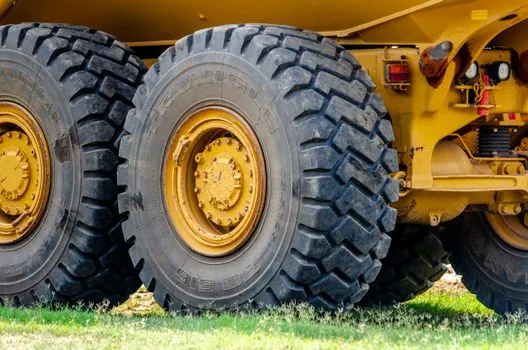
Axle configuration is the primary driver of legal payload, but three failure modes bite spec’ers regardless of class: (a) bridge-formula overloading when a tandem runs too tight on axle spacing; (b) chassis GVWR overage on a 33K Class 7 chassis with a 14 ft steel body and 15 yd³ of wet gravel at 22 tons; and (c) raised-body overhead strikes in urban routes with 14 ft wire crossings [S2][S5]. A 4-inch width difference can change gate-clearance behaviour on tight residential sites, and operators report minimum 10–11 ft of clearance is needed for safe passage [S5].
For buyers weighing the construction machinery and equipment decision, the right rule is: match axle count and bridge-formula spacing to your state’s weight law first, then size the body to that legal envelope, then choose steel vs aluminum based on route length and material density. A steel body adds roughly 2,780 lb over aluminum, a meaningful hit to payload on a tri-axle running at its 68K ceiling [S3]. For further reading on spec’ing within the broader heavy-vehicle catalogue, see the manufacturer data at SANY and the FHWA classification framework at the Truck Characteristics Analysis [S1][S3].
Trackable signals for the next spec cycle: state-level bridge-formula amendments affecting quad-axle and multi-axle configurations, and OEM-published empty-weight deltas for aluminum-bodied quad-axle chassis, which materially shift the payload ceiling on long interstate hauls. The most useful single source for buyers remains the FHWA TIUS axle-and-length breakdown, since axle count, not body length, is the legal gating variable for every U.S. state [S1].