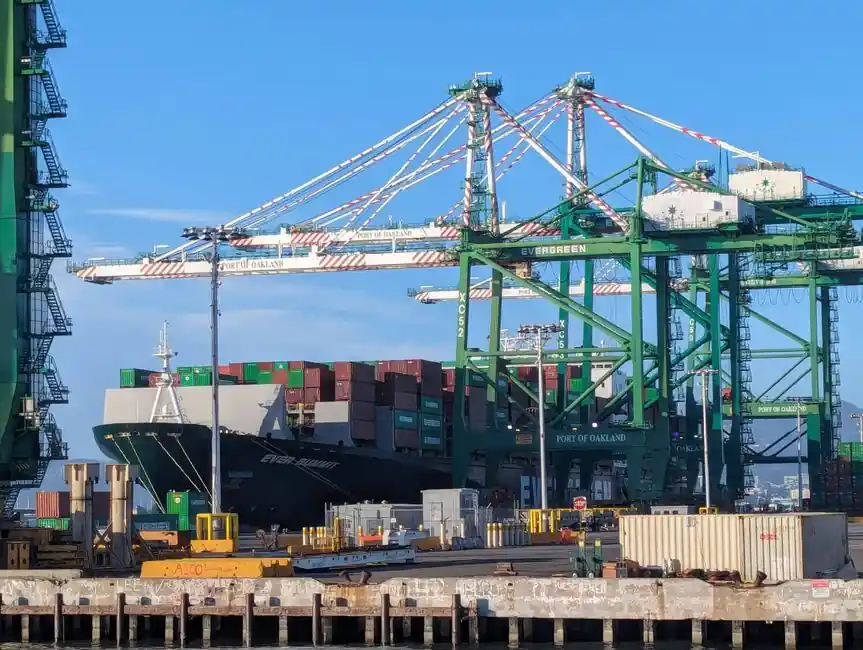
A truck-mounted concrete pump for port work needs three things locked down at the spec gate: boom reach of 40–63 m for elevated deck and pier-cap pours, sustained theoretical output of at least 150 m³/h to keep formwork crews fed, and chassis/boom corrosion protection rated to marine C4–C5 environments per ISO 12944 [S1].
Port terminals are not generic construction sites. Saline air, abrasive cement dust from neighbouring bulk handling, and tight staging between ship unloaders and silos dictate a different selection logic than urban high-rise pours, and the 2026 launch of SANY's intelligent hybrid pump truck, with 1,400.5 km range and 650+ m³ of continuous pumping per charge/fill cycle, marks the first serious plug-in option for terminal operators looking to cut diesel burn on the apron [S2].
Scope: What a Port Pump Truck Actually Has to Do
Terminal concrete work breaks into three distinct duty cycles: wharf deck and pile-cap pours (high volume, long boom reach, frequent repositioning), silo and hopper base construction (vertical placement up to 40 m, contained footprint, dust-loaded air), and quay-wall tie-back or service-road repair (intermittent, low volume, tight access) [S1].
Selection starts with a truck-mounted concrete pump configuration rather than a stationary trailer unit, because the unit has to reposition between ship calls and the wharf apron without a separate prime-mover. A concrete pump truck on a 4-axle or 5-axle carrier also matches European road-load limits for terminal-internal haul routes that share pavement with reach stackers and concrete mixer truck fleets.
Selection Criteria: Reach, Output, and Pressure Class
Five-axis booms in the 56–63 m class cover most Ro-Ro ramp and quay-edge pours; 38–47 m booms suffice for silo-ring and service-road work. Theoretical piston output on modern units runs 160–200 m³/h, with concrete pressure ratings from 8.5 MPa (low-pressure line-pump configuration) up to 20 MPa on high-pressure piston models used for long horizontal runs or high-rise. [S3]
For port use, the more binding number is the continuous duty rating at ambient, not the marketing peak figure. SANY's 2026 hybrid unit publishes 650+ m³ of continuous pumping on a single energy cycle, which is a useful reference point for terminals trying to size a single truck against a 4–6 hour silo-ring pour [S2].
Corrosion, Dust, and the Marine-Environment Penalty
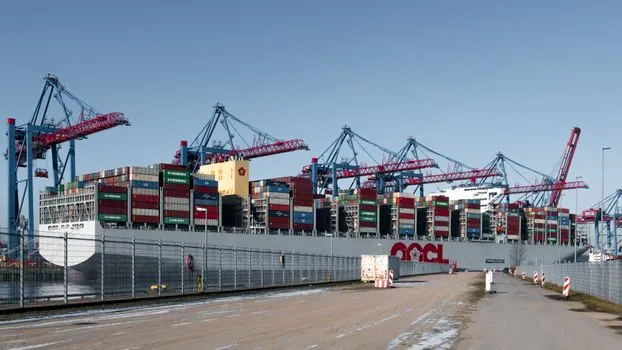
Standard boom steel with a single-coat paint system survives 3–5 years at an inland job site; the same unit in a C4 (industrial-coastal) zone typically shows coating breakdown in 18–30 months, and C5 (marine) zones can cut that in half. Terminals within 1 km of breaking surf or that handle cement via unloader-to-silo transfers should specify a documented C5-M coating system, stainless or hot-dip galvanised outrigger pads, and sealed boom pivot bearings [S1].
Hydraulic-hose routing deserves equal attention: routed away from the boom wash-down zone, with abrasion-resistant sleeves at all chafing points. Cement dust ingestion into the hopper grate is a chronic failure mode at bulk terminals, and the fix is a dust-extraction interface at the receiving hopper matched to the unloader-side dust collector, not larger filters on the pump truck itself [S1].
Hybrid and Electric Drive: Where Diesel-Electric Now Fits
Diesel-electric and plug-in hybrid pump trucks were a niche product before 2025. SANY's March 2026 release, the world's first intelligent hybrid pump truck, claims a 1,400.5 km combined range and 650+ m³ continuous pumping capacity, targeting exactly the terminal and long-haul segment where idling and short-hop repositioning dominate fuel burn [S2].
For port operators, the practical case is not emissions branding but three hard numbers: overnight grid charging at depot instead of mid-shift refuelling (cuts shift interruptions), electric-only mode for indoor or covered silo construction, and the ability to run a full pour on stored energy if the apron is under a temporary emissions restriction during a ship call. Diesel-electric drive does not change the boom or pump-end selection, but it does change the chassis spec: battery mass shifts axle loading, and terminal pavement ratings must be re-checked.
Rental Cost Gate: What a Day on a Terminal Actually Costs
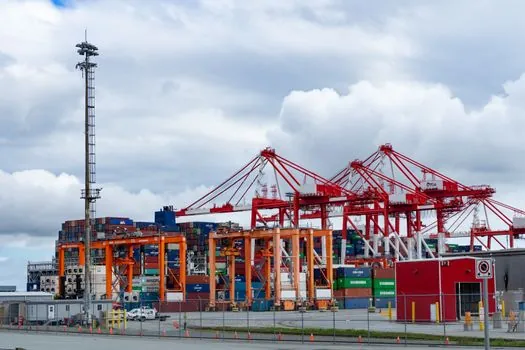
For terminals that hire rather than own, 2026 US Midwest planning ranges are a useful floor: line-pump hire at $900–$1,600/day, $3,200–$5,800/week, $9,000–$14,000/month, and boom-pump truck hire at $1,700–$2,800/day, $6,000–$9,500/week, $17,000–$28,000/month, with large-reach boom trucks commonly $2,500–$4,200/day and up to $40,000/month [S3].
Published billing is almost universally hourly with a 3–4 hour minimum, plus yardage adders of roughly $3.00–$4.50 per cubic yard, plus port-to-port travel time billed from yard to yard. On a port job, the line items that blow budgets are: standby during ship-call interruptions, hose and system footage for elevated deck pours, and washout constraints on a site that cannot drain slurry into the harbour. Build those into the rental quote, not as extras [S3].
Limitations and Failure Modes
The four recurring failure modes in port pump-truck service are: boom-corrosion-induced hydraulic leaks at pivot bearings (linked to inadequate coating spec), hopper grate blinding from cement-dust accumulation (linked to no dust extraction at the receiving end), boom-section fatigue cracking at the knuckle joints (linked to over-rated pressure on long horizontal hose runs), and chassis electrical faults from chloride ingress in unsealed connectors. Each is a spec-gate decision at purchase, not a maintenance event afterward [S1].
The other hard limit is reach versus payload: a 63 m five-section boom on a 5-axle carrier in C5-M coating is near the upper limit of what European road rules will register without special permits. Above that, terminals should evaluate a placing boom on a fixed tower fed by a stationary trailer pump rather than chasing longer truck booms.
Standards and Sourcing Map
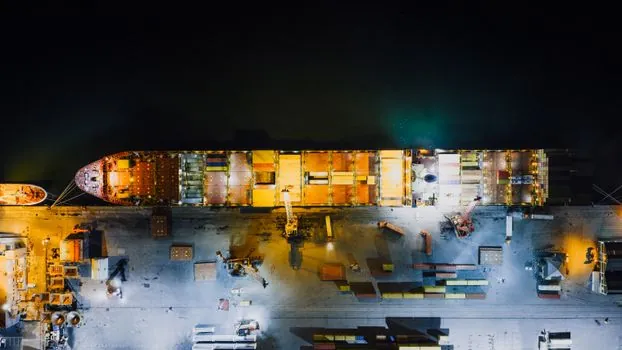
Three standards govern the spec sheet directly: ISO 12944 for the corrosion-protection class, EN 12001 for concrete pump safety and performance, and the carrier chassis emissions class (Euro VI / EPA Tier 4 Final) applicable to the registration region. The boom structural design is typically verified per EN 13000 for crane-class machinery, and the concrete delivery line per the pump OEM's published pressure derating curves. [S2]
For port-side strapping and pallet loads around the placement zone, strapping machine selection for port logistics covers PET vs PP spec gates for outdoor storage. For broader equipment-category context, the construction machinery and equipment reference page maps adjacent selection logic.
Track two signals over the next two quarters: (1) second-generation hybrid pump-truck releases from SANY, Putzmeister, and Schwing that publish independent third-party continuous-pumping verification, not OEM-internal test figures, and (2) port-tender language that begins naming C5-M coating and Euro VII / EPA Tier 5 chassis class as a pass/fail line item, which will force the rental fleet to upgrade rather than the operator to pay a corrosion premium on the existing stock [S2].