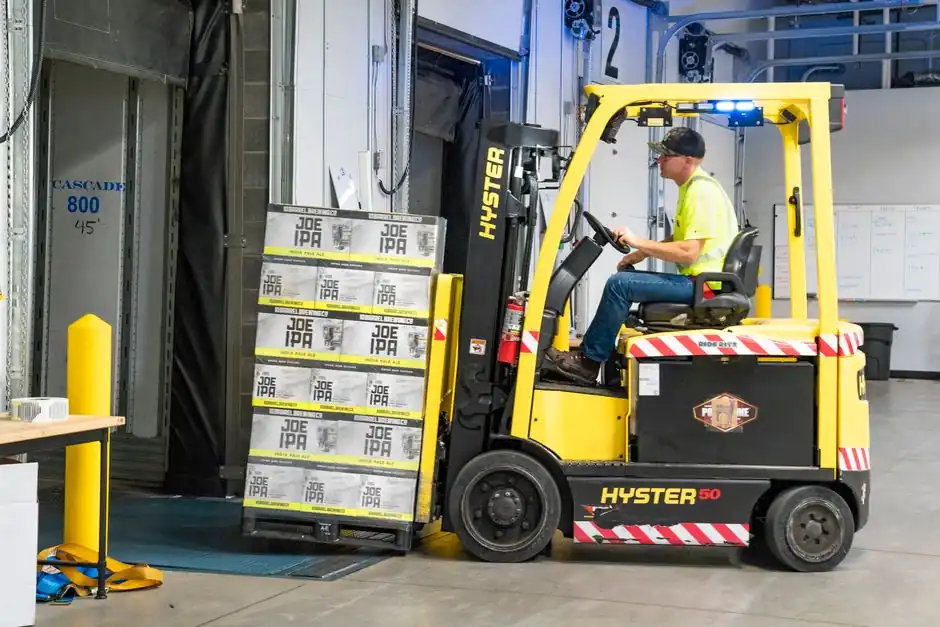
Disposable dust mask selection for warehouse operations is governed by four hard gates: particulate concentration vs. occupational exposure limit, oil aerosol presence, filter efficiency class, and face-seal fit factor.
Under GB/T 18664, a half-mask particulate respirator is only valid when ambient concentration stays within 10x the OEL; above that, a full-face or higher protection factor device is mandatory [S4].
Filter Class vs. Concentration: The Core Decision
Per GB/T 18664, a half-mask is approved for particulate hazards up to 10x the occupational exposure limit, defined as the Assigned Protection Factor of 10 for an APF-10 half-mask [S4]. When measured dust concentration sits between 10x and 100x OEL, the worker must move to a full-face respirator or a powered air-purifying respirator, which carries an APF of 50 to 1,000 depending on the configuration.
For nuisance and general warehouse dust (cardboard, paper fibre, ambient PM2.5 below 2 mg/m³), an FFP2 / N95 / KN95 class disposable is the standard baseline, with typical exhalation resistance in the 70 to 100 Pa range and filter efficiency at or above 94% for the most common NaCl and paraffin oil test aerosols [S4].
Construction-grade activities inside the warehouse (light demolition, drywall cutting, bagged-cement handling) routinely push concentrations past 10x OEL, which means a half-mask disposable is no longer compliant and a full-face elastomeric or PAPR must be specified.
Oil Aerosol, High-Toxicity and Radiological Dust Gates
When oil-bearing aerosol is present (machining coolant drift, certain polymer dusts, forklift diesel soot), the filter letter matters: N-series (NIOSH) and FFP (EN 149) disposables are NOT approved for oil; R-series is oil-resistant for a single shift; P-series is oil-proof for longer service [S4]. Selecting an N95 in an oil-laden environment is a common warehouse mis-spec that collapses filter efficiency within hours.
For high-toxicity, carcinogenic, or radioactive particulates (e.g. hexavalent chromium from stainless work, beryllium, some catalyst powders, or contaminated packaging), GB/T 18664 mandates the highest-grade filter material available, which corresponds to FFP3 (EN 149) or P100/HEPA class filters [S4].
Needle-fibre dusts (mineral wool, slag wool, glass fibre, asbestos) are a separate exclusion zone: standard dust masks cannot be washed once the fibres lodge in the face-seal interface, and the resulting skin irritation breaks the seal, so alternative supplied-air respiratory protection is preferred [S4].
Fit Factor, Sizing, and Seal Performance

Filter efficiency is only half the protection equation; the GB/T 18664 framework treats face-seal leakage as the gating failure mode and requires that masks be issued in multiple sizes to match facial geometry [S4]. A one-size flat-fold respirator with a quoted 95% filter media rating can deliver 50% or less effective protection if the inner seal flexes under movement.
Quantitative fit testing (CNC or particle-counting method, typical pass threshold fit factor ≥ 100 for half-mask) is the standard verification step in regulated warehouses; warehouses using disposable-only programs without fit testing consistently show higher reported fit-fail rates during powered industrial truck work, where head rotation and chin lift routinely break a marginal seal.
For warehouse workers with facial hair along the seal zone, a half-mask cannot achieve the required fit factor, and a hooded PAPR or full-face with alternative seal geometry is the engineering path, not a closer shave or a different brand.
Construction and Material: Why Spec Sheets Matter
The reference construction for a disposable dust mask is two outer layers of non-woven polypropylene with a central melt-blown (meltblown) filter layer, which carries the electrostatic capture mechanism for sub-micron particles [S3]. This three-layer sandwich is standard across KN95 / FFP2 / N95 product lines, and the meltblown layer is the cost driver and the spec that separates compliant media from commodity cloth.
For warehouse buyers, the FOB price band for CE-marked disposable respirators from Suzhou-region manufacturers sits at roughly US $0.6–1.0 per piece for the basic CE Russia-style cup mask at 10,000-piece MOQ, scaling to US $1.7–2.0 per piece for higher-spec CE welding or welding-adjacent face masks at 1,000-piece MOQ [S2].
Accessory items pulled in by the same procurement cycle include PU foam earplugs at roughly US $0.06–0.065 per pair at 10,000-pair MOQ and CE safety spectacles at US $1.7–2.0 per piece at 1,000-piece MOQ, which is useful when a single PPE RFQ covers respiratory, hearing, and eye protection for one warehouse site [S2].
Comparison of the Three Main Disposable Options
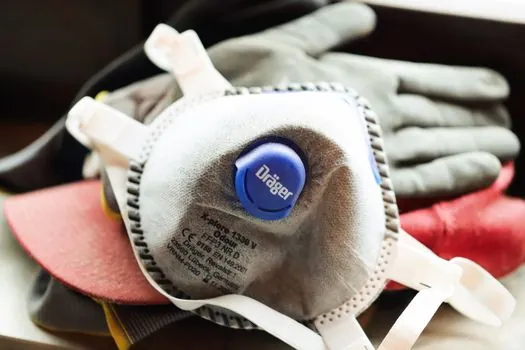
The three dominant disposable respirator classes used in warehouse duty compare as follows: FFP1 (EN 149) is rated for 4x OEL with a minimum 80% filter efficiency, suited to nuisance dust only; FFP2 is rated for 10x OEL with a minimum 94% filter efficiency and is the default for general warehouse particulate; FFP3 is rated for 20x OEL with a minimum 99% filter efficiency and is required for high-toxicity, carcinogenic, or radiological particulates [S4].
The NIOSH equivalents differ on oil: N95, N99, N100 are not oil-resistant; R95/R100/R99 are oil-resistant to one shift; P95/P99/P100 are oil-proof and the correct warehouse spec for diesel soot, coolant mist, or polymer dust with oil content.
For full-face or powered-air options the APF jumps to 50 and 1,000 respectively, which is the only compliant path when particulate monitoring repeatedly returns values past 10x OEL on a half-mask program.
Adjacent Equipment and Selection Logic
Airborne particulate is not the only warehouse exposure; complementary gear includes safety spectacles, PU foam earplugs, and full-face shields, and they are typically bundled on the same supplier MOQ for cost efficiency. A CE welding goggle with elastic head band lists at US $3.0–3.5 per piece at 1,000-piece MOQ, while chemical PVC transparent protection goggles list at US $1.5–2.0 per piece at the same MOQ [S2].
For stationary dust generation points (bag dumping, granulate transfer, pallet shredding), fixed dust detectors and benchtop dust particle meters provide the live concentration data that drives whether the next shift needs a half-mask or a PAPR, and the same monitoring standardises the respirator selection across a multi-warehouse network.
The site link to a deeper lab-grade respirator selection walk-through sits at lab dust mask FFP fit factor and filter spec, which is the natural next read when warehouse operations include a QC sampling room with sub-micron powder handling. For warehouses that also act as e-commerce fulfilment, the throughput-driven PPE turnover logic is similar in shape to the AMR safety gates for e-commerce fulfilment discussion, where per-unit cost and shift-life of consumables are the deciding economics.
Selection for warehouse operations closes cleanly when particulate concentration is mapped against OEL, the oil-aerosol presence flag is set, the filter class matches both, and a sized, fit-tested half-mask program is in place; any one of those four gates failing is the trigger to escalate to a full-face, PAPR, or supplied-air configuration, and the next trackable signal is the publication of updated GB 2626-2019 enforcement guidance for warehouse-class workplaces in Q4 2026.