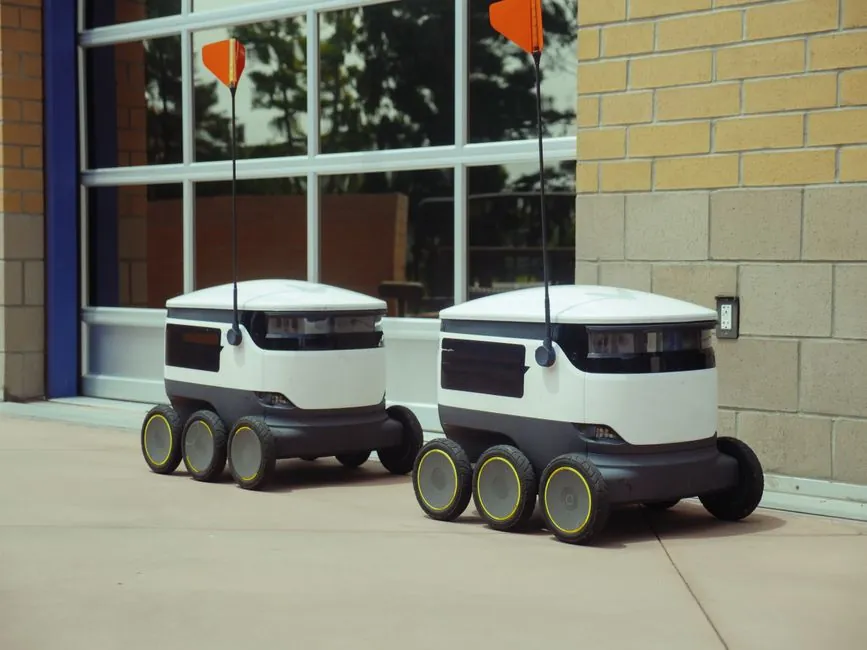
Autonomous mobile robots in e-commerce fulfillment rely on onboard SLAM, sensor fusion, and per-vehicle negotiation, so each unit can reroute around a dynamic obstacle without a central controller, unlike legacy AGV robot systems where a central unit owns scheduling, routing, and dispatching [S1].
That architectural shift is the reason a single fulfillment site can scale from 20 to 200 vehicles on the same map: every AMR robot holds its own localization and reacts locally, which collapses the bottleneck that limits AGV fleets above a few dozen units [S1].
Why AMRs replaced AGVs in parcel and e-commerce sortation
The intralogistics literature now distinguishes AMRs from AGVs by the locus of decision-making: AGVs receive routes from a central planner, while AMRs negotiate independently with other resources, machines, and systems [S1]. For e-commerce, that difference shows up in two measurable ways: first, the same map can absorb seasonal SKU expansion without re-cutting magnetic tape or QR codes; second, peak-season fleet size can scale without proportional dispatcher rework.
In sortation, the EU MARS project frames the trade-off sharply: collaborative sortation robots run in the same space as humans and stay slow for safety, while fenced non-collaborative systems run at higher speed but lose floor flexibility [S2]. MARS vehicles are designed to switch between these modes by detecting a cordoned area, then raising speed autonomously while keeping the same vehicle and fleet manager [S2].
Three decision criteria that actually drive vendor selection
For an operations engineer, the criteria that move a purchase order are not the marketing claims; they are payload class, fleet software, and safety certification. A typical e-commerce AMR covers three payload bands: totes and bins at roughly 10–100 kg, shelf and rack units at roughly 100–500 kg, and pallet or dolly movers at 500–1500 kg, so a single site often ends up running two classes of industrial robot chassis rather than one. [S1]
Compare the three main options on the criteria that hit the budget and the safety file:
Option A, collaborative tote AMRs: lowest unit cost, cap speed about 1.5 m/s in human zones, fit goods-to-person stations, weakest on heavy-pallet work. Option B, rack-lift AMRs: mid-cost, roughly 1000 kg payload, lift height 1.0–1.8 m common, fit bin shelving and apparel picking, the workhorse of mid-size fulfillment. Option C, autonomous forklifts and pallet movers: highest unit cost, 1500 kg+ payload, run in fenced cells at higher speed, the right tool for inbound and outbound dock work but not for aisles narrower than roughly 2.5 m.
Localization, SLAM, and the perception stack

Perception and SLAM is where most of the engineering risk hides. In the CNC factory study from 2023, the team integrated Google Cartographer with a linear quadratic Gaussian (LQG) controller and benchmarked it against Gmapping and Hector, with the result that Cartographer-LQG improved map loop-closure accuracy and reduced cumulative SLAM error for navigation in a real industrial cell [S5]. That result matters in e-commerce because warehouse lighting, reflective shelving, and dynamic pallet jacks break many 2D-LIDAR-only systems, and the safer pick is a chassis that fuses 2D-LIDAR with at least one additional modality (depth camera, IMU, or wheel odometry).
Two practical implications follow. First, specify a SLAM stack that supports loop-closure in long corridors over 50 m, because pick-aisle runs in fulfillment routinely exceed that length. Second, plan for roughly 2–4 hours of site survey per 10,000 m² for map building, plus a separate pass for safety-zone tuning; this is where project schedules slip when buyers underestimate the perception-tuning effort.
Fleet management, WMS hooks, and RaaS economics
On the software side, AMRs are a fleet problem, not a robot problem. A modern fleet manager exposes REST or AMQP hooks into the WMS, treats each order as a task with a pickup, a dropoff, and a priority, and handles charging-depot arbitration when battery state of charge falls below roughly 20–30 percent. Cloud-resident fleet platforms such as the MARS RAMEN platform add predictive-maintenance and AR visualization services on top of containerized microservices, which is a useful pattern for plants that want to keep the WMS vendor-neutral [S2].
On commercial terms, the Cyberclean advisory track describes a four-stage lifecycle, evaluation, deployment, optimization, and ongoing tuning, and flags underutilization as the dominant failure mode in real installations, ahead of hardware faults [S3]. For e-commerce, that translates into a procurement rule: contract for fleet software that exposes per-vehicle utilization, idle time, and charge-cycle metrics, then run a 90-day post-go-live optimization pass before signing off acceptance.
Safety, standards, and the collaborative vs fenced split

Safety design drives the operating envelope. Collaborative AMRs carry LiDAR safety scanners and bumpers, run in mixed traffic at restricted speed, and typically meet ISO 3691-4 for driverless industrial trucks. Non-collaborative units run in fenced or light-curtained cells and can take speed up to roughly 2 m/s or more. The MARS vehicles switch the speed envelope autonomously when they detect they are inside a cordoned area, which is the engineering basis for combining both modes on one site without doubling the fleet manager [S2].
For e-commerce sites in the EU, expect the safety file to include a risk assessment per ISO 12100, a functional-safety section referencing ISO 13849-1 performance level on the safety stops, and CE marking under the Machinery Directive. In the UAE, the same sites still need the ISO 3691-4 evidence plus local third-party inspection; the Dubai fulfillment operator IQ Fulfillment markets same-day and next-day delivery backed by automated, temperature-controlled storage, which is the use case where the AMR + WMS + SLA package has to perform end-to-end [S4].
When AMR is the wrong tool, and where AGV still fits
AMR is the wrong tool in three e-commerce scenarios. First, greenfield mega-sites over 50,000 m² with very long fixed routes and few dynamic obstacles, where a high-density AGV backbone can still be more cost-efficient. Second, freezer zones below roughly -25 °C, where LiDAR performance and battery chemistry both degrade and a wired AGV with heated scanners can be more reliable. Third, sites with aisle width under 1.8 m and ceiling height under 2.4 m, where even a slim collaborative robot chassis cannot turn safely. [S2]
For a quick decision rule: if a site's order profile is over 70 percent single-unit picks below 5 kg, a tote-moving AMR fleet typically wins on labor and slotting. If the profile is dominated by case and pallet flows with long fixed runs, an articulated robot-loaded AGV cell, or a hybrid where AMRs feed a pallet AGV, is usually a cleaner capex. Reference sites on related handling workloads, such as this pallet rack selection for electronics handling: 2026 spec map, help frame aisle, load, and corrosion gates that the AMR aisle design has to match.
Power, duty cycle, and the 24/7 fulfillment constraint

Battery and charging is the most common source of fleet downtime. Lithium-iron-phosphate (LFP) packs at 24 V, 48 V, or 80 V nominal dominate the current AMR and small AGV market because they accept opportunity charging at 1C without accelerated cell wear, which is the right chemistry for three-shift fulfillment where the vehicle is on opportunity charge for 10–20 minutes every 90 minutes. Lead-acid is still specified for very low-cost fleets but penalizes the duty cycle with mandatory 6–8 hour cool-down charges, which kills the labor economics for a 24/7 site. [S1]
Two numbers to pin into the spec. First, demand a minimum 8-hour continuous operation at a 70 percent duty cycle before a top-up charge; anything shorter forces a battery-swap model and a spare-fleet multiplier. Second, require the fleet manager to report state-of-health per battery pack, not just state-of-charge, because cell drift is what causes surprise no-fault-found vehicle dropouts six to twelve months in. The 2025 AMR review paper flags this as the principal unsolved engineering gap: power systems still limit unattended long-haul work and add a hidden cost layer on top of mechanical, perception, and control [S1].
Closing trackable signals: watch for vendor disclosures of per-vehicle utilization above 70 percent in production sortation, and watch for MARS-style mode-switching safety cases moving from EU pilot sites into commercial fulfillment contracts in 2026. If you are running a similar handling decision, the adjacent spec maps for pallet rack selection for electronics handling: 2026 spec map and port logistics pallet rack selection: load, corrosion, and footprint gates will help you align the AMR aisle with the rack and floor-loading envelope before the fleet integrator locks the layout.