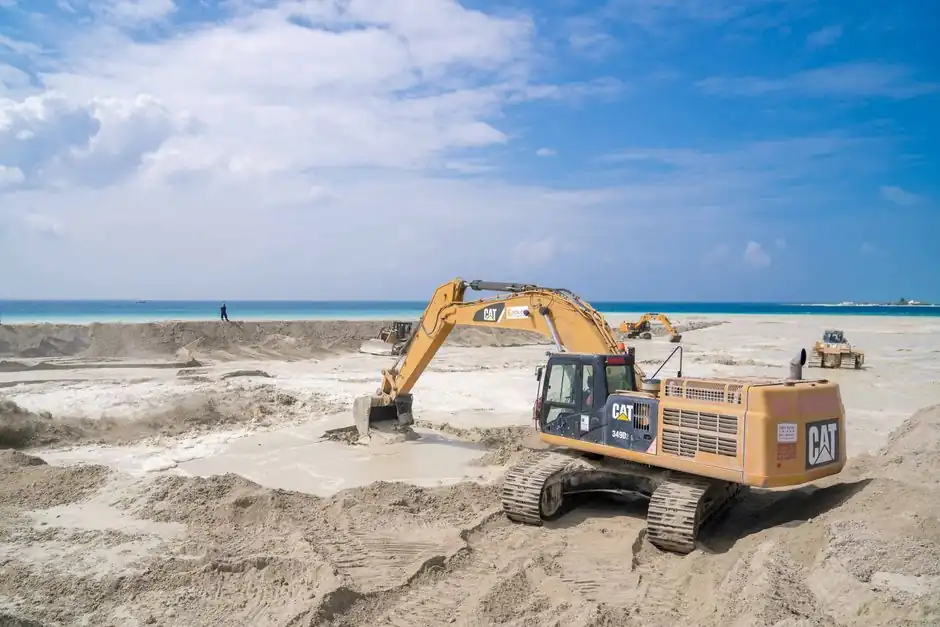
Dynamic compaction uses heavy weights, often steel pounders weighing 10–30 tons, repeatedly dropped from a significant height to densify loose soils and uncontrolled fill [S4].
The method fits large coastal sites needing deep ground improvement, but it requires geotechnical investigation, groundwater management, vibration assessment, trial impacts, and independent quality control before production work [S1][S4].
Applicability and Reclaimed-Ground Profile
Dynamic compaction is an in-situ method for loose sand, silt, granular fill, rubble, and some uncontrolled fills; repeated impacts rearrange particles, collapse voids, and create a denser, more uniform ground layer [S4]. Coastal reclaimed land is a credible application because hydraulic fill and placed fill are often loose, variable, and near a shallow water table, conditions associated with low shear strength, high compressibility, settlement, and liquefaction risk [S1][S5].
The decision boundary is the actual soil profile, not the site label. Dynamic compaction is appropriate where the treatment objective is increased density and bearing capacity through granular-soil rearrangement. It is not a universal remedy for organic soil, clay that does not respond to impact consolidation, buried debris, contaminated fill, or uncontrolled landfill gas [S3][S4]. Former waste dumps require separate gas-barrier, ventilation, and monitoring provisions even if deep dynamic compaction stabilizes the mass [S3].
A coastal trial area should map at least soil type, fill thickness, groundwater level, buried structures, contamination status, and adjacent assets. Coastal development projects face geotechnical challenges associated with loose, sandy soils and fluctuating water tables [S1]. Do not infer performance from a neighboring reclaimed parcel. The engineer must establish whether the deposit behaves as a densifiable granular material and whether deep treatment is required below the shallowest foundation zone.
Energy and Equipment Selection
Dynamic compaction uses heavy weights, often steel pounders weighing 10–30 tons, repeatedly dropped from a significant height [S4]. Deep dynamic compaction should be selected according to site-specific conditions [S2][S3].
Conventional dynamic compaction is the baseline for large granular deposits; deep dynamic compaction extends the available impact range for thicker fills or deeper objectives; excavation plus replacement or deep foundations becomes preferable where unsuitable material, groundwater, vibration limits, or very deep treatment dominate.
A systematic grid is required, with drop points, pass count, and energy selected after site assessment. Primary impacts may be followed by a lower-energy surface ironing pass to improve the upper layer and final grade [S4]. Grid geometry should be engineered rather than copied from a neighboring project; the comparison of square and triangular compaction spacing illustrates why point spacing cannot be treated as a contractor preference.
Groundwater, Liquefaction, and Coastal Constraints
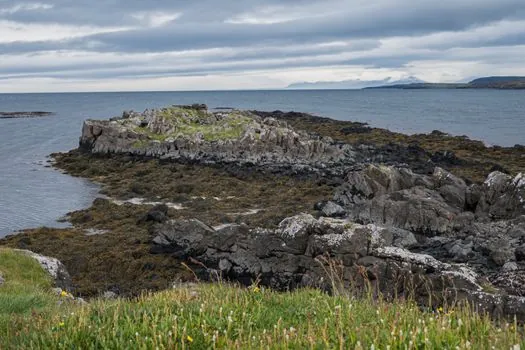
Groundwater is the first screening constraint. Dynamic compaction can be used in dry and saturated conditions, but saturated loose deposits require a site-specific assessment of drainage, pore-pressure response, liquefaction susceptibility, and the ability to prevent surface water or seawater from entering the working area [S4].
Dynamic compaction is a high-energy method for loose and medium-dense granular soils, and published evaluation work examines empirical relationships between impact parameters and densification [S6]. A 2018 case study evaluated dynamic compaction’s effect on liquefaction potential in two ground conditions, confirming that improvement must be demonstrated rather than presumed from completion of the drop passes [S7].
The verification package should include field density or relative-density testing, cone-penetration or other accepted in-situ testing, settlement observations, and groundwater readings before and after treatment. The coastal design must also define vibration limits for nearby buildings, utilities, marine works, and receptors. One documented control measure for excessive off-site vibration is to reduce the loose-deposit thickness by excavation and use a lighter tamper in the upper zone [S8]. That is a site-specific mitigation, not a default substitute for the production design.
Trial Area, Quality Control, and Acceptance
A trial area should precede full-site production because the useful impact energy, number of passes, crater depth, rebound, and improvement profile depend on the actual fill. Engineering guidance describes site assessment, an engineered grid, multiple impact phases, field testing, settlement measurements, and continuous monitoring during treatment [S4]. Coastal practice likewise pairs vibration monitoring with pre- and post-improvement testing [S1].
Establish acceptance criteria before production. At minimum, define the target treatment depth, required relative density or density ratio, acceptable settlement and surface condition, groundwater criteria, allowable vibration, and reporting interval. Dynamic compaction can reach treatment depths up to 30 ft in suitable coastal conditions, but that figure is not a universal site capacity [S1]. If the design requires improvement below that level, test the deeper response or select another method.
One practical verification sequence is: characterize the deposit, install monitoring, execute a monitored trial, map crater and rebound settlement, test the improved profile, compare results with acceptance criteria, adjust energy and spacing, then release production parameters. Deep dynamic compaction has been used on reclaimed land at Anzali Harbor, Iran, confirming the method’s site relevance while leaving the final selection to local soil, groundwater, and equipment conditions [S5].
Comparison with Alternative Ground Improvement
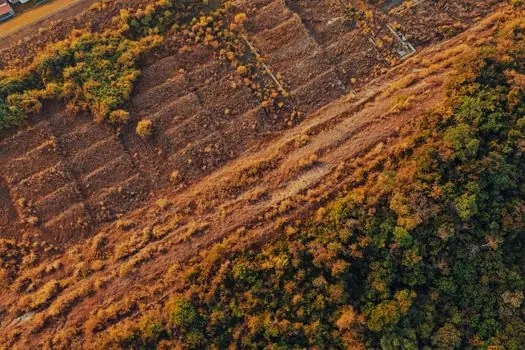
Dynamic compaction is most attractive where the site contains extensive granular fill, material import is costly, and a broad area requires uniform treatment; it can improve bearing capacity and reduce settlement without importing replacement soil [S3][S4]. Those advantages weaken when groundwater cannot be managed, the fill contains organic or compressible material, buried debris interferes with impacts, or vibration at adjacent coastal assets exceeds the approved limit.
Deep dynamic compaction can retain landfill or dump material in place and reduce excavation, transport, and disposal exposure. SCS gives a landfill example of $1.50–$2.00 per ft² for deep dynamic compaction, or $65,000–$87,120 per acre for a 1-acre site with an average 15-ft waste depth, excluding approximately $30,000 mobilization [S3]. These figures are not transferable without quantity take-off and are not a coastal reclamation budget.
Where the same landfill remains in place, buildings generally need a combustible-gas barrier. Documented passive systems include a perforated-pipe ventilation layer and an impervious spray-applied or HDPE barrier, while active systems add blowers; cited capital ranges are $7–$9 per ft² for spray-applied liner, $3–$4 per ft² for HDPE, and $3–$4 per ft² for blower additions [S3]. This can make dynamic compaction unsuitable despite its ground-improvement cost.
For the main coastal options, compare four criteria. Dynamic compaction wins on large-area treatment without clean-fill import; excavation wins when unsuitable strata must be removed; piles win where loads must transfer to competent deeper ground; vibro-compaction or stone columns may be considered by the geotechnical designer when soil type and depth objectives differ. Do not use deep dynamic compaction where a foundation system is required mainly to bypass a weak layer, because densification is not equivalent to load transfer.
Environmental and Contract Controls
Coastal permits should define the permitted impact radius, vibration limits, working hours, runoff control, marine-debris prevention, dust suppression, and monitoring frequency. The design team must coordinate crane access, temporary mat or working-platform requirements, groundwater dewatering discharge, and sequencing around utilities or marine structures. Reduced off-site vibration may require shallower excavation, a lighter tamper, modified pass energy, or another ground-improvement method [S8].
The tender documents should separate equipment capability from performance responsibility. Specify the required treatment depth, soil-property targets, trial requirements, grid and pass plan, monitoring instruments, test locations, acceptance criteria, and response if trial results fail. A broad statement such as “compact to 30 ft” is incomplete without soil-profile assumptions, groundwater conditions, impact energy, and verification method [S1].
Dynamic compaction is a strong candidate for a large coastal reclaimed parcel when the deposit is predominantly loose granular material and impacts can be verified. Proceed only when the trial demonstrates the required density, settlement behavior, groundwater response, and vibration compliance; otherwise shift to excavation, replacement, deep foundations, or a soil-specific alternative. The next engineering node is a geotechnical data-gap review followed by a monitored trial area.