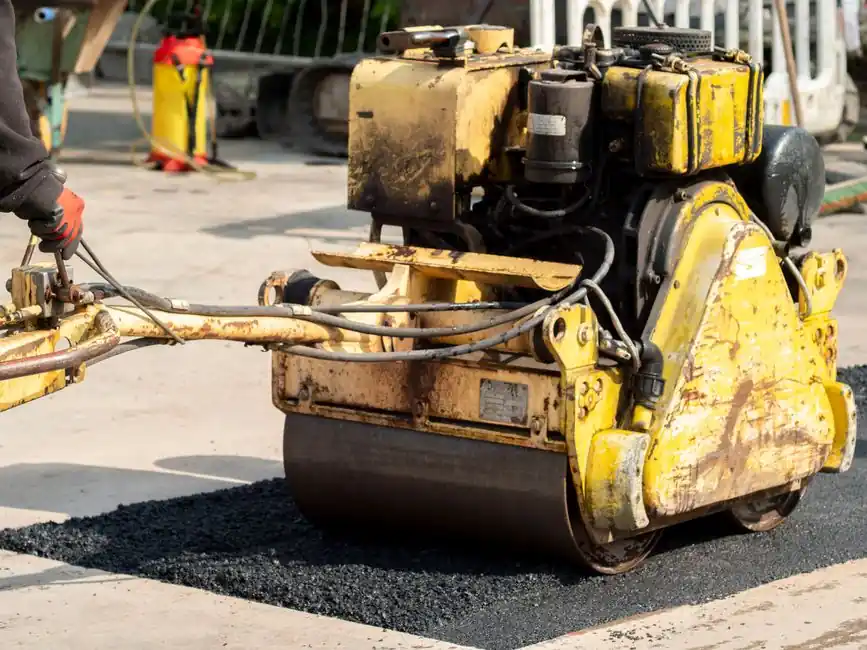
Dynamic compaction in mining covers two distinct families: drop-weight (a crane-suspended pounder free-falls onto the surface) and Rolling Dynamic Compaction, or RDC, a non-circular 3-, 4-, or 5-sided module towed behind a tractor that densifies ground by corner-fall impact [S1].
The engineering driver is layer thickness and traffic duty: standard circular rollers top out near 400 mm lift thickness, while RDC routinely compacts thicker layers, allowing larger particle sizes and more direct re-use of mine spoil on haul roads, tailings dams and pit floors [S1].
What the Two Methods Actually Do On-Site
Drop-weight dynamic compaction increases soil density and bearing capacity by repeatedly dropping heavy weights from significant heights onto the ground surface, with impact energy compacting loose soils and reducing settlement potential in granular fills, reclaimed land and tailings footprints [S2].
RDC operates differently: a non-circular module rotates about its corners as it is towed, causing it to fall to the ground and compact dynamically, and is used as a proof roller, for haul-road construction, and on pit floors and tip heads where it helps break down and rubbilise large surface rocks that are hazardous to haul-truck tyres [S1]. The ability of RDC to detect weak, low-density zones or soft, high-moisture pockets means those areas can be reworked or replaced before differential settlement develops under haul-truck traffic [S1].
Speed, Layer Thickness and Productivity Comparison
The most cited numbers come from University of Adelaide field work: RDC runs at 10-12 km/h, roughly 3-4x the productive speed of a single-point drop-weight cycle, and compacts thicker layers than the 400 mm ceiling of conventional circular rollers [S1].
Thicker lifts on an RDC job let crews push larger particle sizes into the fill, which reduces screening waste, increases reuse of run-of-mine spoil, and shortens haul-road build programmes on tailings dams and processing-plant stockyards [S1]. For drop-weight, the same productivity gain is reached by raising weight and drop height, but cycle time per impact is still slower than a continuous RDC pass over the same area.
Selection Criteria: Soil Type, Particle Size and Haul-Road Duty
For granular soils, fill materials and reclaimed land, dynamic compaction (both families) is commonly used to prepare foundations for processing plants, stockyards, tailings facilities, roads and infrastructure, and is favoured as a cost-effective alternative to extensive excavation-and-replacement of weak soils [S2].
RDC additionally improves uniformity and density of subgrade soils, which is why mine operators use it as a proof roller ahead of surfacing: better uniformity lowers rolling resistance, reduces haul-truck tyre temperatures, extends tyre life, and lowers the risk of rock spillage damaging other vehicles on the road [S1]. On pit floors and tip heads the same impact action rubbilises oversize rock that would otherwise shred tyres and force production stoppages waiting on spares [S1].
Who RDC Fits, and Where Drop-Weight Still Wins
Pick RDC when the job is bulk earthworks, haul-road build or maintenance, tailings dam lifts, and pit-floor proofing, especially where mine-spoil particle size is too large to screen economically for a conventional 400 mm lift [S1].
Stay with drop-weight dynamic compaction when the target is deep treatment of loose granular fills or reclaimed land beneath heavy point loads, processing-plant foundations and stockyards, where the depth of improvement required exceeds what a surface-towed module can reach in a single pass [S2]. Drop-weight is also the practical choice on confined pads or near existing structures where the lateral vibration footprint of a large impact roller is undesirable.
Operating and Trial Parameters that Drive Spec
RDC trial work on mine spoil at the University of Adelaide focused on demonstrating the technique's effectiveness for bulk earthworks at two different mine sites, and the authors lay out factors to plan a compaction trial around: lift thickness, number of passes, towing speed in the 10-12 km/h band, and underlying subgrade stiffness [S1].
Independent research has since used artificial neural networks and linear genetic programming to predict RDC effectiveness from cone-penetrometer and dynamic-cone-penetrometer data, which gives specifiers a defensible way to set trial pass counts and lift thickness before committing a full fleet [S3]. A dynamic compactor spec sheet should therefore carry, at minimum, module side count (3/4/5), module mass, towing speed window, demonstrated lift thickness on representative mine spoil, and proof-rolling detection sensitivity on clayey, high-moisture subgrades.
Equipment and Site-Logistics Constraints
RDC needs a tow vehicle capable of sustained 10-12 km/h on a partially compacted surface, plus a clear corridor wide enough for the module to fall and rotate without striking windrows or berms; on tight pit-floor geometry, the same impact module that rubbilises oversize rock can become a clearance hazard [S1].
Drop-weight dynamic compaction needs a crawler or truck crane rated for repeated lift-drop cycles, a clear overhead zone, and a marked exclusion radius, with energy per blow set by tamper weight and drop height, and a designed grid pattern (often on a triangular or square spacing) to achieve the target depth of improvement [S2]. For mine support fleet planning, the same mining dump truck selection logic that sizes payload against haul-road grade and rolling resistance also drives the axle-load assumption used to set RDC proof-roller pass counts.
Sourcing, Standards and Trackable Signals
No single ISO or ASTM standard is cited in the available research for RDC or mining drop-weight dynamic compaction; specifiers should therefore anchor the contract on a documented field trial using project-specific mine spoil, with pass count, lift thickness and proof-rolling criteria written in, and reference peer-reviewed effectiveness prediction where available [S1][S3].
Two trackable signals to watch: published updates to rolling dynamic compaction practice for haul-road construction and maintenance, and further machine-learning work predicting RDC effectiveness from in-situ tests, both of which feed directly into lift-thickness and pass-count selection on the next greenfield mine [S3]. Related reading on road roller selection for pipeline construction covers adjacent lift-thickness and drum-type decisions that overlap with mining haul-road spec, while pile driver selection for pipeline construction is the closest analogue for drop-weight energy-class sizing on mineral-processing foundations.
For the relevant spec sheets and selection criteria, see dynamic balancing machine.