Industrial tank cleaning machines, from rotary jet heads to static spray balls, run on a different duty cycle than winter plows, but both live on the same municipal or contractor yard and share the same water, fuel, and uptime budget [S1][S2].
Selecting equipment for a snow removal fleet starts with the same four factors that govern tank cleaning: time, temperature, chemicals, and impact, where impact (psi of cleaning fluid or kN of plow push) drives both cycle time and asset life [S2].
What a Tank Cleaning Machine Actually Does on a Snow Yard
A tank cleaning machine is a fluid-driven device mounted inside a vessel: rotary spray heads, jet heads, static spray balls, extension lances, and matched pumping systems form the standard product family [S1]. High-impact rotary heads, exemplified by 360 degree units operating at 500 psi (34 bar), cut IBC tote cleaning from 45 minutes to 10 minutes and delivered $30,000 in monthly savings in one specialty chemical case [S2].
For a snow fleet, the same selection logic applies to brine tanks, pre-wet tanks, and vehicle fuel/day tanks. Hot water at controlled temperature removes road-salt residue; chemical compatibility is required because chloride-laden brine is corrosive and demands resistant alloys or coatings [S2]. A 1-hour wash cycle reduced to 12 minutes on a pharmaceutical line shows the magnitude of uptime a correctly specified rotary head can return to a maintenance bay [S2].
Main Snow Removal Machine Types and Where Each Fits
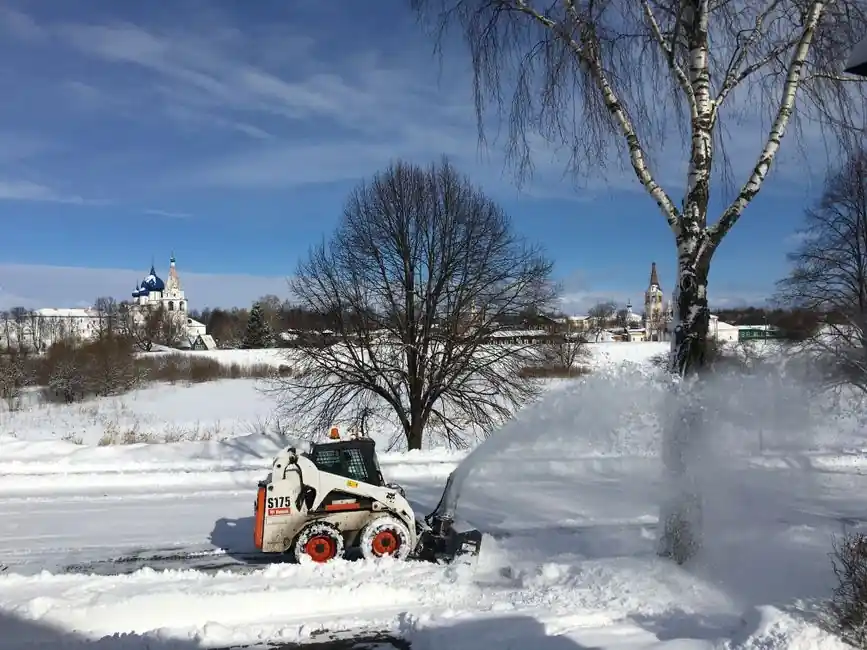
Four machine categories dominate contractor snow work: tractors (25 to 300 HP), telehandlers, trucks with plow/salter packages, and skid steers, with attachments layered on top (blades, buckets, snow pushers, V-blades, angle brooms, snow blowers) [S3][S5][S6].
Tractors lead on fuel efficiency and site-to-site travel speed; telehandlers dominate stacking wet, heavy snow with their telescopic lift; trucks with plows remain the traditional backbone for road and lot work; skid steers win tight walkways and sidewalks because of their compact footprint and the option of wheeled or tracked undercarriage [S3][S5]. Specific OEM packages include the SANY SW305K wheel loader, Kubota SSP25 snow pusher, and Energreen ILF Kommunal units [S3]. Commercial contractors also spec multi-function rigs such as the Toro Snowrator with a 4 foot straight blade and a 20 gallon brine tank, illustrating the trend toward combined plow-and-liquid-treatment machines [S4].
Decision Criteria: Tank Cleaning vs. Snow Removal Equipment
Tank cleaning machines and snow removal machines solve opposite problems, but the procurement criteria overlap. A spec-first comparison of the two equipment families on four decision criteria: [S2]
1. Operating pressure or push force: Tank cleaning rotary jet heads typically run 40 to 500 psi (3 to 34 bar) depending on residue; snow plows and pushers transfer tractor or skid-steer hydraulic push at far higher mechanical loads, with V blades specified for hard-packed or heavy snow [S2][S7].
2. Cycle time: 360 degree high-impact tank heads have demonstrated 45 to 60 minute cycles compressed to 10 to 12 minutes on IBC and pharma vessels, while a single-pass plow route is governed more by lane-kilometres per hour than by minutes per vessel [S2].
3. Chemical and corrosion resistance: Tank cleaning wetted parts demand alloys or polymers resistant to acidic or chloride residues; snow equipment demands corrosion protection against de-icing salts and brine, often achieved with sealed cab filters and salt-resistant hydraulic seals [S2][S3].
4. Attachment density: A modern tractor, telehandler, or skid steer accepts 5 to 10 winter attachments (blade, pusher, blower, bucket, broom, salter, V blade), and a tank cleaning circuit accepts spray balls, rotary heads, jet heads, and lances on a single pump skid [S1][S3][S7].
Use Cases: Brine Tanks, Fuel Tanks, and Day-Tank Cleaning
Pre-wet brine tanks and on-vehicle brine tanks (commonly 20 gallon on a single-axle rig) need a rotary head sized to the vessel diameter, typically a 360 degree unit at 40 to 100 psi for dilute salt solutions, or a higher-impact jet head for sugar-beet juice additives that caramelise on the wall [S2][S4].
Fuel and DEF day-tanks on diesel snow fleets are best cleaned with static spray balls because low-shear coverage protects filters and sensors, while the larger 1000 to 3000 gallon bulk brine and calcium chloride tanks on a contractor yard justify a rotary jet head or extension lance to cut the 1 hour wash down to 12 minutes [S2]. For broader fleet guidance including wheel-loader sizing for the plow side, see the wheel loader selection for snow removal spec map and the tank cleaning machine specs for bitumen and bowser tanks reference for adjacent road-construction tank duty.
Limitations, Failure Modes, and Common Mistakes

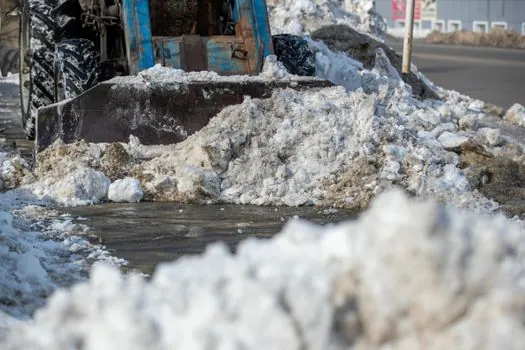
Tank cleaning machines fail in three predictable ways: nozzle erosion under high-impact service, gasket failure at temperature swings above the elastomer rating, and chemical attack on wetted parts when residue chemistry is mis-specified [S2]. Snow equipment fails for parallel reasons: undersized plows on 300 HP tractors that exceed the tractor's hydraulic push rating, salt corrosion on unprotected hydraulic cylinders, and tracks or tyres wrong for the surface (rubber tracks on bare pavement wear fast; tyres on deep snow lose traction) [S3][S5].
A common contractor mistake is specifying one machine for both tank cleaning and snow duty. Rotary jet heads, IBC tank washers, and spray balls are not substitutes for plows; the four snow machine classes (tractor, telehandler, truck, skid steer) are the only credible snow removal platforms, and the tank cleaning circuit is a separate, parallel capital line [S1][S3].
Standards, Sourcing, and Cross-References
Tank cleaning equipment selection follows the four-factor framework (time, temperature, chemicals, impact) published by Spraying Systems Co., with documented case data at 500 psi and 360 degree coverage on stainless rotary heads [S2]. GlobalSpec's product taxonomy groups rotary spray heads, jet heads, static spray balls, extension lances, and pumping systems as the canonical categories [S1]. Snow removal fleet selection draws on contractor-side sources that document tractor HP ranges (25 to 300 HP), telehandler lift capacity for stacking, and skid steer undercarriage options for tight sites [S3][S5].
For adjacent fleet decisions on landfill and quarry work, the skid steer loader selection for landfill operations article and the telehandler-forklift selection for road construction reference apply the same attachment-density and corrosion-resistance logic. Watch the 2026 winter season for OEM updates on heated-cab adoption in rental skid steers and for further integration of brine tanks and plows on single-axle contractor chassis such as the Snowrator 4 foot blade, 20 gallon tank configuration [S3][S4].
Spec-level background on the components involved: self cleaning filter.