Rotary drilling rigs are the default for soft-to-medium formations, large-diameter blast holes, and quarry benches where hole size, not penetration rate per metre, drives the production target [S3][S5].
For hard, abrasive, or fractured rock, a DTH or top hammer rig typically out-drills a rotary unit because impact energy at the bit face does the breakage, not the rotary cutter's torque [S2][S3].
What a Rotary Rig Actually Does on a Quarry Bench
A rotary rig applies rotational cutting force plus crowd pressure to a tricone or blade bit, making it the workhorse for large-diameter holes in soft-to-medium rock, overburden, and limestone [S3][S5]. ScienceDirect frames rotary drilling as the standard method for large boreholes in quarries and open-pit mines where hole diameter, not hole straightness in metres, is the controlling parameter [S6].
In quarry duty, the two numbers that matter are the power-head's maximum applying pressure (kN) and its maximum output torque (kN·m); the harder the formation and the larger the borehole, the higher both must be to avoid stalled penetration and stuck drill strings [S4]. Manufacturers publish "extreme" depth values (for example 100 m at a Ø500 mm borehole), but quarry planners should target the upper-middle of the rig's optimal range, not its limits, or service life collapses [S4].
Rotary vs DTH vs Top Hammer on a Quarry Site
For hard, abrasive rock, DTH rigs deliver higher penetration rate and straighter holes because the hammer sits directly behind the bit at hole bottom, so energy loss over the drill string is near zero [S2][S3]. Top hammer rigs transfer impact at the top of the string, which is fine for shallow, uniform rock benches, but energy loss rises with depth and accuracy drops in fractured ground [S3].
Rotary rigs are not a universal answer: in hard rock their penetration rate falls, hole deviation grows, and bit life shortens, so contractors who buy a rotary unit for a granite quarry usually buy a second method within a season [S3][S5]. The decision table below is the working comparison most quarry planners use.
Criteria-based comparison for quarry blast-hole rigs [S3][S4][S5]:
- Rock class fit: Rotary: soft-to-medium; DTH: hard and mixed; Top hammer: shallow uniform rock.<br>- Typical hole diameter: Rotary: 150-400 mm and up; DTH: 90-200 mm common; Top hammer: 64-127 mm typical.<br>- Energy delivery: Rotary: crowd + torque; DTH: hammer at bit face; Top hammer: hammer at top of string, energy loss with depth.<br>- Compressor coupling: Rotary: low; DTH: high, requires matched rotary-screw compressor; Top hammer: moderate.<br>- Depth sweet spot: Rotary: up to ~100 m; DTH: deep holes stable; Top hammer: shallow to medium benches.
Spec Parameters That Drive Buy or Reject
Power-head applying pressure and main winch lifting force (kN) decide whether the rig can both cut into the formation and recover the drill string; insufficient applying pressure kills penetration in hard rock, insufficient lifting force risks drill-string burial [S4]. The harder the formation, the deeper the hole, and the heavier the string, the higher the required kN on both ends.
Power-head maximum output torque (kN·m) is the "twisting force" that turns the bit, and high torque is non-negotiable in clay layers to clear bit jamming events [S4]. Travel and positioning method matters in quarry benches: crawler-mounted units track over broken rock and haul-road ramps that would bog a truck-mounted rotary rig, so for greenfield quarries crawler undercarriage is the safer default.
Diesel versus electric power selection is largely a site-utility question: diesel wins on remote benches without grid power, electric or hybrid wins on urban quarries with strict emissions limits; both are now offered across the major OEM surface-mining lines [S1][S7].
Geology-First Selection Workflow
The first selection step is always the rock class, not the brand: hard and abrasive rock points to DTH, mixed or fractured ground to DTH for hole-stability reasons, shallow uniform rock to top hammer, and soft ground or overburden to rotary [S3][S4]. Ignoring geological variability is the most common cause of low productivity and accelerated tool wear in quarry drilling [S3].
Hole diameter and depth are the second filter: a Ø500 mm blast hole at 50 m calls for a heavy rotary rig with high torque, while a 102 mm hole at 25 m points to a top hammer unit with lower air consumption [S4][S5]. The third filter is production rate: high-volume blasting programmes favour DTH for cycle-time reasons, while low-volume dimension-stone quarries often stay with rotary to control vibration and overbreak.
Sandvik's published surface-mining portfolio explicitly covers the open-pit and quarry duty cycle, confirming that major OEMs now sell matched rotary, DTH, and top hammer platforms into the same quarry customer base [S7]. A related reference for quarry fleet planning, including motor graders and ancillary earthworks, is covered in Motor Grader Selection for Quarrying.
Who Should and Should Not Buy a Rotary Rig for Quarrying
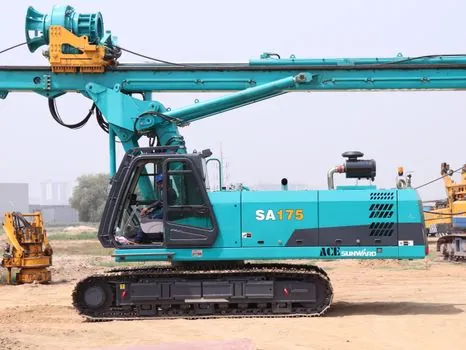
A rotary rig is the right pick for quarry operators drilling Ø200-400 mm blast holes in limestone, shale, or weathered overburden, for dimension-stone quarries that need low-vibration holes, and for mixed fleets that already need a rotary unit for piling or water-well work [S3][S5].
A rotary rig is the wrong pick for hard granite or abrasive gneiss quarries, for deep blast-hole programmes above ~100 m where DTH straightness wins, and for operations without a high-capacity rotary-screw compressor to back a DTH system; in those cases, persist with rotary and you will pay for it in bit consumption and downtime [S2][S3].
For drill-and-blast contractors servicing mixed rock, the common hedge is to run rotary for overburden and large-diameter pre-split, and to add a DTH rig for the hard-rock production holes; the two methods are complementary, not competing, in a multi-rig quarry [S3][S4]. Buyers evaluating adjacent heavy plant for the same quarry should also review Truck-Mounted Crane Selection for Mining.
Standards, Safety, and Maintenance Load
Operator-protection cabs, emergency stop systems, and dust collection are no longer optional on quarry drill rigs: dust suppression directly affects silica-exposure compliance on limestone and granite benches [S1][S5]. Regular inspection of hydraulic systems, drill bits, and power sources is the documented lever for keeping a rotary rig in safe, productive service [S1].
Automation is now mainstream in surface-mining drill lines: AI-driven monitoring that predicts component failure before it happens, plus electric and hybrid power packs to cut on-site emissions and noise, are listed as the dominant new-build trends across OEM guidance [S1][S7].
Reference material also flags the rotary drilling rig category page for buyers who need a full definition of method versus machine, and the industrial valve page for the hydraulic and pneumatic control components used in the rig's circulation and crowd systems.
Trackable Signals for the Next Planning Cycle
Two signals to watch before the next capex review: OEM releases of electric and hybrid rotary platforms sized for quarry benches (Sandvik and peers continue to expand their surface-mining lines, with automation and electrification as the published themes) [S1][S7], and any tightening of on-site diesel-emission or silica-dust rules in your operating jurisdiction, which would re-rank electric rotary and high-efficiency dust collection higher in the spec sheet [S1].
The underlying component specifications are covered under rotary encoder.