Reversible plate compactors in the 80-450 kg class deliver 13-50 kN of centrifugal force at 5,500 rpm vibration frequency, suiting them to curbs, gutters, drainage ditches, and trench backfill inside urban footprints [S4][S5].
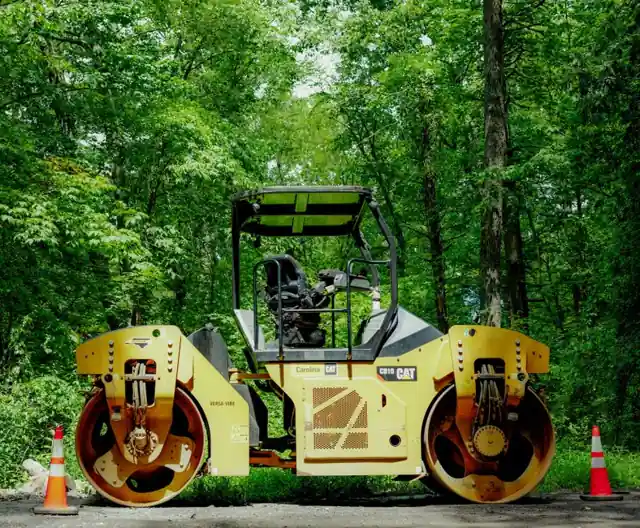
Heavy padfoot and smooth-drum rollers from 10,700 kg to 21,420 kg operating weight, with drum widths of 2,140-2,220 mm and EU Stage IIIA / EPA Tier 3 emissions, cover roadway sub-base and embankment lifts on city arterial projects [S1].
Hydraulic rapid impact compactors with a 7,000 kg hammer dropping 1,500 mm at 250 bar working pressure produce 84 kJ per blow for bridge-head bump elimination and port-yard ground improvement, with 40 cm compaction depth per pass [S2].
Plate Compactor Class: 80-450 kg Hand-Guided Units
The Dynamic HZR-80 entry-level plate runs 80 kg dry weight with a 590x400 mm ductile-iron baseplate, 13 kN centrifugal force, and a Honda GX160 4.0 kW / 5.5 hp gasoline engine at 3,600 rpm max, with a 3.6 L fuel tank [S5]. Forward travel is 20-23 m/min, and the unit reaches 5,500 rpm / 93 Hz vibration frequency, which is the typical minimum for granular-soil compaction on trench reinstatement [S5].
The mid-tier HUR-300 steps to 180 kg with 30 kN centrifugal force, a 600x500 mm shoe, and a Honda GX270 7.0 kW / 9.0 hp air-cooled gasoline engine, hitting 5,500 rpm / 92 Hz and 20-23 m/min travel; the diesel DUR-500B tops the small-plate line at 450 kg, 50 kN centrifugal force, a 600x890 mm shoe, and a CF186F diesel rated 6.2 kW / 8.5 hp with 22 m/min travel [S4]. For city work near walls, formwork, and columns the smaller HZR-80 and HUR-300 footprint keeps the operator productive, while the DUR-500B handles thicker clay and cohesive lifts where higher amplitude is required [S4].
Heavy Roller Class: 10,700-21,420 kg Ride-On Units
The HAMM 3410 single-drum roller is a 10,700 kg (23,593 lb) class machine on a 2,140 mm (84.3 in) drum, powered at 98.0 kW / 133.3 PS / 2,300 rpm per ISO 14396, currently badged EU Stage II / EPA Tier 2 and a candidate for replacement as Tier 3 stock rotates in [S1]. The HAMM 3414 HT VIO shares that drum width at 14,010 kg and runs 100.0 kW / 136.0 PS, factory-rated to EU Stage IIIA / EPA Tier 3 [S1].
At the upper end, the HAMM 322 P padfoot compactor weighs 22,260 kg (49,083 lb) with a 2,220 mm drum and 164.0 kW / 223.0 PS per ISO 14396 at 2,200 rpm, while the Wirtgen 3518 HT smooth-drum unit reaches 21,420 kg operating weight on a 2,220 mm / 87.4 in drum at 155.0 kW / 210.8 PS, also EU Stage IIIA / EPA Tier 3 [S1]. Both are 87.4 in / 2,220 mm drum class, which is the standard for arterial and highway lifts in metro-area paving contracts [S1].
Hydraulic Rapid Impact Compactor Class
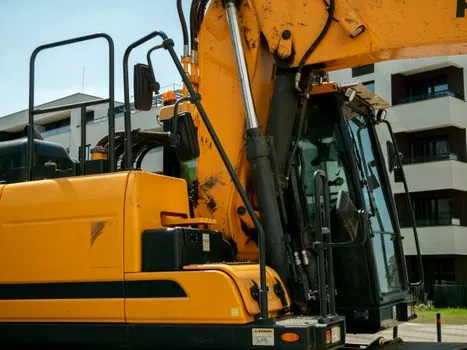
The Sinoway SWRD85 hydraulic rapid impact compactor weighs 16.5 t operating, drops a 7,000 kg manganese-steel hammer from 1,500 mm at 250 bar working pressure, and delivers 84 kJ per blow with 40 kN centrifugal force and 40 cm compaction depth per pass [S2]. Travel speed is 40 cm/s in single-foot / sheep-foot mode on a biaxial dual-roller axle, and certification stack is CS, CE, RoHS, ISO 9001:2000, ISO 9001:2008, and ISO 14001 [S2].
Its documented duty cycles are bridge-head vehicle-bump elimination, port and highway sub-base, and railway embankment remediation, with the integrated monitoring system recording total energy, penetration depth, and settlement for QC traceability [S2]. For urban infrastructure the SWRD85 class fills the gap left by conventional rollers when lifts exceed 40 cm or when the existing fill is uncontrolled demolition debris.
Decision Matrix: Plate vs Roller vs Rapid Impact
On lift weight, the small-plate class (80-450 kg, 13-50 kN) handles 10-30 cm lifts, the heavy roller class (10,700-22,260 kg) handles 30-80 cm granular or cohesive lifts, and the rapid impact class (16.5 t with 7,000 kg hammer, 84 kJ) handles 40-100+ cm lifts on poor fill or bridge approaches [S2][S4][S5]. On vibration frequency, hand-guided plates run 5,500 rpm / 92-93 Hz, while rollers use eccentric weights tuned for amplitude, not published Hz, which matters when matching compaction to soil type [S1][S4].
On emissions, the current Tier-3 / Stage IIIA fleet is the 2026 urban-procurement default in EU and US EPA jurisdictions, and the Tier-2 / Stage II HAMM 3410 is a legacy buy rather than a new specification [S1]. On baseplate vs drum, the plate compactors suit trench and patch work because the 400-890 mm shoe fits 600 mm utility cuts, whereas the 2,140-2,220 mm rollers need full lane width to be productive [S1][S4][S5].
Urban-Infrastructure Application Map
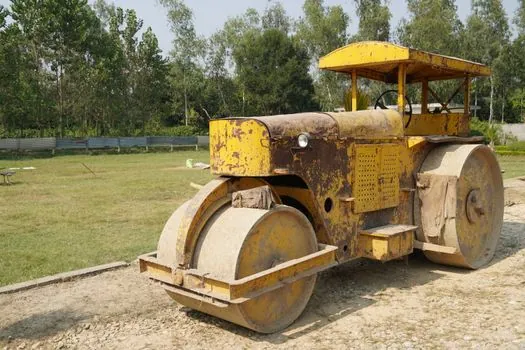
Curbs, gutters, and drainage-ditch reinstatement match the HZR-80 and HUR-300 size band (80-180 kg, 13-30 kN, 590x400 to 600x500 mm plate) because the ductile-iron baseplate can run hot or cold asphalt in confined cuts without rebar damage [S4][S5]. Building-construction backfill, footings, and column pits match the DUR-500B (450 kg, 50 kN) on thicker cohesive lifts [S4].
Arterial-road sub-base, embankment, and landfill-capping lifts match the HAMM 322 P, HAMM 3518 HT, and Wirtgen 3518 HT roller class at 17,825-22,260 kg on 2,220 mm drums, with the HAMM 3414 HT VIO at 14,010 kg serving mid-size municipal work where the 30,892 lb envelope fits restricted urban yards [S1]. Bridge-head bump elimination, port yard, and railway-embankment rehabilitation match the SWRD85 rapid impact at 84 kJ and 40 cm per-pass depth, where conventional rollers stall on poor fill [S2].
Failure Modes and Sourcing Constraints
The small-plate class shares three recurring failure points: clutch wear on the GX160/GX390 gasoline engine, ductile-iron baseplate cracking under repeated impact on rocky fill, and vibration-handle isolator fatigue on the HUR-300 and HZR-120 [S3][S4][S5]. Operators report that 3.6-6.5 L fuel-tank capacity limits a single shift to roughly 3-4 hours under load, so spec sheets should pair the compactor with a planned refuel cycle [S3][S4].
For the SWRD85 rapid impact, the documented risks are hammer-manganese-steel embrittlement above rated impact energy, hydraulic-hose surge beyond 250 bar working pressure, and free-fall overspeed if the foot diameter is non-standard, so customisation is gated by the supplier's quality documents and ISO 9001:2008 traceability [S2]. For rollers, the practical spec trap is ordering a Tier-2 unit like the HAMM 3410 into a Tier-3-mandated urban contract, where retrofitting or rejection is the only resolution [S1].
For a working spec sheet on the small-plate class, watch three numbers in 2026: centrifugal force (kN), plate size (mm), and engine tier; for rollers, watch operating weight (kg), drum width (mm), and ISO 14396 power (kW/PS/rpm); and for rapid impact, watch hammer weight (kg), working pressure (bar), and CE/ISO 9001 documentation status [S1][S2][S4][S5]. Equipment buyers comparing roller, loader, and spare-parts categories across the same job site often cross-reference adjacent spec maps such as wheel loader failure-mode diagnostics when planning fleet uptime.
The underlying component specifications are covered under dynamic compactor, dynamic balancing machine, and pressure transmitter.