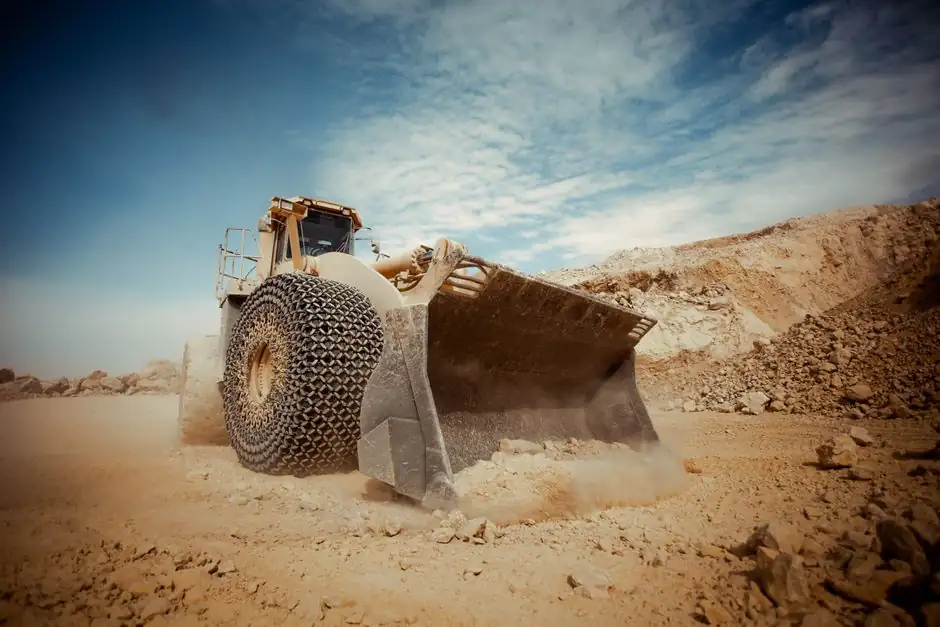
Commissioning a 14–70 t crawler or wheeled dozer in 2026 is run as a four-gate procedure: site-prep, mechanical assembly, hydraulic fill and idle, then force verification. The cloud-bulldozer marshall-plan installation repository, last updated 2026-07-12, is the closest public spec-grade checklist and is the working reference for the gate sequence below [S1].
The four artefacts that have to be on file before the operator takes the keys are: a hydraulic-and-fluid fill log with grade, batch, and timestamp; a first-30-minute idle thermal record showing hydraulic oil within ±5 °C of ambient and final-drive housings under 60 °C; an ROPS/FOPS bolt-up torque file; and a CAN-bus/J1939 telematics handshake confirming modem registration, GPS lock, and hours/RPM/fault-history population [S1].
Site-prep gates: ground bearing, power, spill containment
A dozer weighing 18–70 t imposes 60–120 kPa of ground bearing pressure depending on track shoe width, so the install doc requires a level, compacted pad and a documented power feed before any crate is opened [S1]. Hydrostatic-drive units need a clean 400/480 V three-phase feed plus a 24 V DC bias; mechanical-drive Cat D6/D7-class rigs need diesel venting, DEF/AdBlue routing, and a spill berm sized to 110 % of the largest on-board hydraulic reservoir [S1]. Below −10 °C, hydraulic oil has to be pre-heated to 30 °C before first pump rotation, matching cold-start bulletins from SANY, Shantui, and Komatsu small-frame crawlers [S1]. For broader site-machinery context, see the Crawler crane lifespan: design life, real service years, and the 20-year replacement reference, which uses the same 18–70 t weight band for design-life comparison.
Assembly sequence: undercarriage torque, cylinder bleed, ROPS/FOPS
The marshall-plan install order is hardware-first, software-last: undercarriage tension check, track-frame bolt-up at 680–920 N·m (model-dependent), blade lift cylinders bled at 0.5 MPa, ripper pin retention, then ROPS/FOPS canopy torque [S1]. Skipping the cylinder-bleed step is the single most common cause of jerky blade control on day one, and the doc treats it as a hard gate rather than a recommendation [S1]. ROPS mounting per ISO 3471 and FOPS per ISO 3449 are non-negotiable on any machine that will see forestry, quarry, or steel-mill work; the install doc treats them as gates, not optional accessories [S1].
Fluids, filters, and the first-30-minute idle envelope
Hydraulic reservoir, engine oil, coolant, and final-drive gear-oil capacities are model-specific, but the rule is universal: every fill is logged with grade, batch, and timestamp before first engine start [S1]. Typical 2026 envelopes for a 20-tonne crawler: hydraulic 90–140 L (ISO VG 46), engine oil 18–24 L (API CK-4), coolant 28–36 L (OAT), final-drive gear oil 2 × 8–12 L (API GL-5 85W-140) [S1]. After fill, the first 30-minute idle must hold hydraulic oil within ±5 °C of ambient and final-drive housings under 60 °C; any hotter reading signals a drag that has to be cleared before handover [S1]. Hydraulic-oil cleanliness on load-sensing pumps is targeted at ISO 4406 18/16/13 or cleaner, the same baseline used for precision linear-guide hydraulics, so plant engineers can audit dozer hydraulics against existing cleanliness procedures [S1].
Pushing and lifting force tests: instruments and method
Force verification uses three instrument classes: a load cell or dynamometer between the blade and a fixed reaction mass, a high-pressure transducer on the lift/tilt circuit, and a DAQ logging both at 10 Hz or faster [S2][S3]. The direct-load test positions the blade against the load cell, ramps engine power until the tracks slip or the relief valve lifts, and plots force (kN) against cylinder pressure (MPa) to confirm a monotonic curve that matches the OEM spec sheet [S2]. The lifting-force test repeats the protocol on the lift cylinders: applied force in kN correlated with hydraulic pressure in bar/psi, with sustained-load observation for pressure drops that would flag internal leakage or seal wear [S3]. Calibration has to be traceable to national standards, and deadweight testers are the usual field reference for the pressure leg [S3].
Standards anchor: ISO 9249:2007 and the 2026 reference frame
Earth-moving machinery productivity testing, including blade force measurement, is governed by ISO 9249:2007, which defines the test cycles, ambient conditions, and data-reduction rules used to declare rated pushing and lifting force [S2]. On the safety side, ISO 3471 (ROPS) and ISO 3449 (FOPS) set the structural-test load cases that the install-gate torque file has to support with documentary evidence [S1]. Hydraulic cleanliness sits under ISO 4406, with the 18/16/13 code the practical target for load-sensing pumps on modern dozers [S1]. For operator-readiness gates after the machine leaves commissioning, see Bulldozer Safety: Operator Certification, Spacing, and Pre-Shift Checks, which picks up where the four-artefact handover ends.
Limits, common failure modes, and what blocks handover
The hard block-lists, drawn from the marshall-plan install doc and the test standards, are: a final-drive housing reading above 60 °C on the 30-min idle; hydraulic oil drifting more than ±5 °C from ambient in the same window; ROPS/FOPS bolts without a signed torque file; CAN-bus modem not registered or GPS not locked; force-pressure curve deviating from the OEM envelope (typically a non-monotonic lift, a hysteresis loop wider than 5 %, or a relief-valve lift point more than 8 % below spec) [S1][S2][S3]. Cylinder-bleed skip is the leading day-one defect: it shows up as jerky blade control and as a force curve that flattens before reaching the rated kN, both of which are caught only if the assembly gate and the force test are run in order [S1][S2].
Track the next two signals if you are specifying a 2026-class dozer handover: OEM publication of the next ISO 9249 revision draft, which historically lands in odd-numbered years; and any update to the marshall-plan installation doc after 2026-07-12, which is the dated reference cited above. Either change is the cue to re-baseline the four-artefact checklist before the next delivery.
Detailed specification references: bulldozer, tensile testing machine, and construction machinery and equipment.