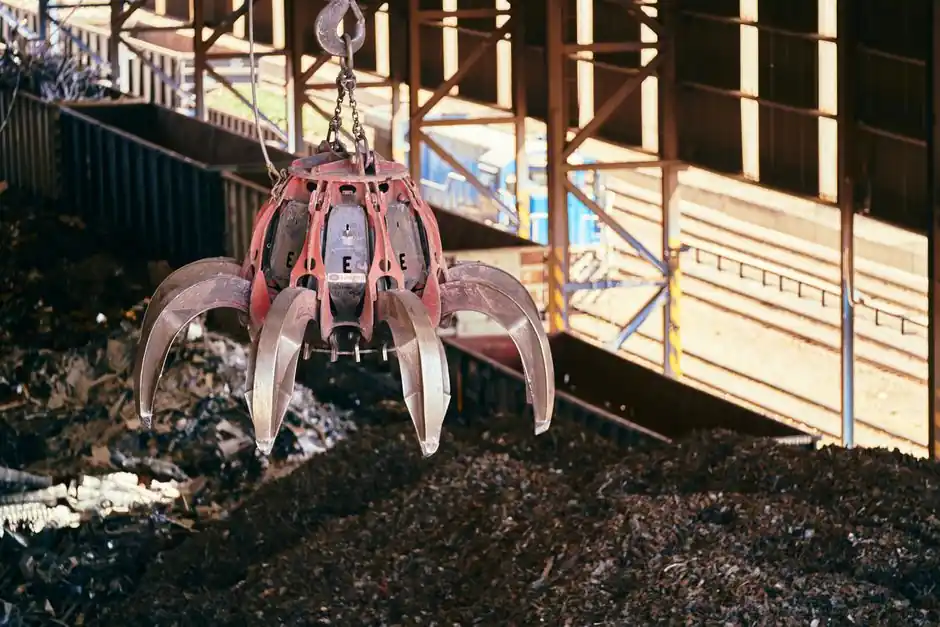
Electric arc furnace (EAF) equipment demand is on track to grow from US$3.95–4.00B in 2025–2026 to US$5.7–6.12B by 2033–2034, at a compound annual growth rate between 4.84% and 6.40% depending on the forecaster [S1][S2][S5][S6].
That equipment wave is riding a feedstock transition: scrap-based EAF output emits roughly 0.3 t CO₂/t steel on a scope 1+2 basis, versus 2.2 t CO₂/t for the coal-fed blast furnace-basic oxygen furnace (BF-BOF) route [S3]. Procurement is now biased toward suppliers who can document recycled content and grid carbon intensity alongside delivery, not just tonnage.
Regional share and where EAF capacity is concentrating
North America captured 27–30% in 2025, with the US alone representing 78–82% of that regional total, and is projected to grow at 4.2–4.7% CAGR through 2034 on mini-mill retrofits and rebar/flat product demand [S1].
Europe held 24–27% share in 2025, forecast at 4.5–4.9% CAGR through 2034, driven by the EU policy push to displace BF-BOF with EAF [S1][S7]. The capacity growth in EAF steelmaking is closely tied to broader decarbonization efforts, including the integration of electric actuator and power quality analyzer systems that manage the variable loads of renewable-powered furnaces.
AC versus DC furnace share and what is driving each
AC EAFs hold the larger installed base at 57–64% of the 2025–2026 market, growing at 4.4–4.8% CAGR through 2034 thanks to broad steelmaking compatibility and lower retrofit cost [S1][S2]. DC EAFs hold 36–39% share but are advancing faster at 5.2–5.6% CAGR, favored by premium melt shops chasing electrode consumption savings, lower harmonic distortion on weaker grids, and easier fume control [S1].
For melt-shop spec work, the practical rule is: AC dominates where the existing transformer, electrode handling, and refractory envelope are already in place, while DC is gaining share on greenfield premium-grade melts and on sites where harmonic compliance is a binding constraint. Both architectures rely on arc welder-style electrode regulation principles adapted to melt-scale currents (commonly 50–100 kA on modern UHP shells), and both are now routinely paired with AI scrap-mix optimizers such as SMS group's EAFXpert and Metallics Optimizer to stabilize the energy input as charge composition swings [S2].
Scrap quality as the binding constraint on EAF share growth
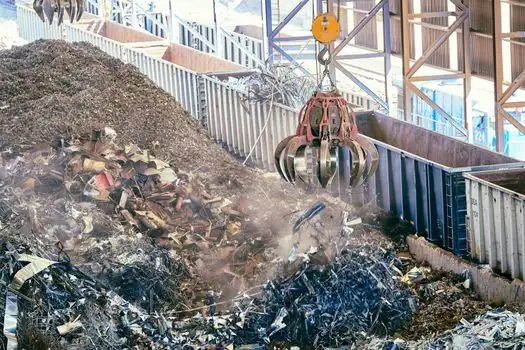
Scrap quality, not just tonnage, has become the gating variable. A BF-BOF route produces around 2.2 t CO₂/t steel (scope 1+2), while a scrap-fed EAF averages 0.3 t CO₂/t steel; an EAF fed on fossil gas-based direct reduced iron (DRI) sits at roughly 1.4 t CO₂/t steel, and a green-hydrogen DRI plus renewable-powered EAF aims for net-zero scope 1+2 [S3]. That 7× spread between best and worst EAF feedstock, on the same equipment, is the reason scrap sorting, copper control, and residual-element limits now drive EAF economics as much as electricity price does [S3].
On 5 April 2025, Tata Steel Nederland announced a target to recycle 120 million kg of old tin cans by 2026 under its ZEREMIS circular-steel program, an indicator that European producers are beginning to publish feedstock-recovery volumes alongside melt output [S2]. The US share of regional EAF demand (78–82% in 2025) is supported by a developed domestic scrap recovery infrastructure that gives US mills a structural cost and emissions edge over scrap-scarce regions [S1][S3].
Scrap trade flows: who has it, who pays to import it
Countries with strong scrap resources, principally the US and parts of Europe, can produce steel at lower cost and with lower scope 1+2 emissions by leaning on recycled feedstock, while regions with limited domestic scrap (much of Southeast Asia) face import-driven cost and trade-balance pressure [S3]. This is the single largest reason a US-based EAF retrofit still pencils out at higher US power prices than a similar unit in parts of South or Southeast Asia [S3].
China sits in the middle of this transition: current Chinese output leans on pig iron because domestic scrap supply is still limited, but policy is pushing toward a larger EAF share as the scrap economy matures, which will reshape both Chinese and Pacific-rim trade flows over the forecast window [S3]. The 1 March 2026 final approval of a US$450M GM Steel EAF green-steel mill in Toowoomba, Australia, designed to operate 24/7 on contracted renewable electricity, is a concrete example of how scrap import dependence is being paired with renewable PPAs to keep both carbon and cost in spec [S2].
What this means for plant-side specification and equipment selection
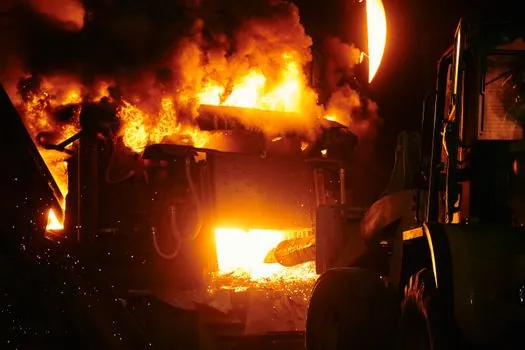
Specifying an EAF in 2026 means specifying a feedstock envelope, not just a shell. The standard EAF segment is estimated to capture 46.0% of the market share in 2026 [S2]. For most brownfield retrofits, the binding checks are: electrode rating in MVA versus scrap-bucket charge weight, transformer impedance, harmonic and flicker compliance (typically IEC/TR 61000-3-7), fume and dust handling for higher FeO and ZnO loadings in dirty scrap, and the arc welder-derived regulation loop that drives electrode lift and arc stability.
On the process-side ancillaries, the practical mix is a power quality analyzer on the EAF bus to track flicker and harmonics, an electric ball valve on the water-cooled oxygen and carbon-injection lances for slag-free tapping, an electric actuator on the tap-hole slide gate and roof swing, and an air quality monitor at the baghouse outlet to close the dioxin, PAH, and PM loop on dirty-scrap charges. For shop lighting and electrode-handling bay illumination at 200 lux+ with high CRI, lighting equipment and electric lamps selection is a small but real spec line, since electrode stub handling and slag-pot decanting are now the dominant near-miss sources on most UHP-EAF melt decks.
Limits, failure modes, and the open questions
EAF growth is not unbounded. The 4.84–6.40% CAGR spread across forecasters is itself a signal of uncertainty around the pace of BF-BOF retirement, scrap export policy (notably the EU and Turkish scrap export regimes), and grid carbon intensity in each region [S1][S2][S5][S6]. Scrap-based EAF output also depends on residual-element control: copper, tin, and chromium accumulate in circulation and force dilution with prime scrap or virgin iron units, which tightens the available scrap pool and lifts cost.
Two trackable signals to watch into 2027: (1) the pace of additional greenfield EAF announcements in India and Southeast Asia, which will indicate whether scrap import dependence can be offset by DRI-EAF pairs running on renewable PPAs; and (2) the publication of more EU mills' recycled-content and scope 1+2 emissions per tonne, which will determine whether European EAF steel can command the green-premium procurement that the EU's circular-steel policy framework assumes [S2][S3][S7].
This topic is covered further in PID loop audit findings: oscillation sources and retuning priorities.