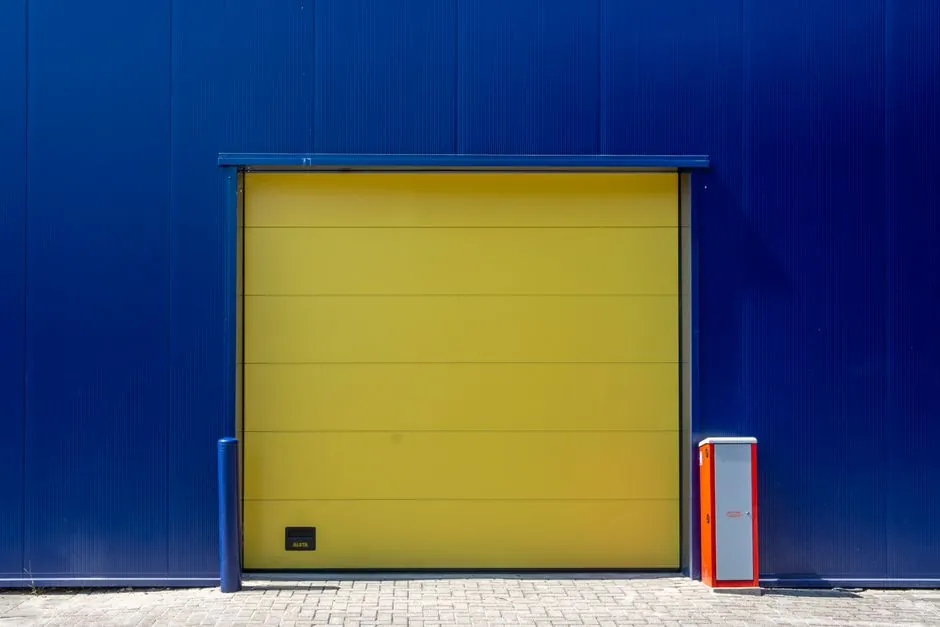
An edge-of-dock (EOD) leveler bolts or welds directly to the face of an existing dock and typically goes live the same day; a pit-mounted dock leveler requires a recessed concrete pit framed into the building slab before the unit can be set, which is the single largest source of cost and schedule difference between the two [S1][S3].
The choice is governed by dock height (commonly 38-55 in.), trailer height variation (40-50+ in. across a mixed fleet), duty cycle, and whether an existing pit is already in place, not by brand preference [S3]. The rest of this guide lines the two options up against installation method, operating range, capacity, cost, and facility-fit criteria so a specifier can match hardware to a real loading profile.
Installation Method: Bolt-On Face vs Recessed Concrete Pit
EOD units anchor to the dock face (or to the exterior wall) and weld to the embedded steel angle of the dock, so the prep work is limited to drilling anchor holes and running a 110 V supply for hydraulic or air models [S2][S3]. Dockzilla markets its exterior variant as installing 10x faster than a pit-style leveler, requires no concrete pour, and remains relocatable if the dock layout changes [S5].
Pit levelers require a recessed concrete pit framed into the slab before installation, plus pit-forming steel, a sump pit for the hydraulic power pack on hydraulic and air models, and rebar/embed work tied to the dock door framing [S3][S4]. On a retrofit dock with no existing pit, demo-ing the surface and framing the opening is a structural job that the supplier market treats as a significant cost adder on top of the leveler itself [S2]. Vertical storing levelers (RHV-4100, RHV-5000 class) are a pit-mounted variant that stores inside the building so the dock door seals onto concrete, a layout used in washdown and food-service facilities [S2][S4].
Operating Range and Capacity: 12 in. Travel vs Limited EOD Reach
A standard pit-mounted hydraulic or air leveler provides roughly 12 in. of travel above dock level and 12 in. below dock level, which is enough to absorb the full 40-50+ in. range of mixed trailer heights sitting on 38-55 in. docks [S3]. Mechanical pit units (RHM-4000 class) and fully automatic mechanical units (FA-1600) use a stored-energy spring and walk-down design, so the operator must be heavy enough to walk the deck back into the stored position [S2][S3].
EOD units have a more limited operating range than pit levelers and are consistently described across the supplier base as the economical option for light-duty applications where service is intermittent and trailer heights are uniform [S3][S9]. Hydraulic EODs (RHE-300 class) push a button to actuate, while mechanical EODs use a lever to raise the deck into the trailer and have the narrowest adjustment window of the four common variants [S2]. The practical ceiling is what the industry calls a light-duty dock: think grocery, parcel, and lower-volume retail back-of-house, not a 24/7 grocery distribution or cold-storage cross-dock.
Drive Mechanism Comparison: Mechanical, Air, Hydraulic, Vertical
Four drive packages dominate the pit-leveler side, and each maps to a different maintenance and power budget. Mechanical pit levelers are the lowest acquisition cost, run without dock-side electrical power, but carry higher lifetime service cost because of the spring and linkage [S3][S4]. Air-powered pit levelers use a pneumatic bag (typically 110 V supply) and sit in the middle on both price and service burden [S4].
Hydraulic pit levelers are the most adaptable of the four, accept anything from 110 V single phase to 575 V three-phase, and generally carry the lowest lifetime service cost of the powered options [S4]. Vertical storing levelers are a hydraulic sub-type used where building envelope control matters, common in food service and washdown environments [S2][S4]. On the EOD side, the drive split mirrors pit levelers at smaller scale: mechanical EODs (lowest cost, lever-actuated) and hydraulic EODs (push-button, higher acquisition cost, easier on the operator) [S2][S3].
Cost and Schedule: Acquisition vs Concrete Work
EOD levelers are described across the supplier base as significantly less expensive than pit levelers on first-cost basis, primarily because the pit-forming concrete and structural steel are removed from the bill of materials [S1][S3][S7]. The savings show up even more sharply on retrofits, where demo-ing an existing slab and framing a new pit is treated as a separate, significant cost line that EODs eliminate entirely [S2].
Pit levelers trade that higher first cost for longer service life under high-cycle duty, lower per-cycle operator effort, and integration with powered trailer restraints, dock lights, and interlocked Dok-Commander controls (Rite-Hite product family) [S2][S3]. For a new-build spec where the pit is poured as part of the slab package, the cost gap narrows because no retrofit demo is required, and the higher-capacity pit unit is usually the better long-term return above roughly 8-10 loads per dock per shift.
Decision Matrix: Match Profile to Hardware

Specify a pit-mounted hydraulic or vertical storing leveler when the dock sees high-cycle service (multi-shift, cross-dock, cold storage), when mixed trailer fleets create height variation beyond 6-8 in., or when a washdown/food-service seal requires the door to close on concrete [S2][S3][S4]. For a side-by-side on a dock leveler selection, pit units also win when the spec calls for integration with powered restraints and interlocked sequence-of-operations controls [S2].
Specify an EOD leveler when the project is a retrofit on an existing dock without a pit, when trailer heights are uniform within roughly 2-3 in. (a single carrier or captive fleet), when duty cycle is light to moderate, and when installation downtime must be measured in hours rather than days [S1][S3][S5][S9]. A mechanical EOD is the budget pick for low-volume docks; a hydraulic EOD is the operator-friendly upgrade for the same envelope. The same build-vs-buy logic that drives a truck-mounted crane retrofit decision applies: concrete work is the schedule killer, and bolt-on hardware is the schedule saver [S5].
Failure Modes and Constraints to Spec In
EODs share the industry-wide complaint that the operating range is the limiting factor: a mixed-fleet yard that runs both step-deck and standard 53 ft trailers will push the EOD outside its adjustment envelope, and operators will start shimming or refusing loads [S3][S9]. The lip engagement on EODs is also shorter than on a full pit unit, which is why EODs are flagged for light-duty service rather than repeated forklift impacts from heavy pallet loads.
Pit levelers have their own failure profile: the pit collects water and debris (a Safe-T-Pit class accessory exists for exactly this reason), the sump pump fails, and hydraulic cylinders on high-cycle units cycle past their seal life around 100,000-200,000 cycles depending on the OEM [S2]. On any new build, specify a formed pit with a drainage path, a pit-mounted leveler with a self-cleaning lip hinge, and a service contract that budgets seal replacement at the OEM-recommended interval rather than waiting for a leak [S2][S4]. For facilities already running truck-mounted concrete pumps on tight sites, the same constraint logic applies: hardware envelope dictates the work envelope.
Track two signals before the next purchase: (1) OEM-published EOD operating range figures in inches above and below dock (currently described only as "more limited" than pit units across the supplier base [S3][S9], so a hard number is worth requesting on the submittal), and (2) any 2025-2026 update to ANSI MH30.3 or the equivalent industry standard for dock leveler testing, which governs the cycle-life and load-test basis most pit-leveler warranties are written against. Locking those two data points into the spec eliminates the most common retrofit disputes.
For related coverage, see Digital vs Analog Panel Meter Accuracy: Spec-Level Decision Guide.