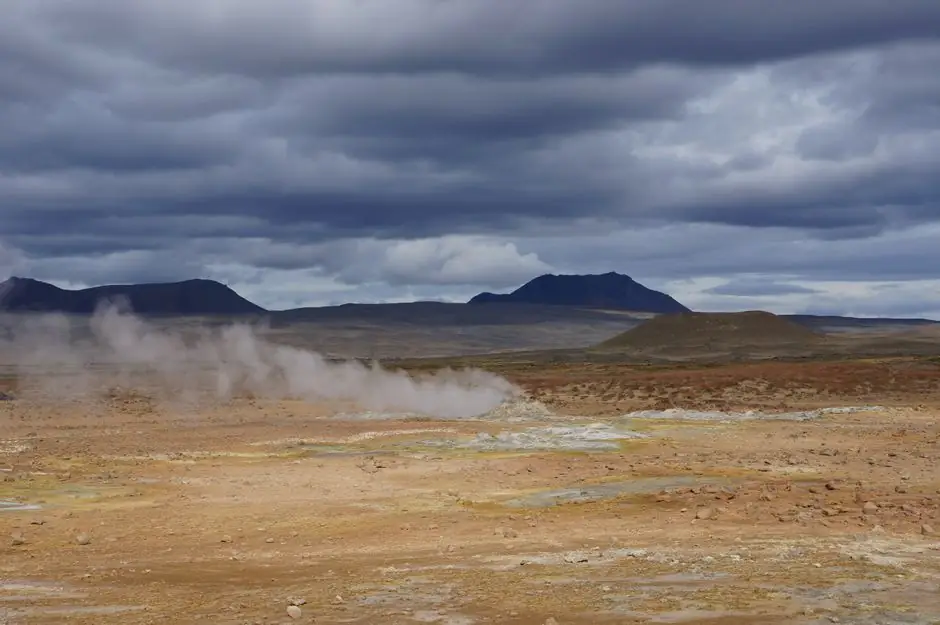
U.S. geothermal nameplate capacity reached 3,969 MWe in 2024, up 8% from 3,673 MWe in 2020, with 246 MWe of new plants, 132 MWe of expansions and 82 MWe of retirements driving the net change [S2][S3].
The first large-scale commercial enhanced geothermal system (EGS) power plant in the United States is under construction, with the operator targeting a June 2026 commissioning date reported in the EIA generator survey [S1].
Conventional vs enhanced geothermal: resource definition and operating envelope
Conventional geothermal plants tap naturally occurring hydrothermal reservoirs in permeable, porous rock, usually near tectonic plate boundaries or volcanic hotspots, with reservoir fluids ranging from 300°F to 700°F (about 149°C to 371°C) [S1].
EGS applies horizontal drilling and multi-stage stimulation borrowed from shale oil and gas operations to create a man-made hydrothermal reservoir where geology alone cannot supply one, which is the lever that allows siting outside the western U.S. volcanic arc [S1][S4]. That crossover is why a 2025 NLR technical analysis counts nine new plants, six retirements, and net expansion since the 2021 report, even as the number of projects under development holds flat at 54 [S3].
U.S. installed capacity, ownership concentration, and where new megawatts sit
Two operators, Ormat and Calpine, control 69% of installed U.S. geothermal capacity and 61% of operating plants, with California hosting 53 of 99 plants at 2,868 MWe (72% of national capacity) and Nevada second at 892 MWe across 32 plants [S3].
Summer and winter annualized mean net generation rose from 2.56 GWe and 2.96 GWe in 2019 to 2.69 GWe and 3.12 GWe in 2023, evidence that the fleet is not just larger but producing more net electricity per season [S3]. Behind those fleet totals, the 27 power purchase agreements (PPAs) signed since 2021 total 1,661 MWe, and at least 639 MWe trace back to a 2021 California Public Utilities Commission procurement order that pulled in Nevada and Utah imports [S3].
Next-generation geothermal: EGS PPAs, drilling cost deflation, and the Enhanced Geothermal Shot

Next-generation systems (EGS, closed-loop and advanced geothermal) account for 61% of PPAs signed since 2021, and 12 of those PPAs commit utilities to 1,007 MWe: 462 MWe in California, 150 MWe in New Mexico, 135 MWe in Nevada, 110 MWe in Texas, and 150 MWe undecided east of the Rockies [S3]. Google became the first EGS offtaker through NV Energy, the first next-gen PPAs were signed in 2022, and the U.S. Department of Energy has committed USD 74 million across seven pilot demonstrations under the Enhanced Geothermal Shot, targeting a 90% well-cost reduction by 2035 [S3][S4].
U.S. summer capacity in conventional geothermal sits at 2.7 GW, or 0.2% of total U.S. summer generating capacity, while the U.S. Geological Survey estimates 135 GW of EGS potential in the Great Basin alone, and one study projects up to 150 GW of cost-effective EGS nationwide in the coming decades [S1]. The National Laboratory of the Rockies estimated 90 GW of EGS could be economically built across the country by 2050 [S1].
Venture funding into next-generation subsurface heat developers exceeded USD 1.1 billion between 2023 and 2025, layered on top of roughly USD 5 billion in 2025 conventional geothermal project finance, a four-fold increase over 2018 levels [S4][S5].
Plant type and resource temperature: a criteria comparison for spec decisions
Flash steam captured 44.2% of installed value in 2025 on the strength of proven high-enthalpy (>180°C) reservoirs, while binary cycle (ORC) plants delivered USD 2.26 billion of 2025 value by unlocking medium-enthalpy resources (100°C to 180°C) that flash units cannot use directly [S4]. EGS is the fastest-growing technology class at a 17.5% CAGR through 2035, and the legacy 1980 to 2005 single-flash fleet is now being repowered with organic Rankine bottoming cycles that pull an extra 8% to 12% from brine reinjected near 140°C [S4].
Spec-relevant comparison points for a new project sit in four columns: resource temperature (low <100°C, medium 100–180°C, high >180°C), plant type, typical use case, and growth signal. High-enthalpy >180°C resources feed flash steam and dry steam plants, the proven utility-scale workhorses, while medium-enthalpy 100–180°C resources are the binary cycle sweet spot and the lower bound for EGS. Low-enthalpy <100°C resources are normally direct-use only (district heat, greenhouse, aquaculture), which is why Europe, where district heating matters, tilts toward binary and ground-source heat pump designs rather than flash builds [S4].
Regional split: where value and growth concentrate

Asia-Pacific held 41.2% of global geothermal market value in 2025 and is also the fastest-growing region at 11.1% CAGR through 2035, propelled by Indonesian and Philippine capacity auctions, with Indonesia's Ministerial Regulation No. 112/2022 restoring bankable feed-in pricing for high-enthalpy concessions [S4]. North America ranks second with 24.6% share, repriced by clean firm offtake from hyperscale data centers running long-tenor contracts, while Europe differentiates less on electricity and more on heat, with municipal networks swapping fossil boilers for subsurface supply [S4]. The renewable energy procurement angle is one of several forces reshaping power distribution planning for new geothermal tie-ins.
Policy, cost, and seismicity: the three things that gate EGS at scale
The U.S. Inflation Reduction Act extended a transferable 30% investment tax credit to qualifying geothermal projects, which trims levelized cost by roughly USD 14 to USD 19 per MWh for developments that hit the credit, and that gap is the single biggest commercial driver behind the EGS build-out [S4]. Capital cost is the other gating factor, with well construction the dominant line, and the Enhanced Geothermal Shot's 90%-by-2035 well-cost reduction target is the spec engineers are working back from when sizing the power supply at the wellhead [S1][S4].
Induced seismicity remains the second named hurdle after capex, and Utah FORGE (Frontier Observatory for Research in Geothermal Energy) is the DOE-sponsored field laboratory for testing EGS reservoir creation, stimulation controls, and seismic-risk mitigation at scale [S1]. Geothermal could meet as much as 15 percent of global electricity growth through 2050, with the IEA reiterating the same 15 percent figure for growth in global electricity demand between 2024 and 2050, so the constraint is execution speed, not resource ceiling [S6][S8].
Market sizing: where the three reports disagree, and why
Market Research Future puts 2025 size at USD 8.42 billion, 2026 at USD 9.22 billion, and 2035 at USD 21.22 billion (9.7% CAGR, 2026 to 2035) [S4]. Precedence Research sizes the same year at USD 7.31 billion in 2026, reaching USD 10.78 billion by 2034, while Coherent Market Insights values 2026 at USD 6.42 billion and 2033 at USD 9.35 billion [S7][S9]. The spread between USD 6.4 billion and USD 9.2 billion for 2026 reflects different scopes: some reports count only utility-scale electricity, others include direct-use heat and district networks, so any sourcing step should pin the report's plant-type and application split before quoting a number.
Limitations, failure modes, and signals worth tracking
The first U.S. commercial EGS project's June 2026 in-service date is a single data point, and slippage on that commissioning would reset the next-gen PPA pipeline that already commits 1,007 MWe to offtake [S1][S3]. Drilling cost curves must fall fast enough to pull the resource base beyond current plate boundaries, and induced-seismicity control at scale is the non-technical risk that can stop a project even when the rock physics works [S1][S4].
Track these three nodes through the next two reporting cycles: the EIA generator survey update on whether the June 2026 EGS plant cleared commercial operation, the next NLR U.S. Geothermal Market Report for the post-2024 capacity number, and the DOE Enhanced Geothermal Shot pilot demo results, which set the pace for the 90%-by-2035 well-cost goal [S1][S3][S4]. Adjacent coverage on multi-site data center builds shows how hyperscale load is already pulling clean firm offtake into long-tenor geothermal contracts, the same demand-side pressure that is reframing the 24.6% North American share.
Spec-level background on the components involved: power cable.