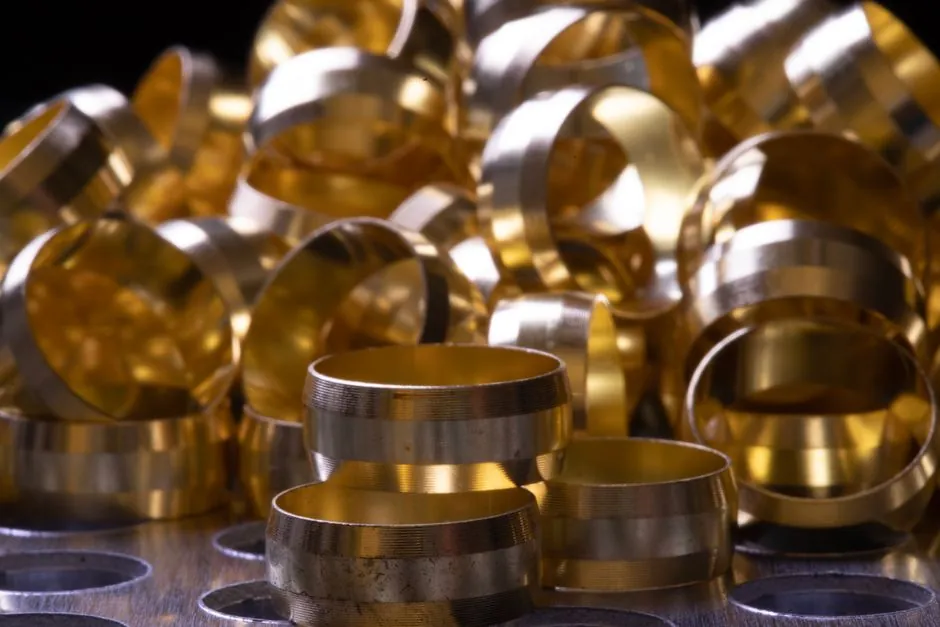
For copper-alloy connector strip and pin stock, beryllium copper (BeCu) and phosphor bronze (PB) are the two materials that actually carry the load: BeCu delivers the highest combination of strength, conductivity, and fatigue life of any copper alloy, while phosphor bronze is the default lower-cost copper alloy where harsh-environment corrosion resistance and stable spring properties are required [S1][S2][S6].
Samtec's published guidance puts the three common base metals in board-to-board connector pins at brass, beryllium copper, and phosphor bronze, and explicitly recommends not using brass in spring contacts because the beams take a permanent set after a few mating cycles [S1]. That narrows the real decision for strip supply to BeCu versus PB, with the pin-and-plating cost often reaching 25-30% of total connector cost on a micro-pitch high-density part and 60-70% on a basic 2.54 mm centerline terminal strip [S1].
Mechanical and electrical property comparison
Phosphor bronze cannot be age-hardened the way BeCu can; its strength is locked in by cold work, so temper designation (annealed, half-hard, hard) controls tensile strength directly, and formability drops as strength climbs [S2]. BeCu is supplied in different tempers and is then age-hardened after forming, which is why Materion's heat-treating guide treats the supplied condition and the aging schedule as inseparable parts of the final property set, not separate variables [S2].
On conductivity, phosphor bronze is widely cited at roughly 15% IACS versus pure copper, while BeCu is the only high-strength copper alloy that also approaches pure-copper conductivity, which is why it is preferred for current-carrying miniature contacts [S7]. For power and signal contacts the same strip therefore behaves very differently: a BeCu socket at the same cross-section carries more current for the same temperature rise, while a PB strip needs a larger contact area to hit the same ampacity [S3].
Cost, machinability, and supply position
Bead Electronics states directly that phosphor bronze costs more than brass but less than beryllium copper, placing PB in the middle of the three commonly stocked contact alloys [S3]. Weld Machining's 2026-09-18 buyer-focused guide repeats the same hierarchy and adds that switching to BeCu "solely to obtain higher tensile strength" is unjustified when the PB temper already meets the part's load and deflection requirements [S2].
For strip supply, both alloys ship in 0.005 in (0.127 mm) thicknesses and in coil form: MSC lists 0.005 in phosphor bronze sheet marketed for springs, and Practical Machinist forum participants in 2019 could not find BeCu in that exact 0.005 in strip gauge, which is a real-world supply asymmetry for ultra-thin connector strip [S5]. Machinability ratings put both alloys below free-machining brass but above tool steels, and beryllium dust generated during grinding, sanding, or machining is a documented inhalation hazard, so shops must control particulate and never dry-grind BeCu [S5].
Application fit: miniature, high-cycle, and micro-pitch
Samtec specifies BeCu for miniature and high-cycle interconnects because, once formed and age-hardened, it retains its shape across many mating cycles, while phosphor bronze's lower spring performance is why Samtec does not use it as much in micro-pitch connectors [S1]. BeCu's stable springback also makes it the default choice for slotted contact sockets, precision spring clamps, and heavily loaded connector components where the cross-section is constrained [S2].
Phosphor bronze is favored instead for larger contact systems with longer beams and more deflection, including many 2.54 mm pitch terminal strips, industrial pin headers, and connector pins exposed to corrosive atmospheres [S1][S4]. Connector Supplier notes that PB's higher tensile strength relative to brass and its corrosion behavior make it common in harsh-environment applications, and QW Terminals' 2026-07-23 terminal comparison adds that PB terminals are specified for "balanced performance, good corrosion resistance, stable spring characteristics, and cost" in mainstream consumer and industrial harnesses [S4][S6].
Decision matrix: BeCu vs phosphor bronze strip
Across four decision criteria drawn from the source material: (1) tensile strength, (2) electrical conductivity, (3) corrosion / harsh-environment behavior, and (4) unit cost, the ranking is clear. BeCu wins on strength and conductivity, PB wins on cost and is at least comparable in corrosion resistance for most non-marine atmospheres [S1][S2][S3][S6][S7].
For specification, the rule of thumb is: specify BeCu (typically C17200, age-hardened) for micro-pitch, high-cycle, and current-carrying contacts in miniature cross-sections; specify PB (typically C51000 or C52100, half-hard or hard temper) for 2.54 mm and larger pitch strips, long-beam spring contacts, and connectors exposed to industrial atmospheres where cost per pin matters more than ultimate fatigue life [S1][S2][S4][S6]. Do not substitute brass for either in a spring contact, and do not specify BeCu simply to chase tensile numbers that the PB temper already satisfies [S1][S2].
Handling, sourcing, and qualification risk
BeCu strip and bar require dust control during cutting, stamping, and grinding because inhaled beryllium particulate is a recognized health hazard; XRF or acid-etch identification is the standard way to confirm alloy when incoming material is unmarked, since color alone is not definitive [S5]. Phosphor bronze does not carry the same inhalation risk, but its conductivity ceiling (~15% IACS) means a down-spec to PB from BeCu must be compensated with a larger contact cross-section to hold the same current rating [S7].
For sourcing, the practical signal to watch on 2026-09-26 is that the same Weld Machining buyer guide is now explicitly walking purchasers through temper selection, age-hardening schedule, and failure mode (permanent set vs stress relaxation vs overheating) rather than just listing alloy names, indicating the connector-strip market is moving toward spec-driven alloy + condition purchasing rather than generic "BeCu strip" or "PB strip" requests [S2]. Learn more about copper alloy selection in our copper material encyclopedia and tin bronze alloy properties for related spring-contact grades.
Track two signals over the next quarter: whether connector OEMs publish per-temper BeCu strip datasheets (currently most still list generic C17200 properties) and whether strip distributors start stocking 0.005 in (0.127 mm) BeCu coil, which forum reports in 2019 indicated was effectively unavailable off-the-shelf [S5]. For power-supply and industrial-UPS connector pins that drive the switching power supply and industrial UPS markets, both signals directly affect whether a miniature BeCu pin redesign becomes a stock item or a special-order job.
Related analysis: Ethernet vs PROFINET Remote I/O Modules: Protocol, Latency, and Cost Compared.