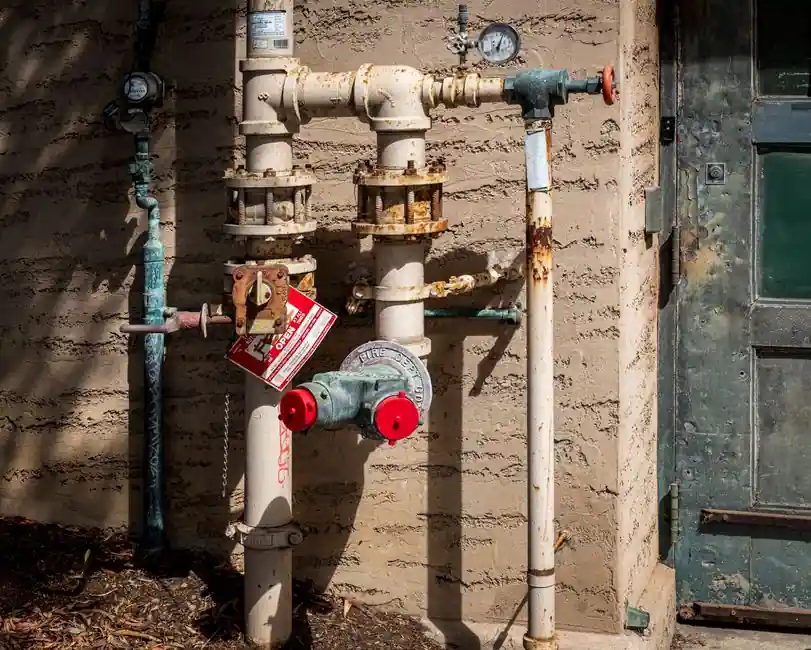
For utility water metering, an electromagnetic flow meter datasheet is read against five hard parameters: nominal line size (commonly 40 to 2200 mm / 1.5 to 84 in), stated accuracy as a percent of rate, electrode and liner material, flow range expressed as a turndown ratio, and minimum fluid conductivity (typically 20 to 30 μS/cm for water) [S3][S10]. These map directly to the custody-transfer and billing-grade use cases encountered in municipal water and wastewater service.
Magnetic flow measurement operates on Faraday's law of electromagnetic induction: a magnetic field passes through the conductive water column and induces a voltage at electrodes proportional to average flow velocity, with no moving parts and an unobstructed bore [S1][S2]. Because the bore is empty, pressure loss is essentially the pipe's own hydraulic loss, and fluids with entrained solids, ore slurries, or fibrous wastewater streams can be metered without damage [S2].
Line size, accuracy class, and flow range
The ABB WaterMaster family covers 40 to 2200 mm (1.5 to 84 in) with ±0.4% of rate as standard accuracy and ±0.2% as an optional accuracy class, in both forward and reverse flow directions, with verification to OIML R49 type 'P' requirements [S3]. Utility buyers use OIML R49 Class 1 or Class 2 as the accuracy benchmark for cold-water billing meters; AWWA standards govern meter sizing rules, including the convention that thread sizes are typically one nominal iron-pipe size larger than the meter's inlet internal diameter [S1].
Turndown ratio, the ratio of maximum to minimum measurable flow at stated accuracy, is the single most abused parameter on a datasheet. An oversized electromagnetic meter will not accurately measure low flows, which is exactly where leak detection and night-flow analysis live in a distribution network [S1]. PNNL's best-practice guidance recommends sizing the meter against the building or application's expected extended low-flow and maximum continuous duty, not the connection pipe size.
Conductivity, electrodes, and liner compatibility
For clean water, the LDG-SUP datasheet specifies a minimum conductivity of 20 μS/cm, with the best results achieved above 30 μS/cm; fluids below that floor are unsuitable for the magnetic principle regardless of pipe size [S10]. Distilled, deionized, or oil-continuous fluids fall outside the technology envelope and are why the electromagnetic meter is paired with other instruments in the utility toolbox, see electromagnetic flowmeter for the principle limits.
Electrode materials on utility datasheets are typically 316L stainless steel, Hastelloy C-22, or titanium for raw and treated water; liner materials are EPDM, PTFE, or hard rubber depending on chemical exposure and temperature [S3]. Badger Meter's ModMAG and E-Series, the Rosemount 8750W, and ABB WaterMaster all offer hard-rubber liners as a default for buried water service because hard rubber tolerates occasional soil-chemical exposure in flooded vaults [S4][S5]. Selection should match the worst-case chemical in the stream, not the average; a single liner attack will lift the meter's measurement to outside spec long before the body corrodes.
Ingress protection, burial, and installation geometry
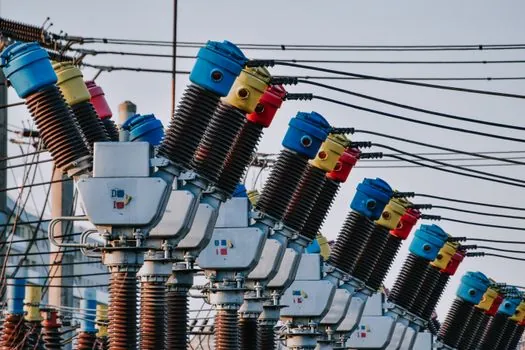
IP68 (continuous submersion) and NEMA 6P are the standard ratings on utility-grade electromagnetic sensors, and ABB explicitly markets all WaterMaster sizes as inherently submersible and buriable, with installation reduced to excavate, fit, cable, and backfill [S3]. The Rosemount 8750W datasheet positions the same IP68 envelope for water and wastewater service to reduce lifecycle cost and downtime [S4].
Upstream straight-pipe length is the single most under-spec'd parameter on procurement documents. Electromagnetic meters are less sensitive to swirl than turbine or compound meters, but the octagonal bore used in WaterMaster still reduces profile-disturbance sensitivity, it does not eliminate it [S1][S3]. Specifiers should require at minimum 5 diameters of straight pipe upstream and 3 diameters downstream, plus a flow conditioner where two out-of-plane bends fall within 10 diameters of the meter.
Diagnostics, communications, and self-verification
Modern utility datasheets carry NAMUR NE107-compliant diagnostics, true electrode and coil impedance measurement, and continuous self-checking against OIML R49 type 'P' [S3]. That is the difference between a meter that needs annual bench verification and one that flags coil-driver drift, electrode coating, or empty-pipe conditions in real time over HART or a remote HMI [S3].
Output options on contemporary electromagnetic meters include 4-20 mA with HART, Foundation Fieldbus, PROFIBUS PA, Modbus, and pulse/frequency outputs for totalizer-based SCADA or AMR endpoints [S3][S5]. For a comparison of the pulse versus analog output path on related flow hardware, weighing metering gives the mass-batch baseline, while utility billing integrations typically use the pulse channel into a totalizer with OIML R49 traceability. Badger Meter's ModMAG and E-Series, Rosemount 8750W, and ABB WaterMaster all expose infrared service ports for parameter dump and simultaneous HART plus remote HMI [S3][S4][S5].
Pressure loss, pumped versus gravity systems, and sizing trade-offs
Because the bore is unobstructed, the pressure loss across an electromagnetic meter is essentially the straight-pipe loss at the same flow; PNNL contrasts this with venturi meters, which use a pressure drop as the measurement, and with mechanical meters, which add bearing and impeller drag [S1]. In a pumped system that pressure loss is a real operating cost; in a gravity-fed distribution main it is usually negligible. An undersized electromagnetic meter, however, will impose a high single-point loss; an oversized one will miss low flows, so the sizing exercise is a trade-off, not a "bigger is safer" decision [S1].
Spec sheets that bury the pressure-loss curve as a small graph in section 7 are the ones to distrust. Ask for the ΔP-vs-flow curve at the installed line size, and overlay it on the system curve before signing the PO. The Sensus-style approach of using a high turndown ratio at the meter's stated accuracy, rather than a wide range at degraded accuracy, is the procurement language to use, and it ties back to the OIML R49 Class 1/2 envelope in the previous section [S1][S3].
Comparison of common datasheet parameters across vendor utility families
On a head-to-head datasheet reading, ABB WaterMaster (40 to 2200 mm, ±0.4% standard / ±0.2% optional, OIML R49 type 'P', IP68/NEMA 6P, hard-rubber or PTFE liner), Rosemount 8750W (water and wastewater optimized, IP68, HART/Fieldbus options), Badger Meter ModMAG and E-Series (electromagnetic and battery-powered AMR variants for pit retrofit), and the SUP-LDG LDG-SUP (≥20 μS/cm conductivity floor, broad liner menu) cover the bulk of municipal procurement specs [S3][S4][S5][S10]. On four decision criteria, accuracy class favors ABB at the optional ±0.2%, size range favors ABB at 2200 mm upper end, conductivity tolerance is similar across the four (water is well above 30 μS/cm so this rarely binds), and AMR/battery operation favors Badger's E-Series for pit retrofit without mains power [S3][S4][S5].
For process water and treated-effluent service with chemistry concerns, the liner menu matters more than the brand. PTFE gives the broadest chemical compatibility up to roughly 180 °C process temperature; hard rubber is the lowest-cost default for potable and raw water; EPDM sits between them. Confirm with the vendor's chemical resistance table before specifying PTFE on a hot digester line, or hard rubber on a chlorinated finished-water main. See online water analyzer for the chemistry side of the same plant, where free chlorine, pH, and turbidity sensors complement the magnetic meter on the same SCADA node [S3].
Where electromagnetic flow meters fail and what to specify instead
Three failure modes recur on datasheets and in field service: low-conductivity fluids (below 20 μS/cm) where the induced voltage drops into the noise floor of the preamplifier, gas bubbles or partial pipe fill that breaks the conductive path, and electrode coating from iron, manganese, or biological fouling that shifts the zero and degrades accuracy [S6][S10]. The Analog Devices technical note on electromagnetic flow meter design highlights low-leakage-current, high-input-impedance preamplifier front ends specifically to deal with electrode-coating scenarios where the electrode-to-water impedance can climb to the megaohm range [S6].
For non-conductive fluids (oils, hydrocarbons, high-purity water) the right alternative is a Coriolis mass flowmeter or ultrasonic flowmeter, not a magnetic meter at any accuracy class. For steam or district heating, the same logic applies, and the metering pump reference is the right place to look when the flow is being dosed rather than metered in a main [S2][S6]. Specifiers who try to "spec up" a magnetic meter to cover a non-conductive service by demanding tighter accuracy are buying a future failure, not a better instrument.
Track three signals over the next procurement cycle: (1) whether the OIML R49 type 'P' continuous self-check language appears on more utility datasheets as a default rather than an option, (2) whether the 20 μS/cm conductivity floor is being pushed lower on next-generation meters, which would open new reclaimed-water and condensate service, and (3) the spread of battery-powered electromagnetic meters with integrated AMR endpoints for pit retrofit without mains power, a category that Badger Meter, Itron, and Sensus variants have been pushing into 2026 [S3][S4][S5][S7].
Background reading: SABB vs Spherical Roller: Load Capacity, Speed, and Misalignment.