
Electronics packaging lines handle ESD-sensitive boards, molded-housing consumer devices, and boxed accessories that all collide with a single end-of-line constraint: a case packer that cannot keep pace with the SMT or final-assembly cell becomes the bottleneck that drags the whole plant's OEE down [S1].
Top-load and robotic top-load configurations dominate the electronics segment because they drop product vertically into an erected RSC case, the gentlest trajectory for populated PCBs and bagged accessories; side-load stays common for uniform boxed SKUs such as routers, set-top boxes, and finished-cable kits, where the horizontal push matches a rigid rectangular form factor [S2]. A spec-first electronics buy starts with five measurable axes: case format (FEFCO 0201 RSC, 0200 HSC, or 0203 FOL wrap-around), throughput in cases per minute, ESD-safe contact surfaces, changeover time in minutes, and integration with the upstream coding machine and downstream palletizer.
Why Electronics Lines Are Spec-Different From Food or Pharma
Electronics case packers are not generic secondary-packaging cells: the product mix on a typical SMT or final-assembly line spans bare PCBs in ESD bags, plastic-housed consumer devices, and boxed accessories, each with its own fragility and static-discharge profile, and that mix drives the choice of loading geometry more than raw throughput does [S2]. Top-load packers drop product vertically into a pre-erected RSC, the lowest-impact trajectory for populated boards and the geometry most OEMs recommend for ESD-sensitive SKUs; side-load packers push product horizontally into an open case and work well for uniform rectangular boxes but apply shear loads that rule them out for tray-packed PCBs [S2][S3].
Two operational metrics separate electronics lines from food or pharma. First, changeover frequency is typically higher because SKU counts on a consumer-electronics line run into the dozens per shift, which penalizes mechanical-format changeovers measured in hours and rewards servo-driven, recipe-based changeover under 15 minutes [S1][S4]. Second, the case packer must physically coexist with the material handling system upstream (ESD conveyors, ionizers, tray stackers) and the coding and palletizing stages downstream, so the machine's footprint, control bus, and reject path have to be specified against ANSI/PMMI B155.1 safety references and ISO 12100 risk-assessment methodology, not just quoted as line equipment [S3].
The Five Selection Axes for an Electronics Case Packer
Procurement engineers who skip straight to price on an electronics case packer buy themselves a retrofit; the five axes below are the same ones packaging-line integrators use, in the same order, and they line up against the case packing machine spec framework already documented on SourceBySpec [S3].
Axis 1, case format range. Confirm that the magazine and forming section accept the blank caliper, flute grade, and ECT rating your distribution channel demands, since ECT per TAPPI T811 is the metric that matters for palletized loads while the Mullen burst test per TAPPI T810 measures flat-side puncture resistance only [S3]. Axis 2, throughput in cases per minute. Ensure the packer's cycle rate matches or exceeds the upstream SMT or final-test cell's output so the packer does not become a bottleneck in the line [S1]. Axis 3, ESD-safe handling. Specify ESD-conductive contact surfaces, ionization on the collation area, and a controlled discharge path for any vacuum or gripper end-effector that touches bare PCBs or populated boards. Axis 4, changeover time. Require recipe-driven changeover under 15 minutes for plants running 20+ SKUs per shift, and demand proof-of-concept FAT data rather than brochure claims [S1][S4]. Axis 5, integration. Verify the control bus (EtherNet/IP, PROFINET, or CC-Link) matches the line PLC, that the reject path can divert mispacked or mis-coded cases, and that the storage handling system downstream of the palletizer can accept the throughput the packer delivers [S3].
Loading Geometry Comparison: Top-Load, Side-Load, Wrap-Around, Robotic

The four dominant loading geometries for electronics map to different product profiles, and the matrix below lines them up against the decision criteria an electronics buyer actually weighs [S2][S3][S7].
Top-load mechanical packers insert product vertically into a pre-erected RSC case, run 20-50 cpm on mid-range builds, suit PCBs in ESD bags and boxed accessories, and offer the lowest-impact trajectory at the cost of limited pattern flexibility. Side-load packers push product horizontally into an open case, run 40-80+ cpm, suit uniform rectangular SKUs such as routers, set-top boxes, and finished-cable kits, but apply shear loads that disqualify them for tray-packed boards. Wrap-around packers fold a flat blank around a pre-grouped collation and glue it in one motion, run 30-60 cpm, suit shrink-wrapped multipacks of small consumer electronics, and eliminate the separate case-erection step but constrain blank inventory. Robotic top-load cells use articulated arms with vision-guided pick, rate 10-25 cpm on mixed-SKU lines, suit high-mix low-volume electronics assembly, and dominate the high-changeover segment where recipe time and pattern flexibility outweigh raw cpm [S2][S3].
For a high-mix contract-electronics-manufacturing line running 30+ SKUs per shift, robotic top-load wins on pattern flexibility and changeover time; for a high-volume single-SKU consumer-electronics line, side-load or wrap-around wins on raw cpm; for a PCB assembly plant packing ESD-bagged boards into RSC cases, mechanical top-load wins on impact control and the lowest capital cost per cpm. The geometry that loses most often in electronics is bottom-load, which is reserved for heavy or delicate product that cannot be top- or side-loaded and is uncommon in mainstream electronics packaging [S2].
Corrugated, ESD, and the Standards Map
Electronics case packers have to form corrugated cases that survive a distribution cycle, and three test standards govern that survival independent of the machine that packs them [S3]. ECT, edge crush test, per TAPPI T811 measures the stacking strength of the corrugated board in the direction perpendicular to the flutes and is the metric that matters for palletized distribution. The Mullen burst test per TAPPI T810 measures puncture resistance from the flat side and is more relevant for parcel shipping than for pallet loads. Box compression is validated per ASTM D642 with a full distribution sequence per ASTM D4169 or the ISTA series, and the case packer must reliably form whatever flute and ECT grade your distribution demands, so the blank caliper, flute, and ECT range the magazine and forming section accept have to be on the spec sheet, not assumed [S3].
ANSI/PMMI B155.1 and ISO 12100 are the safety references packaging-line engineers cite when validating guarding, risk assessment, and lockout-tagout on a new case-packing cell, and the gland packing and sealing stations on hot-melt-equipped packers are governed by the same machinery-safety discipline as any other end-of-line equipment [S3]. For ESD-sensitive product, the relevant reference framework is ANSI/ESD S20.20 for the packaging cell as a whole, with ionization, conductive contact surfaces, and a controlled discharge path specified as part of the case packer's bill of materials, not as an afterthought retrofitted at the line [S3][S8].
Integration, Reject Path, and Where the Packer Sits in the Line
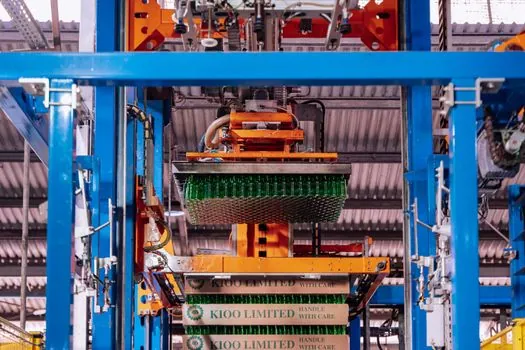
A case packer is the bridge between secondary packaging (the cartoner, tray loader, or shrink-wrap station that creates the saleable unit) and tertiary packaging (the palletizer that stacks sealed cases onto a pallet), and on an electronics line that bridge is short, instrumented, and intolerant of misfeeds [S2][S3]. The upstream core machine on a typical electronics line is the final-test cell, which means the packer's infeed has to accept trays, ESD bags, or boxed SKUs at a deterministic rate and feed them into the collation section without inducing static charge or mechanical impact. The downstream stage is the palletizer plus the coding and labeling cell, which means the packer has to deliver sealed cases with a clear, scannable panel face for the coding machine to mark and the labeler to flag.
Reject handling is where electronics lines fail most often, and the spec that matters is a dedicated low-pressure reject conveyor that can divert a mispacked, mis-oriented, or mis-coded case without stopping the main line. Auto-stop on jam or misfeed is table stakes on any modern case packer, but the spec that separates a serious electronics cell from a food-grade retrofit is whether the HMI flags the reject by category (case erect fault, load fault, seal fault, code-read fault) and writes the event to a line-level historian for OEE tracking [S1][S4]. The same five-axis spec discipline that applies to a case packer for chemical shipping applies here, with the product-handling constraints swapped for ESD and impact control instead of corrosion and hazardous-materials zoning.
Common Selection Mistakes on Electronics Case Packers
Three mistakes recur on electronics case-packer procurements, and each one is avoidable with a spec-first quote review [S1][S4][S6]. First, quoting a case packer that excludes the erector and top sealer. On purchase orders the term "case packer" is ambiguous: a narrow-sense packer only loads and top-seals, while a full erect-load-seal system includes the case erector, and the price and footprint difference is material, so confirm exactly which stations are included in the quotation before comparing bids [S3]. Second, under-specifying the changeover. A mechanical-format changeover that takes two hours wipes out the throughput advantage of a high-cpm side-load line on a high-SKU electronics plant, so demand recipe-driven changeover data from the OEM's FAT record, not from marketing literature [S1][S4]. Third, ignoring the reject path. A packer that cannot divert a mispacked or mis-coded case without stopping the line is a packer that drags the upstream final-test cell down with it, and the fix is a dedicated low-pressure reject lane and a category-coded HMI alarm, both of which have to be on the spec sheet before PO [S1][S3].
Signals to Track Over the Next Two Quarters
Three signals are worth tracking through Q4 2026 and into Q1 2027 for any electronics plant that has just specified or is about to specify a case packer. Second, ESD-safe component integration: more OEMs are shipping case packers with factory-integrated ionization and ANSI/ESD S20.20-compliant contact surfaces as standard rather than as options, and a line-item audit on the next quote is the cheapest way to confirm whether that trend has reached the vendor short-list [S3][S8]. Third, the line-level OEE data from the first 90 days of operation, which is the only objective test of whether the spec-first selection actually delivered the throughput, changeover, and reject-rate figures the FAT record promised.