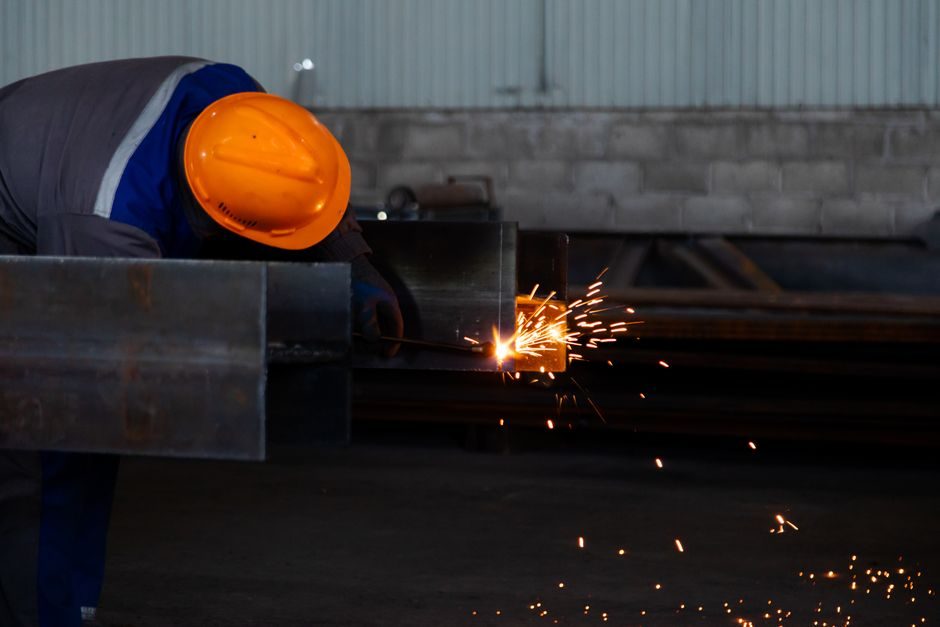
Electroslag pressure welding (ESW) is a high-productivity, single-pass fusion process where a DC current of roughly 600 A at 40-50 V passes through molten conductive slag at about 1900 °C to melt a continuously fed consumable electrode and the parent plate edges [S1]. The molten metal pool is contained by water-cooled copper retaining shoes on either side of the joint, and the electrode plus guide tube are pulled upward as the weld pool rises, producing a vertical or near-vertical seam in one continuous pass [S1].
The process is engineered for thick-section work: typical plate thickness runs from above 25 mm up to roughly 300 mm, which puts it in a different operating envelope than arc welder processes such as SMAW or TIG welder multi-pass routines that dominate thinner structural and stainless work [S1].
Process Parameters and Operating Envelope
ESW runs on DC at 40-50 V with welding current around 600 A, scaling upward for thicker plate; slag temperature sits near 1900 °C, well above the melting point of the consumable wire and the parent plate edges [S1]. The consumable guide tube and wire feed travel vertically upward at a controlled rate matched to the melt-off, while copper retaining shoes on each side of the joint contain the molten pool and slag bath so the cavity does not run off [S1].
Because the heat input is sustained rather than pulsed, ESW delivers a deposit rate reported up to 20 kg/h with flux consumption held low versus multi-pass submerged-arc routines, and the kWh-per-kg-of-deposited-metal figure is correspondingly favorable [S1]. For procurement work, the practical consequence is that ESW competes with electroslag pressure welder variants and stud-type setups on thick-plate jobs but not on thin gauge where arc-on-arc precision matters more.
Advantages: Where ESW Earns Its Slot
ESW requires no special joint preparation — square-edged plate can be welded without the beveling, gapping, or root opening that arc processes demand, and the entire seam is completed in a single pass, which trims labor and weld-pass inspection hours [S1]. Deposit rate reaches 20 kg/h, a figure that lets a single ESW station replace multiple multi-pass arc bays on heavy plate.
Flux consumption is low because the molten slag bath is reused as the heat source and shielding medium, and the per-kilogram electric-power demand is correspondingly below many comparable fusion processes [S1]. Uniform heating across the thick plate reduces the residual-stress gradients and distortion that plague multi-pass welds, which is why ESW is widely specified for thick low-carbon-steel plate and heavy structural sections [S1].
Limitations and Failure Modes
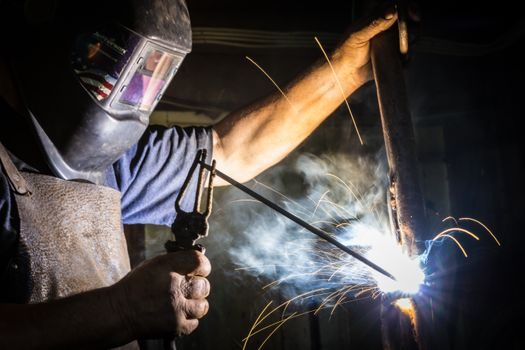
ESW is restricted to vertical or near-vertical orientation because the molten pool and slag must be held by gravity and copper shoes; out-of-position work is mechanically impractical with a standard ESW rig. Plate thickness is also bounded — below roughly 25 mm the slag bath cannot be reliably established and held, so thin-gauge fabrication stays on conventional arc welder processes [S1].
Coarse prior-austenite grain and a wide heat-affected zone (HAZ) are inherent to the slow cooling produced by the large slag mass, and on some quenched-and-tempered or alloyed grades this drives HAZ hardness above the bands that sour-service or low-temperature toughness regimes will accept. Welds are also limited to low-carbon steel and a narrow band of structural steel when standard ESW flux and parameter windows are used; stainless, high-alloy, and aluminum grades are not in the documented operating window for generic ESW [S1].
Decision Map: When ESW Fits vs When It Does Not
ESW fits: vertical or near-vertical seams on low-carbon steel plate 25-300 mm thick, where single-pass productivity, low joint-prep cost, and low residual distortion matter more than HAZ toughness — heavy ship-panel sections, large storage-tank shell courses, thick-wall pressure-vessel rings, and the vertical rebar splices covered by a separate rebar coupler installation: site prep, torque bands and ISO 15835 acceptance ecosystem where the welding counterpart is a stud welder-class head for smaller diameter bar. [S1]
ESW does NOT fit: thin gauge below ~25 mm, quenched-and-tempered steels where HAZ softening or hardness bands are a code concern, out-of-position joints, alloys outside the standard ESW window, and any code-of-construction path that requires a refined HAZ grain structure. For those, an arc welder bay (SMAW, GMAW, SAW multi-pass) or TIG welder root-pass + fill routine remains the reference choice.
Comparison: ESW vs Multi-Pass SAW on Thick Plate
On a 100 mm vertical low-carbon-steel seam, ESW finishes in one pass at up to 20 kg/h with no joint prep, while multi-pass SAW typically runs 6-10 passes with beveled edges, a higher flux-per-metre bill, and more cumulative distortion to grind out [S1]. HAZ width in ESW is wider and the grain structure coarser, so SAW retains the edge on toughness-critical code work; ESW retains the edge on productivity and per-metre cost when the steel grade allows the larger HAZ.
Standards, QA, and Trackable Signals
ESW procedure qualification is normally handled under the same AWS/ASME framework used for other fusion processes, with the additional note that for vertical rebar splices, the rebar coupler installation: site prep, torque bands and ISO 15835 acceptance performance bands and ISO 15835 acceptance criteria are the relevant comparator — ESW competes with mechanical couplers in that ecosystem. Vendor-side, parameter logging (V, A, travel rate, slag temperature near 1900 °C) and in-process NDT of the as-deposited seam are the only reliable checks, since the coarse HAZ masks small defects on standard RT film. [S1]
Trackable signals for the next planning window: any shift in code-acceptance for ESW on quenched-and-tempered plate above 50 mm, and any new low-heat-input ESW variant that compresses the HAZ width without dropping the single-pass productivity — both would widen the decision map above. Procurement teams should also re-tie pressure gauge and pressure calibrator records on hydrostatic test fixtures that the thick-plate ESW seam eventually feeds into, since that is where a coarse-grain weld would be first caught on a pressure-test failure.