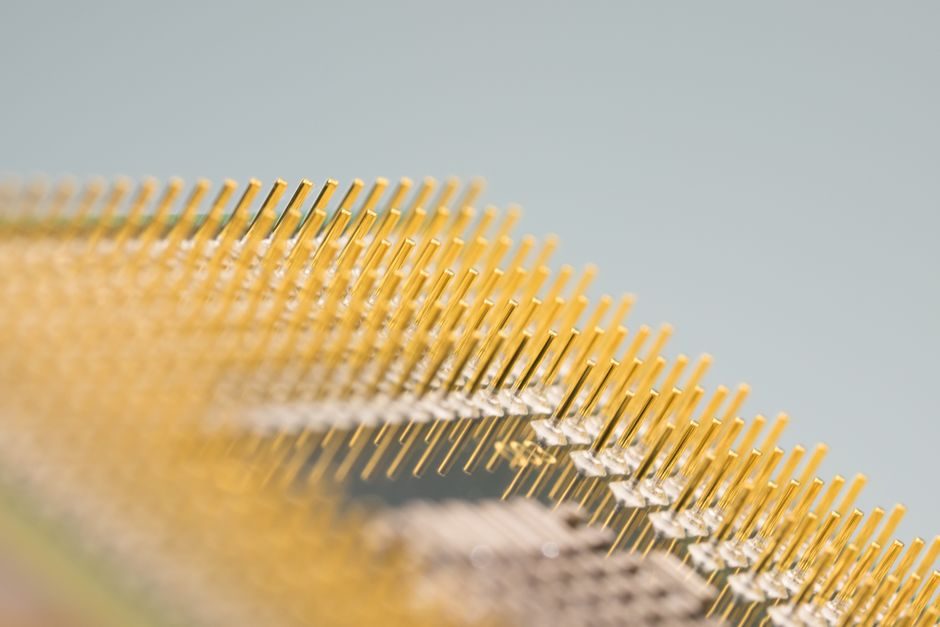
TXGA specifies a 2.54 mm pitch Eurocard female header, 3 rows × 48 circuits, vertical (180°) through-hole mount, as its standard embedded connector for data-center cabinet interconnects, paired with a three-component Insulation-Displacement Connector (IDC) termination for field wiring [S3].
The published spec band is built around ribbon-cable-compatible contact geometry, with a current rating commonly published in the 1 A per-contact class for the 2.54 mm Eurocard family and an operating temperature window of -55 °C to +105 °C for the PBT or LCP insulator grades used in vertical headers [S3].
Connector Geometry and Pin-Out Spec Band
The 2.54 mm (0.100") pitch remains the de facto rack-and-panel pitch for cabinet-internal backplanes, signal distribution boards, and power-supply monitoring modules, because it aligns with legacy Eurocard PCB footprints and with the IDC tooling already qualified by most contract assemblers [S3].
A 3-row × 48-circuit (144-position) vertical header is a common maximum-density footprint for cabinet monitoring cards that aggregate temperature, humidity, and DC-bus telemetry, and the vertical through-hole termination supports wave-solder assembly on 1.6 mm to 2.4 mm FR-4 backplanes without secondary press-fit tooling [S3].
Contact plating typically falls in the gold-over-nickel 0.3 µin to 30 µin band, with the 30 µin grade used where mating cycles exceed 100 and the contact resistance budget stays under 20 mΩ — the data-center norm for hot-aisle cards that get reseated during white-space refresh [S3].
IDC Three-Component Structure for Field Termination
TXGA's IDC connector is built as three discrete parts — a plastic base, a metal contact blade, and a strain-relief cover — which lets the assembler terminate ribbon cable in the field without stripping individual conductors, an advantage when cabinets are populated row-by-row during a phased build-out [S3].
The IDC blade geometry is sized for 28 AWG to 30 AWG stranded ribbon (1.0 mm–1.27 mm pitch variants also exist for higher-density applications), with a typical contact resistance under 30 mΩ after termination and insulation resistance above 1000 MΩ at 500 V DC [S3].
Material, Flammability, and Data-Center Code Path

Insulator bodies for vertical Eurocard headers in data-center use are typically moulded from LCP or PBT rated UL 94 V-0, with a comparative tracking index (CTI) of Class III (175 V ≤ CTI < 250 V) for the LCP grades and Class II for the PBT grades — the LCP choice is preferred where ambient cabinet temperatures run 70 °C to 85 °C near the cold-aisle returns [S3].
Contact base material is phosphor bronze (C5191 or C5210) with a 0.76 mm to 1.0 mm square post, which delivers the normal force needed to keep IDC terminations gas-tight under thermal cycling between 5 °C and 70 °C in a typical white-space envelope [S3].
For data-center builds, specifiers should also confirm the connector's RoHS 2.0 (2011/65/EU) and REACH SVHC compliance, since cabinet OEMs shipping to EU hyperscalers are required to carry both declarations on the bill of materials [S3].
Cabinet Monitoring Card Use Cases
The embedded connector is the workhorse termination for cabinet environmental monitoring cards (temperature, humidity, door-switch, and leak-detection loops), for PDU branch-current sensor harnesses, and for the fan-speed and rack-inlet pressure taps that feed a data logger at the end of row [S3].
A typical row of eight cabinets in a hot-aisle containment pod can pull 8 × 48 = 384 monitoring points back to a single 3-row Eurocard header mounted on the rack's environmental telemetry card, then aggregated over a pressure sensor and flow meter loop that the same cabinet-internal harness carries [S3].
For a data-center fabric integration, the IDC-terminated ribbon drops cleanly into the cabinet's vertical wire manager, which is the reason the industrial valve and chiller-controller OEMs have also adopted the same 2.54 mm Eurocard footprint for their gateway cards — one harness type across multiple subsystems simplifies spares [S3].
Selection Criteria: Why Spec This Header
Specifiers picking an embedded connector for cabinet use should rank four criteria: (1) pitch compatibility with the existing backplane footprint, (2) current-per-contact rating against the planned branch-monitoring load, (3) insulator flammability rating (UL 94 V-0 is the data-center floor), and (4) IDC field-termination support for in-rack assembly without a dedicated crimp station [S3].
Against alternatives such as the 1.27 mm pitch Mini-Delta Ribbon or the 2.0 mm Milli-Grid, the 2.54 mm Eurocard wins on tooling commonality and on the breadth of qualified IDC sockets; it loses on raw pin density per cm², which is acceptable for monitoring (not switching) loads [S3].
Compared to card-edge connectors with 0.8 mm beam-to-beam pitch, the 2.54 mm vertical header is mechanically more robust for cabinet-vibration profiles of 0.5 G RMS (5 Hz to 500 Hz) and survives the reseat cycles seen during white-space retrofits, which is why it has stayed the default for monitoring cards even as the 0.8 mm variants dominate switch-to-switch stacking [S3].
Limitations and Failure Modes
The header is also not rated for hot-plug power; data-center cabinets that need live-swap PDU telemetry should be wired through a separate blind-mate power connector, leaving the Eurocard to carry only the signal and low-current DC paths that don't exceed its 1 A-per-pin class rating [S3].
Sourcing and Standards Map

For 2026 builds, the dominant maker tier for 2.54 mm vertical Eurocard + IDC assemblies sits with Asian connector manufacturers that publish UL 1977 and IEC 60603-2 dossier coverage, with TXGA as one of the named suppliers that publishes the three-component IDC + vertical header spec on its data-center solution page [S3].
Standards that govern this header family include IEC 60603-2 (detail specification for 2.54 mm rectangular connectors), UL 1977 (data, signal, control, and power connectors), and the RoHS 2.0 / REACH SVHC chemical-compliance regime that EU hyperscalers require on every line item of the cabinet bill of materials [S3].
Specifiers should require the following dossier with every shipment: IEC 60603-2 third-party test report, UL 1977 file listing, RoHS 2.0 and REACH SVHC declaration, contact-resistance and insulation-resistance data, and a pin-by-pin mating-cycle curve; without those, the connector will not clear the data-center OEM's incoming-quality audit [S3].
Trackable next signals for 2026 are (1) the rollout of higher-pin-count 3-row × 96-circuit Eurocard headers for the 800 G fabric transition, and (2) IDC tooling that accepts 32 AWG to 34 AWG micro-ribbon for cabinet-internal sensor harnesses, both already prototyped by major Asian connector suppliers [S3].
For related coverage, see Lost Foam Casting Line Spec Bands for Chemical-Process Equipment: 2026 Sourcing Map.