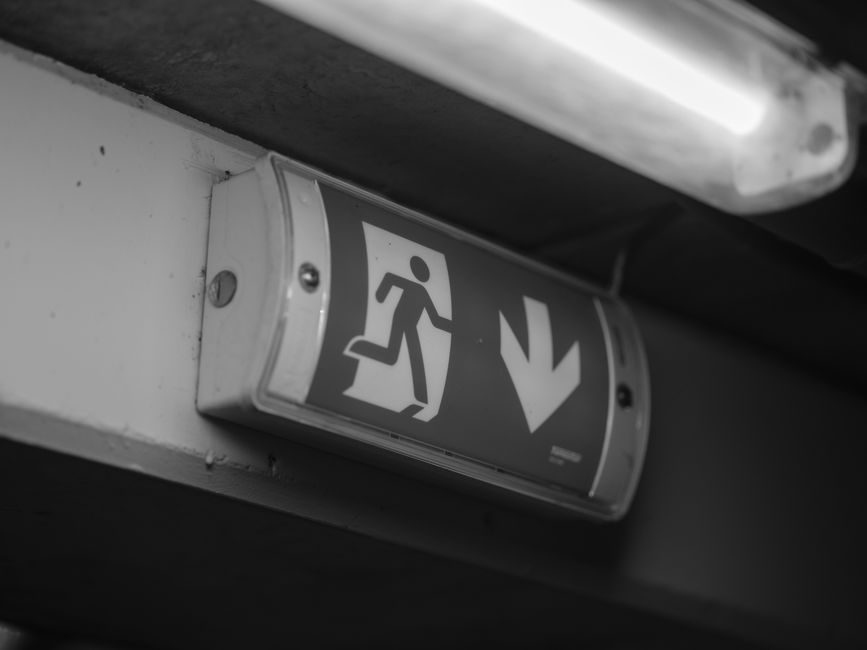
Commercial-grade emergency lights on the 2026 Chinese wholesale market cluster into two duty tiers: 3 W / 4 W / 6 W LED bulkhead lamps with NiCd or NiMH battery packs delivering 3 hours of maintained (M) or non-maintained (NM) operation at FOB $4.50-$12 per unit, and 9 W-15 W twin-head or ceiling-recessed luminaires with LiFePO4 packs rated for 1.5 h-3 h autonomy in the $18-$80 band [S1][S3][S4].
For an engineer specifying a 2026 facility rollout, the binding decision points are: autonomy minutes (90 vs 180), battery chemistry, ingress rating for the mounting location, and certification pack (CE/RoHS for general commercial, ATEX or IECEx for Zone 1/2). Pair the emergency light duty tier to the escape-route geometry and the local code, not to catalogue wattage.
Maintained vs Non-Maintained: How the Two Architectures Behave
A maintained (M) emergency luminaire operates the lamp continuously on AC mains and switches the same LED array to battery power on loss of supply; a non-maintained (NM) unit keeps the LED dark on mains and only energises it from the battery when the feed drops [S4]. Maintained gear is mandatory above illuminated exit signs and in buildings where the same fixture doubles as a normal-area light, while non-maintained units serve corridors, stairs and plant rooms where a permanently lit lamp is undesirable. A third "sustained" variant keeps two lamps inside one housing — one mains-fed, one battery-fed — and is common in cinema and theatre egress chains.
Typical 2026 mainland OEM spec sheets log the changeover at <1 s on AC loss, with built-in Ni-CD 3.6 V / 4.8 V packs sized for 3 h of full-flux discharge on the 4 W-6 W SKUs [S4]. Buyers should treat "3-hour" claims on bare $4.50 catalogue items as nominal — verify by reading the test report, not the marketing line. See the emergency light reference for the maintained/NM wiring conventions that govern self-test routines.
Autonomy, Battery Chemistry and Cycle Life in 2026
Code-driven emergency lighting falls into two autonomy bands: 90 minutes (the IEC 60598-2-22 default for escape-route illumination allowing safe evacuation plus a short re-occupancy pause) and 180 minutes (the band most European fire codes require for high-rise and healthcare premises, and the default most US jurisdictions adopt for standby). The chemistry decision is harder: NiCd remains the cheapest and most cold-tolerant option, NiMH lifts energy density by 30%-50% for a similar form factor, and LiFePO4 trades higher cell cost for 2,000+ cycles versus the 500-800 typical of NiCd at 25 °C [S2][S3].
For an ambient -10 °C cold-store or unheated warehouse, NiCd is still the conservative pick; for an indoor office tower on a 5-year maintenance cycle, LiFePO4 now wins on total cost of ownership because the reduced battery-replacement frequency offsets roughly $5-$8 per fitting of upfront premium. The supplier cluster around Guangzhou and Shenzhen stocks both chemistries in 3 W / 6 W / 9 W housings, with LiFePO4 versions commanding a 20%-35% FOB uplift over equivalent-flux NiCd SKUs [S1][S3].
Ingress, IK and the Wet-Room Decision
IP rating is the second hard spec. An IP20 emergency light is acceptable inside a finished corridor; IP44 covers most plant-room retrofits; IP65 is the floor for car parks, food-processing zones and external canopies where water jets or hose-down cleaning hit the body. EFFORT's 2026 export-grade product line lists IP65 die-cast aluminium housings with stainless-steel mounting clips for European industrial customers, paired with -10 °C to +55 °C ambient ratings [S5].
IK rating is often skipped in the Chinese catalogue data, but for transport hubs, schools and detention facilities, IK08 or IK10 (5 J-20 J impact) is increasingly written into tender documents. Buyers who skip the IK clause end up replacing lenses after one misuse cycle. If the luminaire sits within 2.5 m of floor level in a public area, an IK08 polycarbonate diffuser is cheap insurance. For hazardous-zone installations the discussion moves to ATEX and IECEx — see the explosion-proof light reference for the certification chain that governs Zone 1 / Zone 2 fitting selection.
ATEX/IECEx, Self-Test and the Compliance Stack
Any emergency luminaire installed in a Zone 1 or Zone 2 area — refineries, paint lines, grain silos, ATEX category 2 or 3 process — must carry Ex-e or Ex-d marking under ATEX 2014/34/EU and the matching IECEx scheme; bare CE/RoHS is not sufficient [S4][S5]. Mainland Chinese OEM lines rarely stock finished ATEX units at the $4.50-$12 tier; the certified SKUs are bespoke orders with 6-10 week lead times and a $200+ unit price.
Self-test (ST) or auto-test (AT) variants are now standard on the 9 W-15 W range. They run a 30 s functional check weekly and a full 3 h discharge quarterly, flagging battery degradation on a bi-colour LED. The EN 50172 / IEC 62034 standard family governs centralised test reporting; owners should specify whether they need a DALI-2 or wireless mesh reporting layer at tender, not after installation. Pairing emergency luminaires with a linear guide or a crossed-roller guide is unrelated to lighting, but it is the kind of cross-discipline spec that the same facilities engineer is often writing in the same week.
Sourcing Levers: MOQ, Incoterms and the FOB/CIF Spread
For a 1,000-fixture office-tower rollout, the gap between a $4.50 catalogue bulkhead and a fully certified, ENEC-stamped, IP65, 3 h autonomy LiFePO4 unit is roughly $25 per fitting — multiply by 1,000 and the spec choice is worth $25,000 before shipping.
Incoterms matter more than usual because the battery cells are Class 9 hazmat on ocean freight. A FOB Shenzhen quote typically excludes the dangerous-goods surcharge ($180-$320 per 20 ft container for lithium cells) that a CIF Hamburg quote will bundle. For buyers who also manage egress hardware, the same supplier base often quotes emergency stop buttons and emergency stop enclosures, so consolidating the RFQ cuts both unit price and the air-freight battery surcharge. Cross-referencing against a structured eye wash station buying guide helps frame the same compliance logic for adjacent safety gear.
Use Cases Matched to Spec Tier
For a 200 m² retail fit-out with ceiling heights under 3 m, a non-maintained 3 W / 4 W IP20 bulkhead at FOB $4.50-$7 with NiCd 3 h autonomy covers the escape route at 1 lux minimum on the floor. For a 5,000 m² logistics warehouse with 12 m racking, a 9 W-15 W IP65 twin-head unit at $18-$35 is needed to throw usable light across the racking aisle. For a 30-storey office tower, the spec must reach 180-minute autonomy, LiFePO4 chemistry for the 5-year maintenance window, DALI-2 self-test reporting, and ENEC certification — pushing unit price into the $45-$80 band per fitting [S1][S2][S5].
For Zone 1 chemical plants, the ATEX-certified twin-head Ex-d unit at $200+ each is the only legal option; the same applies for Zone 21 dust environments. The lesson: never let the specifier conflate "explosion-proof emergency light" pricing with commercial emergency-light pricing — the gap is 10×-20× and reflects certification cost, not feature creep.
Limitations, Failure Modes and What the 2026 Datasheets Still Skip
The two failure modes that consistently kill emergency-light installations are battery thermal runaway (NiCd cells venting when the charge voltage drifts above the float specification) and LED-driver brown-out on dirty mains (causing the unit to detect a "mains fail" and discharge into a depleted pack). The 2026 spec sheets from Chinese OEM lines routinely omit both the float-voltage tolerance band and the driver brown-out threshold — buyers should request both numbers in writing before PO. [S1]