
The energy storage system (ESS) value chain runs from cathode active material and cell chemistry at one end to ISO 5167-grade metering and IEC 60079-zone siting at the other, and the 2026 reference set spans every link. The U.S. Energy Storage Coalition reports more than $100 billion committed to U.S. battery and energy storage equipment manufacturing, tied to roughly 350,000 jobs, signalling that the downstream grid-services side is now pulling upstream capacity build-out [S3].
A single 40-foot Honeywell BESS container houses 500 to 4900 kWh of usable LFP energy at 500-2100 kW rated power, with a DC round-trip efficiency of 98% on a 4-hour rating and 100% depth of discharge [S1]. That one enclosure is the unit of commerce that the upstream chemistry industry, the midstream inverter/BMS suppliers, and the downstream utility/ipp customers all converge on, and the chain below is organised the way a process engineer would walk it on a spec review.
Upstream: Cathode Chemistry, Cell Format and Critical Minerals
The starting gun for the storage value chain is the cathode active material, where cobalt-free and lithium-rich chemistries are the 2026 hot zones. A 2022 paper in Energy Storage Materials demonstrated an Li2Ni0.5Mn1.5O4 spinel that, in a Li-rich Li2Ni0.5Mn1.5O4 form, reached 367 Wh kg−1 stack energy density and 88% capacity retention over 50 cycles in an anode-free pouch cell at an E/C ratio of 2 g Ah−1 [S2]. The relevance for stationary storage is the elimination of inactive anode material and the avoidance of metallic-Li foil handling, both of which lower cell BOM cost for grid-scale packs [S2].
On the commercial product side, the cathode decision has narrowed: Honeywell's containerised BESS uses lithium iron phosphate (LFP) cells only, not NMC, and the spec sheet ties the cell choice to UL 1973 component recognition and IEC 62619 cell-level testing [S1]. For process engineers weighing future-proofing, the upstream trade is straightforward: LFP for safety and cycle life on stationary duty, high-voltage cobalt-free spinels (LNMO-class) when the OEM wants to push cell-level energy density beyond LFP's roughly 160 Wh kg−1 cell-class limit [S2].
Cell-to-Pack: BMS, EMS and the Communications Layer
Inside the container, every cell sits under a three-level battery management system covering cell, module, and rack, and the energy management system is bundled rather than supplied as a third-party option [S1]. That BMS hierarchy is not decorative; it is the boundary that the FM Global DS 5-33 loss-prevention data sheet writes its spacing and gas-detection rules against, and it is what UL 9540A fire-propagation testing audits during type approval [S1][S6].
The downstream-facing communications layer is intentionally multi-protocol: Modbus RTU and Modbus TCP for the SCADA/DCS handshake, with DNP3 for utilities that run serial or IP-based substation protocols [S1]. Practically, this means the same cabinet can be dropped behind a meter in a commercial & industrial microgrid or aggregated into a 100 MW+ IPP plant without swapping the gateway card. The Myers EnerShed enclosure spec confirms the same baseline, with 480 Vac three-phase grid connection, less than 5% THD at rated power, and 0.8 leading to 0.8 lagging displacement power factor [S10].
Midstream: Enclosures, HVAC, Fire Suppression and UL 9540A
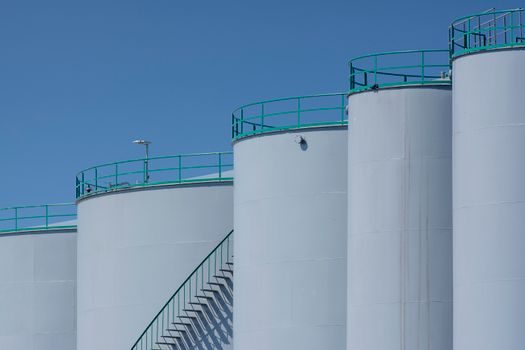
The container itself is the midstream product most engineers touch. Honeywell's 40-foot unit is rated IP54 as standard with IP65 as an option, forced-air HVAC with liquid cooling optional, and ships with aerosol-based fire suppression, water-ingress detection, and optional battery off-gas monitoring [S1]. Ambient operating range is −30 °C to +50 °C, weight 72,000 lb (32,660 kg), and altitude limit 3000 m, with a derating requirement above that line [S1].
FM Global DS 5-33 adds the loss-prevention overlay: the data sheet sizes spacing between cabinets, dictates gas-detection for off-gas events, and scopes the fire-suppression interface that UL 9540A testing validates at the cell, module, unit, and installation levels [S6][S7]. For a VAr-support application, FM explicitly notes that energy storage system size is given in reactive power (MVAr) rather than MW, because real-power throughput is not the limiting parameter for voltage support [S6]. PSCo's Xcel Energy minimum-tech spec layers in the mechanical side: sprinkler piping downstream of the isolation gate valve in ASTM A53 Grade A/B or A106 Grade B, Schedule 40 minimum, with no copper or brass tubing on the pre-action branch [S9]. Engineers who skip these two documents routinely end up with a container that passes UL 9540A but fails the AHJ inspection.
Downstream Services: C&I, IPP and Utility Use Cases
The downstream side is where revenue is monetised, and the use-case list is now standardised across vendors. Honeywell groups the C&I stack as peak shaving, load shifting, demand-charge reduction, time-of-use management, energy arbitrage, maximising renewables, back-up power, black-start, islanding/anti-islanding, power quality and power smoothing, plus ancillary services [S1]. The IPP stack is congestion relief, frequency support, voltage support, and spinning/non-spinning reserves, while utilities add transmission deferral, distribution deferral, and resource adequacy on top [S1].
Quantification of the downstream market is harder, but the PJM reliability signal in the U.S. Energy Storage Coalition data set is concrete: PJM needs to deploy 16 GW of energy storage to maintain grid reliability through 2032 [S3]. That single number is enough to size the upstream cell, pack, and enclosure order book for the next six years, and it is the number to anchor any capex model on. The LADWP standalone-ESS specification template adds the procurement-side datapoints engineers should expect in a 2026 tender: charge time in hours, typical recharge time including any rest period, expected availability as a percentage, and expected warranty term in years [S5].
Comparison of Main Storage Options on Engineering Criteria

The 2026 reference set lets a process engineer line the four dominant options up against the four criteria that matter in stationary duty: usable energy per container, round-trip efficiency on a 4-hour rating, operating temperature window, and standards compliance envelope. Honeywell's LFP container BESS delivers 500 to 4900 kWh at 98% DC round-trip efficiency with a −30 °C to +50 °C window and full UL 9540/9540A plus IEC 62619 compliance [S1]. Myers EnerShed, a smaller-footprint C&I unit, sits at 480 Vac three-phase with less than 5% THD, the same 95% maximum relative humidity ceiling, and forced-air cooling across the same −30 °C to +60 °C operating range [S10].
Atlas Copco's mobile Energy Storage System is the trailerised cousin aimed at construction and event loads, with multiple units synchronisable to act as a microgrid core for EV recharging stations and noise-sensitive sites [S8]. High-voltage cobalt-free spinel (LNMO-class) cells are not yet a commercial stationary product but represent the upstream chemistry frontier, with 367 Wh kg−1 stack energy density demonstrated at the pouch cell level [S2]. The selection call reduces to duty profile: LFP container for utility/ IPP scale and C&I peaks, mobile trailer for construction and event microgrids, and LNMO-class cells as the 2027+ watch item when commercial cells reach the market.
Standards, Sourcing and Siting Constraints
Standards compliance is where most 2026 tenders trip up. The current and expected code set on a containerised BESS is UL 9540 and UL 9540A for system-level and fire-propagation testing, UL 1973 for cell-level recognition, UL 1741 for inverter-grid interconnection, IEC 62619 for secondary lithium cell safety, and IFC 2018 for the fire code overlay [S1]. Loss-prevention comes from FM Global DS 5-33, with spacing, gas detection, and suppression rules that vary by chemistry and enclosure footprint [S6][S7].
On the Chinese side, CNESA had published 17 association standards as of the 2024 White Paper, including T/CNESA 1001-2019 for DC power connectors, T/CNESA 1002-2019 for BMS, and T/CNESA 1003-2020 for battery cables, giving Chinese-procured packs a documented baseline that overseas buyers can reference [S4]. The CNESA stack matters even for non-Chinese procurement because the cost-defining components (cables, BMS boards, DC connectors) increasingly ship from that supply base. For asrs-style automated warehousing of cells and packs in a gigafactory, the upstream cell-storage and storage rack layouts inherit the same fire-spacing logic as a container yard, which is why loss-prevention engineers read both FM DS 5-33 and the storage cage data sheets in the same review cycle.
Limits, Failure Modes and Open Questions
The documented failure modes in the spec set cluster around four nodes: capacity fade in lithium-metal or anode-free cells (88% retention at 50 cycles for the Li-rich LNMO pouch is a research number, not a field number), thermal-runaway propagation between modules, altitude derating above 3000 m, and THD/ power-factor drift at part load [S2][S1][S10]. Each maps to a concrete mitigation: cell-level testing to IEC 62619, UL 9540A unit-level fire propagation testing, altitude-derate curves in the EMS, and grid-code compliance verification through UL 1741 [S1].
Open questions for 2026 are technical, not financial. The 4-hour DC round-trip efficiency of 98% is an inverter-and-BoL number, and the end-of-life efficiency gap is not yet on the datasheet [S1]. The 16 GW PJM 2032 requirement assumes a permitting and interconnection cadence that the data set does not validate, so procurement teams should treat it as an order-book ceiling rather than a contracted pipeline [S3]. Finally, the LNMO-class cell stack energy density of 367 Wh kg−1 is a single-research-team result on a pouch cell with an E/C ratio of 2 g Ah−1, and scaling that to a 4900 kWh container will need answers on electrolyte volume, cell format, and SEI durability that the 2026 reference set does not yet supply [S2].
Track the next data point when FM Global publishes a DS 5-33 revision with explicit module-level gas-detection spacing for LFP at C5 corrosion sites, and when CNESA's next White Paper edition lists standards beyond the current 17, particularly any new specification for second-life or stationary repurposed cells [S6][S4]. On the grid side, the signal to watch is whether the 16 GW PJM 2032 number is joined by an equivalent ISO-NE or CAISO figure in 2026 utility filings [S3].
Related analysis: AMR advantages and disadvantages: a 2026 spec engineer's working reference.