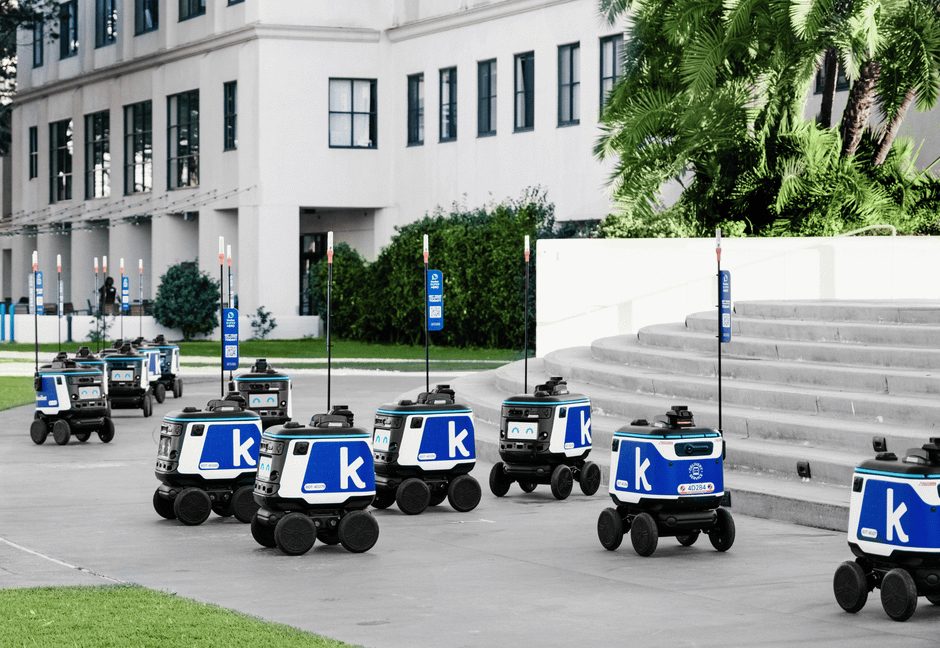
An Autonomous Mobile Robot (AMR) is a self-navigating wheeled platform that localises with LiDAR/SLAM and onboard sensors, plans its own path, and handles materials between points without fixed guides or magnetic tape [S1][S3].
Procurement teams comparing mobile automation options typically weigh three axes: payload class (commonly 50-1500 kg), navigation type (map-based SLAM vs. tape/QR vs. hybrid), and total cost of ownership over a 5-year payback window [S1][S4].
Reliability and uptime: where the ROI case is built
AMRs do not fatigue, do not require shift premiums, and execute pick-and-transport cycles with sub-second repeatability when SLAM is properly tuned [S1]. Autonomous mobile robots can work consistently around the clock, allowing a 24/7 cell to reduce dependence on shift workers without the productivity drop that human fatigue causes [S1].
Navigation accuracy on a well-mapped site sits in the ±10-20 mm range for LiDAR-SLAM stacks, which is tight enough for racking interfaces and conveyor hand-offs but loose for direct machine tending without a fixtured pickup [S3][S6]. For context on the broader mobile-automation class, the mobile crane reference covers human-operated heavy lift — AMRs sit at the opposite end of that autonomy-versus-payload spectrum.
Safety gains and the 25 kg manual-lift threshold
AMRs move loads that exceed the 25 kg recommended male manual-carry limit without ergonomic risk to staff, and they substitute for human presence in unmanned or hazardous zones such as nuclear-handling cells and chemical stores [S1]. The US National Safety Council statistic cited by integrators — one workplace injury every 7 seconds — frames the indirect-cost argument that pushes AMR CapEx past finance committees [S1].
Sensor payloads typically combine a 2D/3D LiDAR, depth cameras, and safety-rated E-stops compliant with ISO 3691-4, the standard that governs driverless industrial truck safety [S4]. A related robotic class with overlapping safety logic is the collaborative robot, which shares the same rated-stop / power-and-force-limiting vocabulary but operates in a fixed cell rather than a free-roaming envelope.
Cost model: CapEx pain, OpEx gain

Entry-tier AMRs (≈50-100 kg payload) start at roughly USD 20,000-40,000 per unit before fleet software, while 1000+ kg heavy-payload units commonly exceed USD 100,000 per unit [S1][S4].
Total cost of ownership over a 7-year service life is dominated by three line items: the robot hardware (≈40-50%), fleet-management software and integration (≈20-30%), and service/battery replacement (≈10-15%) [S4]. Battery chemistry is overwhelmingly Li-ion at 24-48 V nominal, with opportunity charging at ~10-20% SOC windows during idle windows.
Flexibility ceiling: where AMRs still lose to fixed automation
AMRs excel on dynamic routes but struggle on three failure modes: tape/QR-guided variants cannot deviate from the installed track, and even SLAM units lose localisation in long, featureless corridors or under heavy forklift traffic [S1]. An AMR that needs to reverse or pivot in a 1.2 m aisle is a design constraint buyers miss until layout is locked, which is why DF Automation flags narrow-aisle retrofits as a common scope-change [S1].
For comparison, fixed-pick SCARA robots win on sub-second cycle time at one workstation, while articulated robots win on multi-axis reach — AMRs trade speed for the ability to move the entire workpiece between cells, not manipulate it within one. A broader AMR classification view is laid out in the working reference on AMR types and classifications.
Decision matrix: AMR vs AGV vs human-driven transport

Three options, four criteria — the comparison integrators actually use: (1) Infrastructure cost: AGVs need tape/QR + commissioning = high, AMRs need a map scan = low-medium, human-driven forklifts need only aisles = lowest. (2) Route flexibility: AGV = low (track-bound), AMR = high (map-rebuildable in minutes), human = highest. (3) Payload: AGV up to ~5000 kg, AMR typically 50-1500 kg, human-driven up to ~25000 kg. (4) Labour dependency: AGV low, AMR low, human-driven high and shift-bound [S1][S2][S4].
The clear pattern: AMRs win on flexibility × labour-displacement, lose on absolute payload and greenfield infrastructure cost. The crossover point versus an AGV robot fleet typically lands around 30-50 paths or 3+ layout changes per year, which is when the map-based stack pays back over a tape-based stack.
Real deployments and what they reveal
ShinMaywa Industries runs an AMR-based last-mile delivery R&D programme, citing rapid e-commerce-driven logistics expansion as the trigger for moving autonomy from warehouse corridors onto public-road pilots [S2]. KUKA's iiQKA.OS fleet-management stack standardises AMR bring-up, multi-robot coordination, and WMS/WCS integration for production-logistics cells [S4].
Baumüller Systems sells AMR lifecycle services from concept through after-sales, a model that has become the norm: a 2026 AMR purchase is rarely a hardware buy — it is a 5-7 year integration contract that the OEM fleet software must support [S1]. For warehouse-adjacent buyers also evaluating racking, the pallet rack pros and cons reference speaks to the static half of the same material-flow equation.
Who should buy now, and who should wait

AMRs are FOR: 24/7 light-/medium-manufacturing lines, e-commerce fulfilment, hospital pharmacy transport, and any site with 3+ layout changes per year [S1][S2][S4]. AMRs are NOT for: outdoor heavy haul above ~1500 kg, sites under 500 m² floor area where the fleet-software overhead is uneconomic, or operations where the route is so stable that a fixed conveyor outperforms on cost-per-metre [S1][S4].
Track these signals before specifying: integrator SLAM benchmark numbers for your actual aisle width and floor reflectivity (request the 95th-percentile localisation error, not the mean), the ISO 3691-4 conformance certificate, and a written battery-cycle warranty — most fleets run 1500-3000 full cycles before a pack swap, which is the hidden line item that swings 7-year TCO.