EPDM is a terpolymer of ethylene, propylene and a non-conjugated diene (most commonly ENB, with DCPD and 1,4-HD as alternatives), and the diene residue is what lets the chain be crosslinked — the saturated backbone is what gives EPDM its signature ozone, UV and water resistance, and that backbone chemistry is the single biggest gate in any selection [S1].
For 2026 specification work, EPDM is the right answer in roughly three families of service: outdoor weather-exposed seals, hot water and steam gaskets below ~300°F, and polar-chemical service (alkali, acids at low concentration, ketones, phosphate esters). It is the wrong answer whenever the fluid is petroleum, when continuous service climbs above the cure-system ceiling, or when the application demands high tear strength unreinforced.
Cure System Sets the Temperature Ceiling
General-purpose sulfur-cured EPDM compounds operate from -40°F to 220°F, while peroxide-cured EPDM extends that envelope to -50°F to 290°F, and the ~70°F uplift at the top end is the single most important selection lever on a data sheet [S1].
Sulfur systems are cheaper, faster to process, and dominate general-purpose sheet and extrusion; peroxide cures sacrifice some elongation-at-break for better heat aging, lower compression set, and the ability to carry higher filler loads without reversion. For under-bonnet automotive, hot-water heating, and solar-collector loop service, the peroxide cure is the default; for roofing membrane, weatherstrip, and most door/window gaskets, sulfur cure is still specified. A 2025-08 industry reference frames the two as different products, not interchangeable options on one part [S1].
Hardness, Tensile and Filler Load Are a Triplet
EPDM sheet is commonly produced from 40 to 90 Shore A, with 60-70 Shore A as the workhorse band for gaskets and 70-80 Shore A for higher-pressure flange service [S1].
Hardness is a downstream output of the formulation: tensile strength, elongation, and compression set all move with it, and the specifier should look at all three rather than hardness alone. A 70 Shore A peroxide-cured EPDM gasket compound typically lands in the 1,500-2,500 psi tensile / 200-400% elongation band, while a 50 Shore A weatherstrip grade trades tensile for elongation above 500%. Filler choice — carbon black for static service, mineral fillers (clay, calcium carbonate, talc) for lighter-colored FDA- and potable-water grades — is the second-order lever. The EPDM reference [S1] lists weather, sunlight, water and ozone resistance as headline properties, but those are backbone properties, not filler properties; a poorly chosen plasticizer or process oil can erode them regardless of cure system.
Media Compatibility: Where EPDM Wins and Where It Fails
EPDM resists water, steam, alkali, dilute acids, phosphate esters (Skydrol, HFD fluids), ketones, alcohols, and glycol-based coolants, and is attacked by petroleum oil, gasoline, diesel, and aromatic hydrocarbons — that polarity split is non-negotiable [S1].
On a process line, that means EPDM is the default for boiler make-up water, RO and potable water, HVAC chilled/hot water, brake systems (DOT 3/5.1 glycol), and chemical dosing lines carrying sodium or potassium hydroxide below ~30% concentration. It is the wrong elastomer for anything downstream of a petroleum pump, for any hydrocarbon solvent service, and for any application where the fluid is a mineral-oil-based lubricant. When the spec drifts toward hydrocarbon service, nitrile rubber (NBR) or FKM is the correct swap, not a re-spec of the EPDM grade. For high-temperature dry-heat above EPDM's ceiling, silicone rubber takes over, and the boundary is set by continuous service temperature, not peak excursion.
Form Factor Gates: Sheet, Extrusion, Washer Plug, Granule
EPDM ships in four commercially distinct forms, and the form factor is set by the part, not by the polymer: EPDM sheet (roll goods, 40-90 Shore A), extruded profile (door/window seals, hose, weatherstrip), molded washer plugs and caps (M3-M20 metric thread masking [S5]), and EPDM rubber granule for sport-surface and artificial-turf binder systems [S6].
Specifiers buying sheet rubber for flange gaskets should look at width/thickness tolerance, roll length, and ASTM D2000 line-callout (e.g. M4BA610 A14 B13 Z1) rather than generic "EPDM sheet". Extrusion buyers — door seals, window gaskets, automotive weatherstrip — typically work off profile drawings and a durometer window; one Istanbul-based manufacturer [S2] and a Chinese supplier [S3] both show 60-70 Shore A extrusions with steel-wire or carrier-free cores for compression-set recovery. Molding buyers (washer plugs, boots, mask caps) need a finished-part drawing with thread or hole size; MOCAP's EPDM washer plug line, for example, lists an M3 plug with 0.156 in / 4.0 mm stem diameter and 0.094 in / 2.4 mm flange [S5]. Granule and turf buyers work to mesh size and color fastness, with one Jiangsu manufacturer offering EPDM granule, PU adhesive, and turf machinery as a bundled supply package [S6].
Processing and Vulcanization Equipment
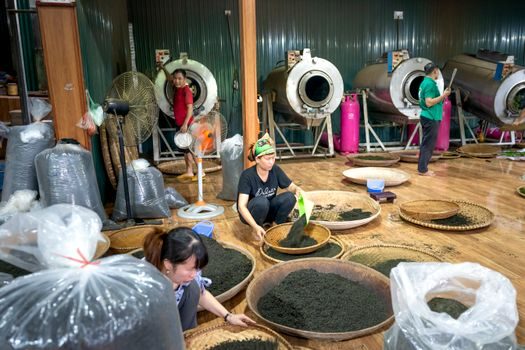
Continuous EPDM extrusion-cure lines — microwave + hot-air tunnel, LCM (liquid curing medium) salt bath, or autoclave batch — are the capital equipment behind the parts above, and a 2026 listing for an EPDM extrusion curing machine / vulcanization tunnel sits in the US$136,000-150,000 FOB band at 1-piece MOQ with CE and ISO certification [S4].
For a process engineer sizing a new line, the relevant variables are line speed (typically 5-30 m/min for profile), cross-section size, and whether the cure medium is salt bath (faster, higher capital, environmental permitting) or hot-air tunnel (slower, lower capital, cleaner). The two-year warranty and Diamond Member since 2008 audit status on that listing [S4] are typical vendor-side signals, not technical gates. For a one-off or low-volume profile, custom-compound extruders with 500-1,000 kg MOQ are usually cheaper than a captive line.
ASTM D2000, REACH, and Food/Potable-Water Compliance
For gaskets and molded parts, the standard line-callout is ASTM D2000 "M4BA610 A14 B13 Z…" where the suffix Z defines callout properties specific to the buyer; without a Z, the part is generic and untraceable [S1].
Potable-water and food-contact grades add separate compliance work: NSF/ANSI 61 for drinking water in the US, WRAS or KTW in Europe, and FDA 21 CFR 177.2600 for aqueous-food contact. Automotive weatherstrip typically references GM, Ford, or Stellantis material standards, each with its own heat-aging and ozone-exposure profile. REACH and RoHS compliance on the polymer and on the plasticizer package is increasingly a hard requirement for EU-bound extrusion; SVHC declarations should be requested as part of the PPAP or first-article package, not retrofitted after a non-conformance. A selection review against the industrial rubber baseline — and a parallel read of EPDM rubber — is the cleanest way to avoid mixing up the polymer family, the cure system, and the form factor on a single data sheet.
Limits, Failure Modes and Sourcing Signals

EPDM fails in three predictable ways: cold embrittlement below its lower limit, reversion or hardening above the upper limit (worse in sulfur cures), and volume swell / softening in petroleum service; the cure system is what governs the upper limit, and the fluid is what governs the chemical attack [S1].
For 2026 sourcing, three signals are worth tracking. One: peroxide-cured EPDM is tightening on lead time because automotive heat-resistant hose and battery-cooling loop demand is absorbing capacity that previously served general extrusion. Two: a price/cost guide for silicone rubber price & cost guide 2026 and a parallel read on nitrile rubber (NBR) 2026 buying guide both show that MOQ-driven price breaks start around 500-1,000 kg for extrusion grade and 100-200 kg for sheet. Three: when EPDM is being considered against a fluorocarbon or UHMWPE alternative for sealing and wear, the FKM vs UHMWPE spec cut framing is the right analog for the boundary, even though EPDM is not the head-to-head subject.
Next step: lock the temperature, fluid, and durometer envelope first, then pick the cure system (sulfur for cost, peroxide for heat), then write the ASTM D2000 line-callout with the Z-suffix properties, and only then run vendor sampling against NSF/WRAS/FDA paperwork where the service demands it. The order is what keeps a 2026 EPDM spec from drifting into a different polymer mid-PO.