
Epoxy resin's industrial chain is anchored by two upstream monomers — bisphenol-A (BPA) and epichlorohydrin (ECH) — that flow into four downstream families: brominated flame-retardant resin for FR-4 PCB laminates, epoxy-polyester powder coatings, water-soluble epoxy emulsions, and epoxy-polyurethane electrophoretic paints, as catalogued in ChemicalBook entries CB51092339, CB72128020, CB32083561 and CB82126548 [S1][S2][S4][S6].
Each downstream branch carries a distinct spec envelope: brominated grades must meet UL 94 V-0 with bromine loadings typically in the 18–21% range for FR-4 laminates; powder coatings target 60–80 µm film build with sub-2% VOC; water-based emulsions hold 40–55% solids for low-VOC concrete primers; and electrophoretic paints operate at 180–250 V DC for cathodic E-coat on automotive bodies [S1][S2][S4][S6]. For the broader supply-chain read, see the epoxy resin supply chain 2026 feedstock and chlorine map.
Upstream Feedstock Chain: BPA, ECH and Bromine Intermediates
The upstream stage is dominated by BPA and ECH, with brominated epoxy resin (CB51092339) representing the dedicated flame-retardant branch where tetrabromobisphenol-A (TBBPA) replaces part of the BPA feed to push bromine content into the 18–21% window required by UL 94 V-0 PCB laminate standards [S1]. ECH purity above 99% is the typical spec gate, because residual 1,3-dichloro-2-propanol and 1-chloro-2,3-epoxypropane impurities hydrolyse during resin synthesis and depress epoxide equivalent weight precision [S1].
Process engineers running BPA-ECH condensation reactors at 70–90 °C with NaOH catalyst must hold the molar ratio of ECH to BPA at 2.2–2.6 to land an epoxy equivalent of 185–195 g/eq, the standard band for general-purpose liquid resin used in downstream coatings and casting [S1]. Off-ratio batches either over-condense to high-viscosity solids or leave excess ECH that must be stripped, both of which propagate into the downstream branches covered in the synthetic resin encyclopedia entry.
Downstream Branch 1: Brominated Epoxy Resin for FR-4 PCB Laminates
Brominated epoxy resin (CB51092339) is the workhorse flame-retardant binder for FR-4 copper-clad laminates, where glass-transition temperature (Tg) sits in the 130–150 °C range for standard FR-4 and 160–180 °C for mid-Tg lead-free grades [S1]. The brominated chain is typically cured with dicyandiamide (DICY) plus 2-methylimidazole accelerator, and the resin is then B-staged onto E-glass fabric at 150–170 °C before lamination at 170–200 °C under 30–50 kg/cm² platen pressure [S1].
For multilayer PCB stack-ups, the resin must deliver copper peel strength above 1.4 N/mm after thermal stress at 288 °C for 10 s (the lead-free float test), and dielectric constant (Dk) at 1 MHz is commonly held between 4.2 and 4.6 to keep impedance within ±10% on controlled-impedance boards [S1]. Restricting brominated resin loading to under 25% of the total binder avoids over-bromination that releases HBr and causes via barrel delamination — a classic failure mode during lead-free reflow at 260 °C peak [S1].
Downstream Branch 2: Epoxy-Polyester Powder Coatings and Resin-Sand Systems

Epoxy-polyester hybrid powder coatings (CB82126548) blend 50–70% epoxy resin with 30–50% polyester at acid values 30–55 mg KOH/g, curing at 180–200 °C for 10–15 min to land a 60–80 µm film with 60° gloss between 80 and 95 GU [S6]. The hybrid balances epoxy's chemical resistance against polyester's UV durability, making it the default spec for indoor appliance housings, switchgear cabinets and architectural aluminium extrusions [S6].
In foundry and resin-sand line applications, the same resin family feeds furan/epoxy binder systems at 1.5–2.5% resin on sand weight, with tensile strength of the cured core typically tested at 1.4–2.0 MPa after a 24 h room-temperature cure [S5]. The resin sand line encyclopedia page covers the sand-to-resin ratio and catalyst dosing in more detail for steel and iron casting foundries. For higher-temperature cures above 250 °C, straight epoxy is preferred over hybrid to keep yellowing delta-E below 2.0 after 500 h QUV exposure [S6].
Downstream Branch 3: Water-Soluble Epoxy Emulsions and Electrophoretic Paints
Water-soluble epoxy resin emulsion (CB32083561) typically runs 40–55% solids with particle size 0.1–1.0 µm and pH 7–9, formulated with non-ionic or anionic surfactants to keep viscosity under 500 mPa·s for spray and dip applications [S4]. The emulsion is the backbone of low-VOC concrete primers, where it penetrates capillary pores and bonds to alkaline substrates, plus acts as the film-former in two-component waterborne floor coatings at 80–120 µm wet film [S4][S5].
Epoxy-polyurethane electrophoretic paint (CB72128020) is the cathodic E-coat system for automotive bodies and white-goods steel, deposited at 180–250 V DC for 2–3 min to land 18–25 µm dry film, then crosslinked at 160–180 °C for 20–30 min [S2]. The dual epoxy-polyurethane backbone gives the coating throw power of 22–28 cm in a Honda-type cell and salt-spray resistance beyond 1000 h at 35 °C, 5% NaCl — the standard auto-OEM acceptance line [S2]. The flow meter encyclopedia page sits in this same process-control environment for paint circulation loops and UF rinse tanks.
Construction and Building-Material Application Map

Epoxy resin modified concrete and mortar (CB32083561 plus S5) is dosed at 5–20% resin on cement weight to lift compressive strength by 15–30% and flexural strength by 20–40% versus plain OPC, with the largest gains when epoxy is pre-emulsified in water before sand-cement mixing [S5]. Rebar coating lines use solvent-borne epoxy at 200–300 µm DFT to pass 1000 h salt-spray per ASTM B117 and chloride diffusion coefficients below 1×10⁻¹² m²/s, the spec most bridge authorities now call out [S5].
For flooring and secondary containment, 100% solids epoxy is trowel-applied at 2–4 mm and must pass ASTM C722 chemical resistance against 10% NaOH, 10% H₂SO₄ and Skydrol LD-4 hydraulic fluid, the latter being the standard aviation hangar acceptance test [S5]. The same resin chemistry shows up in the electronics housing die-casting workflow where the cast metal box is later back-filled with epoxy potting — see the die casting machine spec map for the tonnage-alloy envelope that brackets those parts.
Craft and Small-Batch Casting End Use
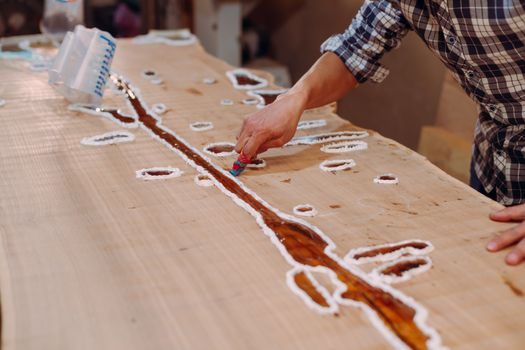
Outside heavy industry, transparent deep-cast epoxy (typical 1.0–1.2 g/cm³ mixed density, 30–50 mm pour depth) is the binder behind the walnut-and-LED night lamp build documented in Instructables Step 1, where American walnut pieces sized 20×20×120 mm and 20×20×200 mm are potted in a plastic-sheet mould over a fairy-string LED [S3]. The project uses 400, 800, 1000 and 1500-grit sandpaper progression plus buffing pad and automotive polishing paste to bring the cured block to optical clarity, illustrating how the same resin chemistry shifts from FR-4 laminates to artisan castings without changing the underlying BPA-ECH backbone [S3].
Practical process notes from that build: a slow-cure hardener (typically 30–45 min pot life, 24 h full cure) is mandatory for pours over 20 mm to avoid exotherm cracking, and micro-USB wiring is potted in last to keep solder joints away from the deepest resin pool where peak exotherm exceeds 90 °C [S3]. Process engineers adapting the same chemistry to instrument potting should pay attention to pressure transmitter potting practice for the gel-time and CTE constraints that the LED build does not formally document.
Decision Blueprint: Matching Resin Branch to End-Use Spec
Selection by end-use can be reduced to four criteria — flame retardancy, UV durability, VOC class, and substrate wettability — and the four downstream branches line up as follows: brominated epoxy (CB51092339) wins on flame retardancy for PCB laminates; epoxy-polyester hybrid (CB82126548) wins on UV durability for indoor architectural coatings; water-based emulsion (CB32083561) wins on VOC for green-building concrete primers and floor coatings; and epoxy-polyurethane E-coat (CB72128020) wins on throw power and corrosion resistance for automotive cathodic deposition [S1][S2][S4][S6].
For applications needing both chemical resistance and flexibility, the hybrid branches (epoxy-polyester and epoxy-polyurethane) outperform straight epoxy on impact resistance and outdoor yellowing, but they trade away peak Tg and dielectric strength — so PCB and electrical-potting use cases still go to straight or brominated epoxy [S1][S6]. Engineers specifying powder coating for outdoor aluminium should target a polyester:epoxy ratio of 70:30 with TGIC or HAA hardener, while indoor appliance coatings can move to 50:50 for higher chemical resistance at the cost of 1–2 years of UV life [S6].
Known Failure Modes and Process Constraints
Common field failure modes track back to upstream and process discipline, not the resin chemistry itself: (1) amine blush on epoxy floor coatings when cure temperature drops below 10 °C or relative humidity climbs above 80% during the first 24 h; (2) micro-voiding in thick pours above 50 mm when the exotherm peak exceeds 90 °C and the resin auto-glassifies around trapped air; (3) HBr outgassing in over-brominated FR-4 boards during lead-free reflow, surfacing as via-barrel delamination; (4) cratering in E-coat paint when UF rinse conductivity drifts above 5 µS/cm, dragging ionic contamination back into the deposition bath [S1][S2][S4][S6].
Process control to manage those failure modes lines up with the same industrial valve and pressure sensor instrumentation stack that any modern paint or resin line already uses for circulation, dosing and tank-level monitoring. For PCB laminate shops, dielectric loss tangent (Df) above 0.025 at 1 GHz and z-axis CTE above 70 ppm/°C above Tg are the two go/no-go screens that flag batch drift before copper lamination [S1].
For sourcing, the 2026 epoxy supply chain feedstock pressure map tracks ECH plant outages in China and chlorine availability signals that propagate into BPA-ECH ratio drift on the upstream side, and ultimately into FR-4 Tg and powder-coat gel time on the downstream side. The next node to watch is the August 2026 bromine pricing tick from the Dead Sea and Chinese producers, which feeds directly into TBBPA and brominated-resin cost — a 5–8% bromine move historically flows into a 1.5–2.5% move on FR-4 resin spot prices within 30 days.