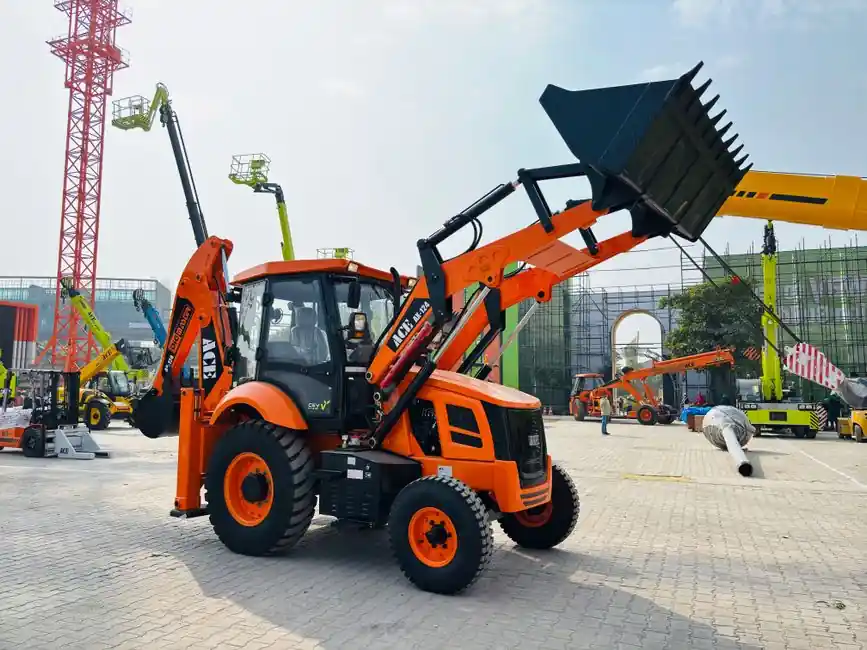
Equal-wheel backhoe loaders carry the same rim and tyre size on both axles, and the matched footprint gives measurably lower ground pressure and higher tractive effort on soft ground than the small-front, large-rear layout that defines most centre-pivot backhoes [S1][S2].
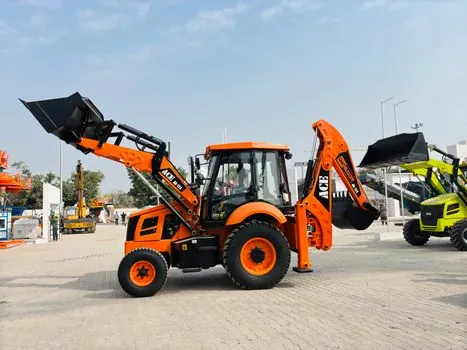
Unequal-wheel backhoe loaders, the dominant global layout, fit smaller front tyres for lighter steering effort and a tighter turn radius, with the larger rears sized for dig-and-lift thrust, a configuration that explains why most utility fleets still spec them on paved urban work [S7].
Wheel Geometry and Why It Changes a Backhoe
Equal-wheel backhoes run matched 4WD front and rear axles, typically both on the same rim diameter and tyre size, which spreads the machine's weight over a larger contact patch and produces the lower ground pressure that soft-terrain operators rely on [S1][S2]. Earthmovers Magazine's 2026 review of equal-wheel backhoe loaders lists the JCB 3CX, JCB 4CX, Hidromek HMK 102B, and Cat 444 among the equal-wheel offerings, with the layout credited specifically for traction and lateral stability when the rear arm is working at full reach [S1].
Unequal-wheel layouts use a smaller-diameter front tyre (often 18 in or 20 in) paired with a larger rear (commonly 24 in to 28 in) because the rear axle carries the backhoe weight plus the digging reaction loads, while the front axle only handles the loader bucket and steering [S7]. Luyu's product description of the 4CX equal-wheel backhoe loader ties the equal-wheel design to "simplicity of operation, low maintenance costs, versatility, suitability for flat terrain", confirming that equal-wheel is preferred on flat, soft, or graded sites rather than tight street work [S8].
Comparison: Equal-Wheel vs Unequal-Wheel Across 4 Decision Criteria
On traction, equal-wheel machines put more tyre on the ground at both ends, so they convert more engine torque into drawbar pull in mud, sand, or wet clay, the same physics that gives an all-wheel-drive tractor its edge [S1][S2]. On ground pressure, the larger and matched footprint distributes the operating weight more evenly; TAD Group's July 2025 buyer guide calls out the lower ground pressure as the headline reason to choose equal-wheel when the site is soft or finished [S2].
On manoeuvrability, unequal-wheel wins by a clear margin because the smaller front tyres cut the turning circle and make the front bucket easier to steer at low trenching speeds, which is the layout most contractors running street and utility work in tight European or Indian cities still specify [S7]. On cost and parts, unequal-wheel dominates simply because it has been the production default for decades, so replacement tyres, rims, and axle parts are stocked at every dealer, while equal-wheel parts often run longer lead times outside the major OEM networks [S1].
Operating-Weight, Reach, and Speed Reference Numbers
Rhinoceros's August 2026 published comparison puts the compact XN290 backhoe loader at 2965 kg operating weight with 2460 mm max digging depth, 3350 mm max digging radius, an 18 km/h top travel speed, and a 0.3 m³ front bucket [S5]. For context, the same factory's compact XN35L wheel excavator weighs 4100 kg, reaches 3025 mm down and 5575 mm out, runs only 10 km/h, and carries no front bucket, showing that a backhoe loader is a lighter, faster dual-function tool, not a heavier one [S5].
Indian retail pricing for backhoe loaders in September 2026 runs roughly ₹22-40 lakh, against wheel loaders from about ₹19 lakh for a compact machine up to about ₹1.55 crore for a large aggregate unit, so the buy decision turns on whether the job needs a trench first or material volume first [S4]. Cat's own product framing positions the backhoe loader as a trenching, utility, and small-excavation tool, while the wheel loader is framed as a high-bucket-capacity production loader for moving material onto trucks across a site [S3].
When Each Layout Is and Is Not the Right Call
Equal-wheel is the right call on soft ground, mud, agricultural lanes, finished turf, and any site where the rear arm cycles repeatedly at full reach with the machine stationary, because the larger rear contact patch resists slipping and the matched front reduces fore-aft pitch [S1][S2]. The JCB 4CX equal-wheel backhoe is the canonical example, and Hidromek's HMK 102B is sold on the same equal-wheel traction story for municipal and rural buyers [S1].
Unequal-wheel is the right call on hard, paved, or constrained urban sites where the front bucket does most of the work and the operator needs a tight turning circle to work around parked vehicles, manholes, and kerbs [S7]. It is also the default pick for rental fleets, where parts commonality and lower acquisition cost across many units matter more than the soft-soil edge case, since the backhoe loader is, in Cat's own framing, the most common multifunction machine on small commercial and utility jobs [S3].
Limitations, Failure Modes, and Specification Pitfalls
Equal-wheel backhoes are heavier on the front axle than unequal-wheel machines, so they can scuff finished surfaces, a real problem on asphalt, cured concrete, or completed landscaping, where the larger front tyre contact area leaves a wider mark when the machine is steered under load [S2][S7]. Parts logistics are the second failure mode: outside the JCB, Cat, and Hidromek dealer footprints, equal-wheel rims, 4WD front-axle components, and matched tyre sets can carry longer lead times and higher unit cost than the standard unequal-wheel consumables [S1].
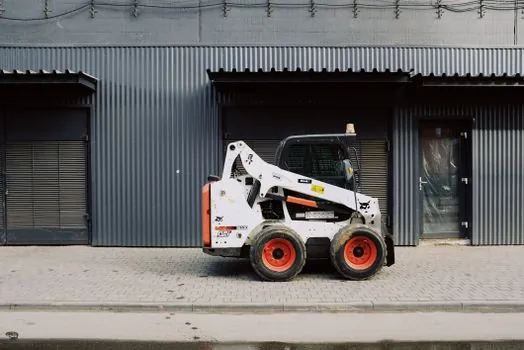
Unequal-wheel backhoes sacrifice tractive effort in soft ground, so operators regularly bog down on wet clay or fresh fill, and the small front tyre is the first thing to wear out on hard urban surfaces because it carries more per-square-inch load than the rear [S7]. Buyers comparing both layouts should also watch for confusion with the skid steer loader and compact wheel loader categories, since a backhoe loader, despite the name, is its own machine class with a fixed front bucket and a rear digging arm, not a swappable attachment platform [S3][S5].
Standards, Sourcing, and Buyer Checklist
There is no single ISO or EN standard that dictates equal-wheel versus unequal-wheel layout, so the buy decision reduces to OEM published specifications, dealer-supported service coverage, and the operator's site mix [S1]. For procurement, Earthmovers Magazine's 2026 equal-wheel roundup and TAD Group's July 2025 buying guide are the two public references that explicitly compare the two layouts on traction and ground pressure, and they should be cross-checked against the OEM's own data sheet before a fleet commit [S1][S2].
The trackable signals to watch into 2027 are Hidromek, JCB, and Cat continuing to offer equal-wheel variants for municipal and agricultural buyers, while Indian and Chinese OEMs such as Tata Hitachi and Luyumachinery emphasise the equal-wheel layout for export and flat-terrain markets, with the unequal-wheel layout staying the default for urban rental fleets [S1][S8][S9]. For buyers still weighing whether a backhoe loader or a wheel loader is the right anchor machine, the trench-versus-volume split remains the cleanest decision rule published by the OEMs [S3][S4].
For a deeper comparison of operating-weight class versus digging reach, the ejector vs tipping body decision map covers related low-overhead material-handling trade-offs that often come up when sizing a backhoe loader for confined sites.