EN 16228 is the European harmonized safety standard for drilling and foundation equipment, structured as Part 1 common requirements plus six equipment-specific Parts 2 through 7 [S1][S2].
The series was originally approved by CEN on 6 March 2014, with Amendment A1:2021 ratified on 22 November 2021 and implemented in the UK on 30 September 2022 as BS EN 16228-1:2014(+A1:2021) [S4][S5]. Part 1 alone lists the common significant hazards, while Part 2 mobile drill rigs alone runs to chapter 5.3 on strength and stability calculations [S4].
The seven-part structure and what each part covers
Part 1 is the umbrella document, giving common safety requirements and protective measures plus a list of significant hazards that apply across all equipment types in scope [S5]. It is intended to be read in conjunction with one of the equipment-specific parts 2 through 7, not as a standalone purchase for a single machine [S2].
Part 2 covers mobile drill rigs for civil and geotechnical engineering, quarrying and mining, classified under ICS 25.080.40 (drilling machines), 53.100 (earth-moving machinery) and 93.020 (earthworks, excavations, foundation construction) [S4]. Part 3 covers horizontal directional drilling equipment (HDD); Part 4 covers foundation equipment; Part 5 covers diaphragm walling equipment; Part 6 covers jetting, grouting and injection equipment; Part 7 covers interchangeable auxiliary equipment [S1].
The seven-part split mirrors how contractors actually buy: a foundation equipment buyer working on driven piles or rotary drilling rig operations will pull Part 1 + Part 2 + Part 4, while a trenchless crew running HDD bores pulls Part 1 + Part 3, and a diaphragm wall crew on a hydromill pulls Part 1 + Part 5 [S1].
CE marking linkage and the Machinery Directive
EN 16228 is the harmonized standard cited under the EU Machinery Directive 2006/42/EC, and a manufacturer applying it can claim presumption of conformity for the relevant health and safety requirements of the directive [S8]. It is the document a Notified Body auditor will check against the technical construction file when reviewing a CE-marked drill rig, and it is the reference an ADSC-style large-foundation drill rig reference manual points its operators to for training on applicable safety regulations [S7].
For a CE drill rig the standard stack is: Machinery Directive 2006/42/EC, then EN 16228 Parts 1 plus the relevant Part 2 to 7, with the noise emission directive (2000/14/EC) and the electromagnetic compatibility directive (2014/30/EU) typically pulled in alongside. EN 16228 does not exist in isolation; it sits inside a stack where each instrument has a defined role and a defined scope boundary.
Practically, a procurement specification for a new European-delivered mobile rig should call out Part 1 + Part 2 by dated reference (2014 + A1:2021) and require the supplier to provide the Declaration of Conformity listing those exact parts, not just "compliance with EN 16228".
Common requirements in Part 1: hazard list, verification, and information for use

Part 1's content shape follows the EN ISO 12100 type-C structure: a list of significant hazards, the safety requirements and protective measures that address each, and the verification method (calculation, testing, or inspection) by which conformity is demonstrated [S5]. The list of significant hazards in Part 1 is then re-referenced and extended in each Part 2 to 7, where equipment-specific hazards such as boom-mounted working platforms for underground use are added [S4].
Part 1 also sets the information-for-use rules: every machine must ship with an instruction handbook covering applicable safety regulations, residual risks, and the noise/vibration data needed for operator exposure assessment under the Physical Agents (Vibration) Directive 2002/44/EC and the Noise Directive 2003/10/EC [S7]. This is the section a safety officer at a contractor will actually read before commissioning a new rig on site.
The Turkish mirror TS EN 16228-1, published 13 November 2014, confirms the same content shape: common requirements intended to be used together with parts 2 to 7, not on its own [S3].
Part 2 mobile drill rigs: stability, booms, and operator protection
Part 2 is the most cited of the seven because mobile drill rigs are the highest-volume CE machine in the family. The visible table of contents in the +A1:2021 revision runs: scope (clause 1), normative references (2), terms and definitions (3), list of additional significant hazards (4), and safety requirements and protective measures (5), with clause 5.3 dedicated to requirements for strength and stability including a 5.3.1 stability calculation sub-clause [S4].
A typical stability check under Part 2 is done by calculation against the worst-case combination of mast inclination, tool pullback force, and ground slope declared by the manufacturer; this is not a type-test, it is a design verification the manufacturer must hold in the technical file and reproduce on request [S4]. A 2015 industry summary of the new EN 16228:2014 framework flagged the stability calculation requirement, the operator protection against falling objects, and the updated noise declaration as the three practical changes contractors had to absorb [S8].
Selection rule of thumb: for a contractor specifying a new construction machinery and equipment purchase, Part 2 governs if the machine is on crawlers or truck and self-propelled between bores; Part 3 governs if it is a horizontal directional drilling rig that launches a pilot string from a stationary anchor; Part 4 governs if it is a piling rig primarily used for driven or bored piles and ground improvement; Part 5 governs hydromill and grab rigs for diaphragm walls.
Who EN 16228 is for, and where it does not apply
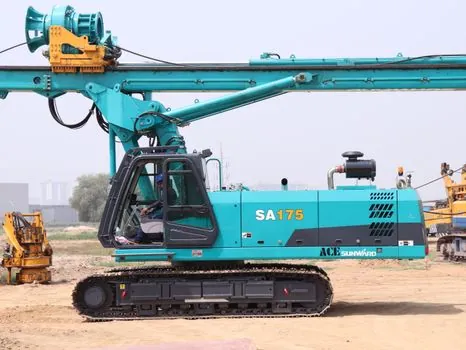
EN 16228 is for designers, manufacturers, importers and distributors placing new drilling and foundation equipment on the EEA market and the UK market; it is also the reference used by Notified Bodies auditing those machines [S2][S8]. It applies to all types of drilling and foundation equipment, which is deliberately broad and was the main point of confusion when the standard first replaced the older EN 791 and EN 996 in 2014 [S8].
It is not for offshore drilling rigs, not for underground mining face equipment covered by EN ISO 19225, and not for hand-held or operator-carried tools like a breaker or a hand auger, which sit under EN ISO 11148. It also does not replace site-level safe systems of work: the standard is the machine's design and information-for-use baseline, and the contractor still owns the risk assessment, lifting plan, and operator competence requirements under national regulations such as the UK CDM 2015 or the German BetrSichV.
For a US-delivered rig the relevant instrument is ANSI/ASME B30.5 plus 29 CFR 1926.1437 for mobile drilling rigs, not EN 16228; the European standard has no US federal regulatory force. Buyers outside the EEA should still see it as a useful design baseline because most large rig builders (Soilmec, Casagrande, Bauer, Comacchio, Liebherr) design their export platforms to EN 16228 first and then add US/Canada-specific modules.
What changed in the 2021 amendment
The A1:2021 amendment was a targeted revision, not a full re-issue. It was approved by CEN on 22 November 2021, with the consolidated text dated December 2021 and the UK implementation logged as 30 September 2022 on the BSI publication index [S4][S5]. The amendment clarified several clause 5 safety requirements in Part 2 and tightened the stability calculation references, and a parallel FprA1 draft of Part 1 was circulated by CEN/TC 151 around the same period [S6].
Practically, a manufacturer with a 2014-only technical file has to gap-check it against the +A1:2021 consolidated text; a procurement specification written before late 2021 should be updated to call out "+A1:2021" so the supplier cannot deliver a 2014-vintage Declaration of Conformity against an obsolete revision [S5][S6].
The +A1:2021 consolidated text is the current enforceable version across the CEN membership of 34 national standards bodies, including the UK, Germany, France, Italy, Spain, the Nordics, Poland, Turkey and the Balkans [S4].
Cross-references to other standards a buyer will see in the file
EN 16228 does not stand alone; a CE technical file will typically cross-reference EN ISO 12100 (type-C risk assessment methodology), EN 60204-1 (electrical equipment of machines), EN ISO 4413 (hydraulic systems), EN ISO 4414 (pneumatic systems), EN 13000 for the crane-style elements on a rig, EN 16228 for the drilling-specific requirements, and on the structural side EN 1993 (Eurocode 3) for steel welded structures [S4][S8].
For diaphragm wall work, the execution side is governed by EN 1538, while the safety side of the same machine is governed by EN 16228-5; a contractor running hydromill or grab rigs will be auditing against both simultaneously, which is where related guides like the EN 1538 execution rules for diaphragm walls sit alongside the EN 16228 stack in a real project file.
For personnel guarding on drill rigs the relevant lockout/tagout and guard-locking rules come from EN ISO 14119, which is the standard a safety officer will pull when assessing interlock performance on a rig's access panels and mast gates; this is the same decision logic covered in guides such as guard locking for personnel vs process protection under ISO 14119.
Verification artefacts the manufacturer has to hold
A EN 16228-compliant technical file for a mobile drill rig will include: a hazard list and risk assessment under EN ISO 12100, the Part 2 clause 5.3.1 stability calculation with declared ground slope and pullback envelope, a structural calculation file (mast, frame, outrigger pads), noise and vibration test data per the relevant physical-agents directives, the operator's handbook with residual-risk warnings, and a Declaration of Conformity listing Machinery Directive 2006/42/EC plus EN 16228-1:2014+A1:2021 and EN 16228-2:2014+A1:2021 by exact reference [S2][S4][S8].
The supplier cannot deliver "CE marked" without this file on day one; if the buyer is auditing, the three artefacts to ask for are the Declaration of Conformity, the stability calculation summary, and the noise test report, because those are the items that most often go missing or are out of date in older fleets.
Specification selection checklist for a buyer
When writing an EN 16228 spec, the following are the verifiable items a competent buyer should pin down: the dated reference (2014 + A1:2021), which Parts 1 through 7 apply to the machine being purchased, the declared maximum ground slope for stability, the noise sound power level LwA in dB(A) under 2000/14/EC, the hand-arm vibration total value ahv at the operator station under 2002/44/EC, the declared maximum tool pullback force, and the operator handbook language and revision [S2][S4].
Each of these is a value the manufacturer can quote from the technical file, and each maps to a specific clause or a specific cross-referenced directive, so a buyer can grade competing quotes on the same baseline instead of taking marketing literature at face value.
Known limitations and failure modes of the standard
EN 16228 is a type-C machine standard, so it is a design and information-for-use baseline, not a site-safety rulebook; a compliant machine can still be operated unsafely if the contractor skips the site risk assessment or the lifting plan. The standard also assumes the manufacturer has done the noise and vibration testing correctly; if the test data is fabricated or copied from a predecessor rig, the type-C compliance is on paper only [S8].
The 2014 + A1:2021 text covers design verification but is silent on the remanufactured or life-extended rig, where the original Declaration of Conformity may no longer reflect the as-built state; that gap is filled by the national putting-into-service rules (e.g. the UK PUWER 1998, the German BetrSichV) rather than by EN 16228 itself, and a buyer of a 10-year-old CE rig should check whether the file has been updated for any mast extension, Kelly bar upgrade, or engine swap.
Drilling fluids and slurry management are partly out of EN 16228's design scope; the environmental and slurry-side rules are covered by national mining and water-authority regulations and by EN 1538 for diaphragm wall execution, so a slurry-handling failure on a diaphragm wall job is typically not an EN 16228 finding, it is an EN 1538 or environmental-permit finding.
For a spec engineer tracking this space, the two trackable signals over the next 6 to 12 months are: any new CEN/TC 151 working group drafts circulating on a Part 8 or a wholesale revision, and any Notified Body audit summaries from the European market surveillance authorities that name EN 16228 as the cited instrument. The 2022 implementation of the A1 amendment on the UK side is the last confirmed regulatory milestone in the public record.