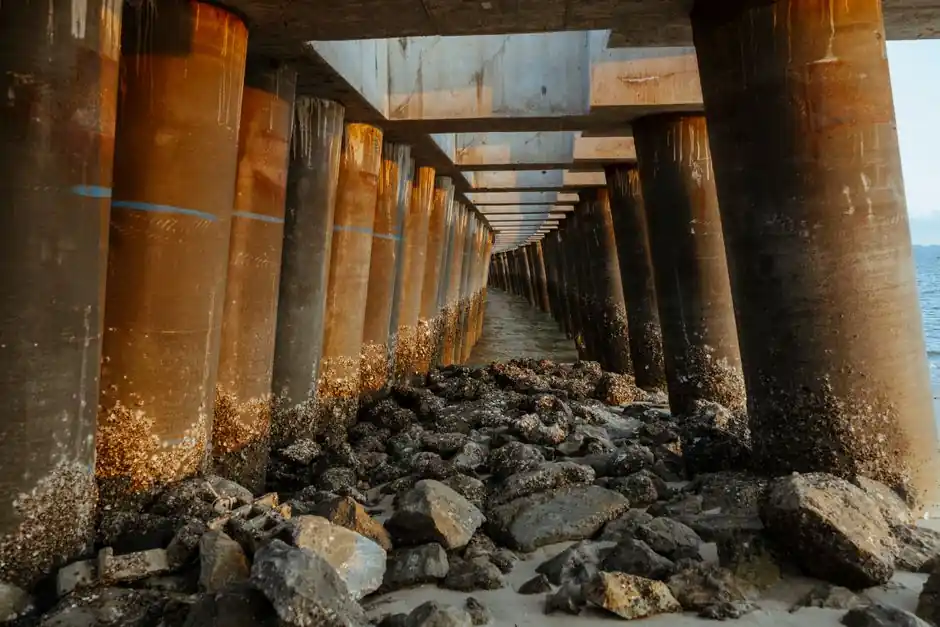
EN 1538:2010+A1:2015 is the European execution standard for diaphragm walls, covering retaining walls and cut-off walls built in support fluid or in dry trenches with wall thickness B ≥ 40 cm, and was amended in 2015 to align concrete provisions with EN 206:2013 [S1][S2][S4].
Structures outside scope include walls in shallow trenches with depth-over-thickness D/B < 5 or D < 5 m, and the standard explicitly states it expands on design only where necessary (e.g. reinforcement detailing) while leaving full geotechnical design to EN 1997-1 and ground investigation to EN 1997-2 [S1][S4].
Scope and the two structural families
EN 1538 divides the work into two families: retaining walls that brace deep excavations, and cut-off walls that block migration of clean, polluted, or contaminated groundwater [S1][S4].
Retaining applications listed in the standard include cast-in-situ concrete diaphragm walls, precast concrete diaphragm walls, and reinforced slurry walls; cut-off applications cover slurry walls (which may be combined with membranes or sheet piles) and plastic concrete walls [S1].
Both permanent and temporary diaphragm walls fall inside the scope, provided the trench is excavated under bentonite/polymer support fluid or dry conditions, and the B ≥ 40 cm wall-thickness threshold excludes thin cut-off barriers [S1][S4].
Materials: bentonite, polymers, concrete, grout
The standard specifies constituents and support fluids: bentonite and polymers for the support slurry, concrete for the structural element, and grout for jointing and ancillary works, all covered under the materials and products clause [S1].
Concrete for diaphragm walls must satisfy EN 206:2013, which contains the specific requirements for concrete in special geotechnical works, so the 2015 amendment removed redundant provisions that had previously sat inside EN 1538 [S4].
Plastic concrete, used in cut-off walls, is a low-strength, low-permeability mix designed to deform with the ground rather than carry structural load, and EN 1538 references the mix family alongside conventional concrete for retaining panels [S1][S4].
Panel layout, stability, and rock socketing
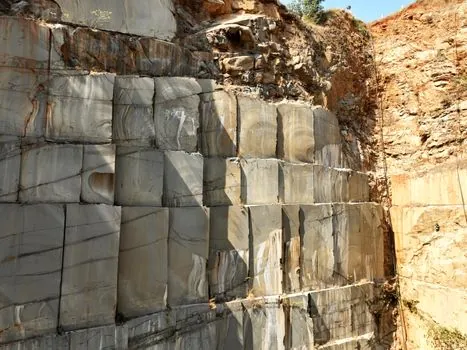
EN 1538 addresses panel geometry and excavation sequence because trench stability under support fluid is the single largest execution risk on a diaphragm-wall site [S1][S4].
Panel layouts (primary/secondary, or stop-end tube joints) must be detailed in the working drawings, and the standard covers socketing of the wall into rock to provide a hydraulic and structural seal at depth [S1][S7].
Execution tolerances on verticality, depth, and panel width are written into the supervision regime, with control schedules for the execution phase provided as informative Annex B and sample concreting record forms provided as informative Annex C [S4].
Reinforcement, joints, and precast options
Reinforcement detailing is the one area where EN 1538 expands beyond pure execution, covering cage fabrication, cover, splicing, and lift points so that the cage can be lowered into the support-fluid trench without trapping slurry [S4].
Precast concrete diaphragm walls are listed as a separate type from cast-in-situ walls, requiring matching execution provisions for panel handling, joint grouting, and sealing against groundwater ingress [S1][S7].
Joint construction between adjacent panels is treated as a critical execution item because defects at joints are the most common leakage path on cut-off walls, and Annex D sets out the obligation level (normative vs informative) of each provision [S4].
Comparison of diaphragm-wall types under EN 1538
Across four execution-relevant criteria, the standard treats the wall families as follows: cast-in-situ concrete walls offer the widest contractor experience base and the lowest tolerance risk; precast concrete walls improve quality control but require heavier handling; reinforced slurry walls trade structural capacity for hydraulic performance; plastic concrete cut-off walls deliver the lowest permeability but cannot carry vertical load [S1][S4].
For cut-off duty, the standard allows slurry walls combined with membranes or sheet piles where single-component barriers do not meet the hydraulic or chemical-resistance target, and EN 1538 sets those combinations as in-scope execution cases [S1].
Supervision, records, and who the standard is for
EN 1538 requires skilled and qualified personnel during execution and emphasises that the standard cannot replace the expertise of specialist contractors, so supervision and records carry the same weight as the construction step itself [S4].
The intended users named in the foreword are construction firms, developers, architects, contractors, civil/structural/geotechnical design engineers, geo consultants, surveyors, safety bodies, regulators, and contracting authorities, with execution details for geotechnical investigation, materials, design considerations, panel stability, rock socketing, and precast concrete all bundled in one document [S1][S7].
Status: the standard is under review, with the existing base standard remaining valid.

A CEN/TC 288 draft prEN 1538 is in progress, indicating that the European committee is actively working on the next revision of the execution standard [S8].
Until a new EN is published, EN 1538:2010+A1:2015 remains the current reference, with BSI listing it as "current, under review" and DIN, SIST, SS, and NSAI all publishing the 2010+A1:2015 version as their national implementation [S1][S2][S4][S5].
For procurement in 2026, specifiers should cite EN 1538:2010+A1:2015 plus EN 1997-1 and EN 206:2013 on the drawings, and watch the prEN 1538 track for changes to panel geometry, joints, and concrete provisions. Cross-references to diaphragm wall grab selection, flow meter use on support-fluid circuits, and industrial valve choice for slurry recirculation also fall under execution planning, and a related note on Portland cement service temperature reminds designers that concrete mixes stay far below melt limits in normal service. A separate piece on Cuplock spigot joints covers ancillary shoring that often sits adjacent to diaphragm-wall guide walls.