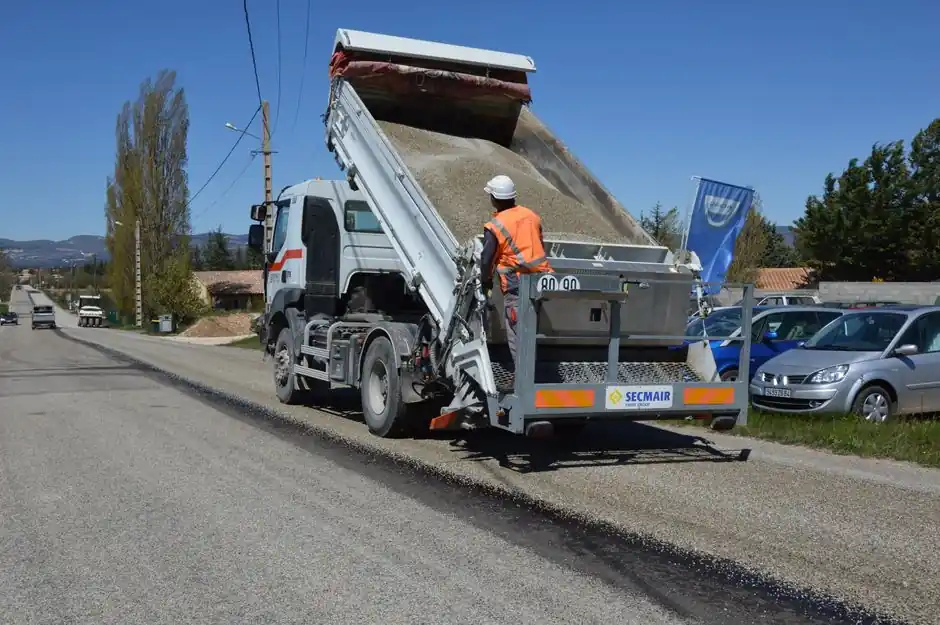
A rear ejector body unloads by pushing material out the back with a hydraulic blade, so the truck bed never leaves its lowest position; a conventional tipping body unloads by pivoting the bed upward under hydraulic pressure, typically 45-50 degrees of raise, which is the exact motion that strikes overhead lines, conveyors, and bridge soffits [S1][S2][S3].
For mine, quarry, and underground-haul fleets, the comparison is now a routine spec question rather than a niche request, with PHIL, Weldco-Beales, Pik Rite, K-Tec, and Homes offering aftermarket ejector conversions and Caterpillar offering factory 730 EJ and 740 EJ ejector models at 30-ton and 42-ton payload ratings [S4].
How each body actually unloads
A rear-tipping body relies on a single or twin hydraulic lift cylinder pivoting the bed about the rear hinge, with the load sliding out under gravity once the angle of repose is exceeded. A rear ejector body keeps the bed flat, fixed to the chassis, and uses a hydraulic cylinder to push an ejector plate from the front bulkhead toward the tailgate, sweeping the load out at a controlled rate [S1][S3].
The mechanical consequence is large. Pik Rite's product page and Weldco-Beales' 2018 launch rationale both state the ejector blade pushes material out at a steady, controllable rate rather than dumping an uncontrolled mass, and PHIL goes further with one cylinder controlling both the ejector and the tailgate, plus ejector guides instead of rollers, and a flat floor claimed to give complete material shedding [S1][S3].
Overhead clearance, stability, and slope behaviour
If the truck fits, the ejector can dump: Weldco-Beales' 2018 release states explicitly that ejector dumping does not require additional height clearance, which makes ejector bodies workable under bridges, power lines, and underground openings where a raised tipping body would not clear [S2].
Stability is the other half. PHIL's HiVol design lowers the load center because the bed never rises, so the truck can dump on downhill slopes, side slopes, and softer underfoot conditions where a gravity-tipping body would risk tipping; the same 2018 WBM article frames the ejector body as a way to "dump in height-restricted areas and on uneven/sloped or softened grounds" without raising the body [S1][S2]. For sites with overhead conveyors, an overhead conveyor crossing the dump zone is a classic ejector-trigger layout, because the tipper-raise path collides with the conveyor stringer while the ejector sweep stays below it.
Cycle time and productivity data
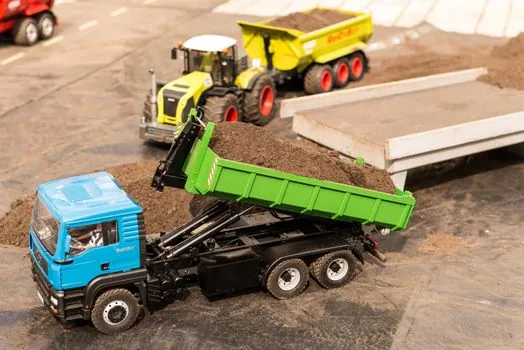
The headline productivity number from a 2020 industry comparison: a standard end-dump body takes about 12 seconds to lift and another 7 seconds to drop back down, roughly 19 seconds of dead cycle, during which the truck must remain stationary and a dozer is often needed to spread the pile [S4].
An ejector body can spread on the go in first or second gear, eliminating the "stop, dump, wait for body to drop" sequence; Caterpillar's product specialist Scott Thomas frames the ejector truck as the unit that gets loaded at Point A, drives to Point B, and ejects while still rolling, increasing loads per day because the truck "never stops at Point B" [S4]. For broader context on matching box volume to payload, the dump truck box dimensions vs payload capacity spec guide walks through how the same body envelope behaves across different chassis ratings.
Comparison matrix: ejector vs tipping body
Four criteria line the two designs up head to head. (1) Overhead clearance: ejector requires zero extra vertical clearance; tipping body needs a full bed-raise envelope, typically adding 1-2 m of vertical sweep depending on chassis [S1][S2][S3]. (2) Slope and soft-ground dumping: ejector stays within the wheelbase footprint with a low center of gravity; tipping body raises load high behind the rear hinge and is the documented rollover trigger on side slope [S1][S2]. (3) Cycle time: ejector can dump while moving and skip the lift/drop wait, while a tipping body burns about 19 seconds parked per cycle [S4]. (4) First cost and payload: tipping body is lower cost, lighter, and accepts a larger struck volume for the same external envelope, so on greenfield open-pit haulage with no overhead constraint, the tipping body still wins on $/tonne [S4].
The two designs split cleanly on the constraint. A mining dump truck fleet running wide benches, no overhead obstructions, and chasing the lowest cost per tonne should stay on rear-tipping bodies; a dump truck working under an overhead bridge crane bay, inside a tunnel, or beneath 25 kV catenary is a hard ejector application.
Material retention and maintenance
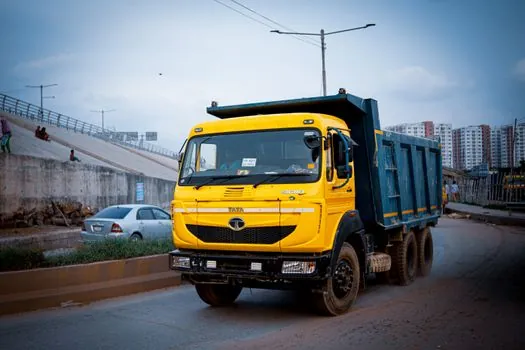
Sticky clay, wet muck, and frozen lumps are the ejector body's home turf: PHIL claims the ejector "forcibly ejects all materials, even the stickiest, and reduces carryback, all without raising the truck bed," and Weldco-Beales' 2018 release states retained material in the body after dumping is "nearly eliminated" [S1][S2].
Maintenance burden is genuinely low. PHIL specifies a single lubrication point that needs greasing just once per year, with no other regular maintenance on the ejector system, while WBM ejector bodies reuse the OEM cylinders, sequencing valve, pins, and bushings, which lets the dealer or end user install the body after the original dump bed is removed with only cab wiring added [S1][S2].
Where the tipping body still wins
The tipping body is not obsolete. It is cheaper to buy, lighter empty, holds more struck volume per external envelope, and uses components the local dealer already stocks, so on a clean open-pit, quarry, or highway-haul route with no overhead obstruction and stable ground, a standard rear-tipping body remains the rational choice [S4][S5].
The 2026 buying-guide framing from Shaanxi Retop International also underlines that "dump truck" and "tipper truck" are largely regional labels for the same gravity-discharge machine, and that body configuration (axles, body size, tires, local support) can swing total cost of ownership more than the ejector-vs-tipping decision itself; that same source notes side-tipping or ejector bodies are the specific option for limited-overhead sites, while rear-tipping stays the default for unrestricted haul roads [S5].
Decision rule and failure modes
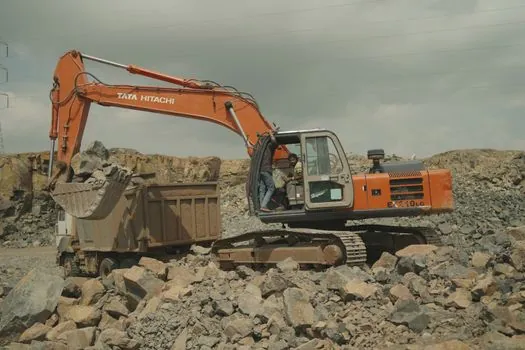
Specify an ejector body when any of these are true at the dump point: overhead clearance below the raised-bed envelope, side or downhill slopes where a standard dump truck would be unstable, soft underfoot that would compromise a stationary raised truck, or material that is sticky enough to cause significant carryback in a conventional dump body. Specify a tipping body when the dump zone is open, ground is firm and level, and cycle cost is dominated by haul distance rather than unload time [S1][S2][S4].
Trackable signals for the next decision: OEM announcements on 50-ton-class ejector factory builds beyond the current 730 EJ / 740 EJ pair, and the next revision of MSHA / provincial-mine guidance on dumping near energized overhead conductors, both of which would shift the ejector-vs-tipping default for new haul-fleet purchases.