
For capacities of 2 tons or less, enclosed track workstation bridge cranes typically outperform I-beam single girder cranes on installation cost, manual ergonomics, and seismic safety, with a rolling resistance of roughly 0.8 percent of the suspended load versus near-impossible hand-push movement on I-beam trolleys [S1].
For loads above that 2-ton threshold, or where spans and duty cycles demand motorized top-running trolleys, a single girder overhead bridge crane built on a standard I-beam or wide-flange section is the proven choice, accepting higher steel mass and electrification cost in exchange for higher capacity [S2][S5].
Load Capacity and the 2-Ton Crossover Point
Enclosed track workstation crane systems top out at 3 tons maximum, with 2-ton units being the most common configuration in the field [S2]. Below that ceiling, the enclosed track design carries a trapped internal trolley that cannot disengage from the rail, an intrinsic safety advantage during seismic events compared to wrap-around I-beam trolleys [S1].
I-beam single girder cranes accept the full industrial capacity range, from light-duty stations up to 10 tons and beyond on a single beam, with the hoist trolley traversing on the lower flange of the girder [S6]. This makes the single girder crane the default pick whenever the load exceeds the practical limit of modular enclosed track sections.
Rolling Resistance, Manual Push, and Motorization
Spanco's published figure of 0.8 percent rolling resistance means a 500-pound suspended load needs only about 4 pounds of push force, courtesy of low-friction polyamide wheels running inside a sealed track on high-quality bearings [S1]. That single number is the reason most enclosed track workstation bridge cranes run unpowered up to the 2-ton ceiling and across spans under 23 feet, with motorization added only when capacity or span forces the issue [S1].
I-beam cranes present a very different mechanical reality. The trolley rides on the lower flange of the I-beam and end trucks roll on ASCE rail (or on the bottom flange for under-running models), so the combined wheel load and flange friction make hand pushing impractical at almost any capacity, and motorization of bridge, trolley, and hoist becomes mandatory [S1]. For buyers comparing apples to apples, the unpowered option of an enclosed track system deletes the VFD, festoon or conductor bar electrification, and radio controls that a comparable I-beam build must include.
Installation Footprint, Foundations, and Seismic Compliance
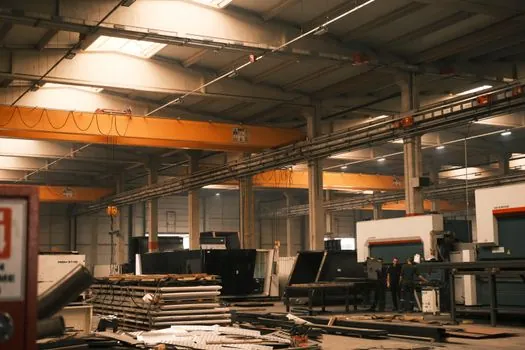
Modular enclosed track workstation bridge cranes install on a standard 6-inch reinforced concrete floor, with freestanding models that usually need no tie-off to building columns, bracing, or special foundation work [S1]. Spanco's standard freestanding systems are pre-engineered to meet IBC seismic requirements across the lower 48 U.S. states (including California and Oregon), up to 14-foot trolley-clevis height, 30-foot support centers, and 34-foot bridge lengths; beyond those limits a PE-stamped seismic package is required [S1].
An I-beam single girder installation is a heavier civil commitment. The runway needs to be designed for the end-truck wheel loads, the support structure (building column extensions or free-standing columns) is sized for the bridge weight plus dynamic factors, and the system weight drives higher foundation reactions. For facilities with limited headroom, under-hung I-beam configurations can be considered, since a single girder crane under-hung layout puts the hoist below the runway and saves building height compared to a top-running design [S9].
Cost Comparison on a Real One-Ton Build
Spanco's published comparison is blunt: a typical 1-ton workstation bridge crane installed is usually a fraction of the cost of a comparable I-beam crane of the same capacity and span, and the cost gap widens as capacity drops [S1]. The price advantage comes from three line items, not from cheaper steel alone: deleted motorization packages, no special foundation, and modular assembly that compresses install labor.
The I-beam side recovers the cost gap at the heavy end. A single girder uses less steel than a double girder, so it is the cheaper of the two I-beam options, but it is still heavier, deeper, and more electrification-intensive than an enclosed track equivalent at any capacity [S5][S6][S8]. For facilities that already run a 480V three-phase bus and a conductor bar runway for other cranes, the I-beam add-on is mostly incremental, and the total installed cost comparison shifts back toward parity.
Decision Matrix: Enclosed Track vs I-Beam Single Girder

Across four decision criteria drawn from the research, the comparison is decisive at the light end and flips at the heavy end: [S2]
Capacity. Enclosed track wins up to 2 tons (3 tons absolute ceiling); I-beam single girder takes over from 3 tons upward [S2][S6].
Manual operation. Enclosed track allows unpowered push (about 0.8 percent rolling resistance, roughly 4 lbf at 500 lb load); I-beam effectively requires full motorization for bridge, trolley, and hoist [S1].
Foundation and seismic. Enclosed track freestanding systems sit on a standard 6-inch slab with IBC seismic pre-approval in the lower 48 states; I-beam systems need engineered runways, larger foundations, and project-specific seismic review above the catalog envelope [S1].
Cost. Enclosed track is a fraction of the installed price for a 1-ton build; the gap narrows as capacity rises and I-beam becomes the only option above 3 tons [S1][S2].
Best-Fit Applications and Where Each System Fails
Enclosed track workstation bridge cranes fit assembly cells, machine shops, and repetitive pick-and-place operations with loads between 30 lb and 4,000 lb, in both ceiling-mounted (column-free floor) and freestanding layouts, with monorail variants chosen when straight-line travel is enough and bridge variants chosen when area coverage matters [S3][S4]. They also integrate as fall-protection anchor rails, a dual-use feature that no I-beam runway offers [S2].
I-beam single girder cranes fit heavier manufacturing, warehousing, and process lines with spans of 20-60 ft, capacities of 3-15 tons, and duty cycles that demand motorized long-travel, VFD control, and rigid runway alignment. A gantry crane variant of the same I-beam logic handles outdoor or temporary installations where a building runway is not available.
Enclosed track fails when capacity exceeds 3 tons, when the application requires top-running maintenance access, or when the environment is so dirty that even the sealed track cannot keep debris out long-term [S2]. I-beam single girder fails when the budget cannot absorb motorization, when the slab is inadequate for the end-truck reactions, or when a small work cell needs a manual, repositionable system that an I-beam cannot deliver without a full runway teardown.
Layout, Reconfigurability, and Future Capacity Growth
Buyers evaluating either system should weigh five factors before purchase: hook travel, ceiling clearance, future capacity needs, duty cycle, and the likelihood of future layout changes [S4]. Modular enclosed track systems score well on the last point, since they can be disassembled and relocated when the factory configuration changes, while I-beam runways are essentially permanent civil work.
For facilities anticipating growth, the safe rule is to overspec the runway, not the crane. An I-beam runway rated for 5 tons can carry a 2-ton hoist today and a 5-ton hoist later, whereas a 2-ton enclosed track system must be replaced or supplemented, not upgraded in place. A related crawler crane decision logic appears when lifts move outdoors, where mobility and ground pressure replace the runway alignment problem entirely.
Sourcing Checklist Before You Buy
Confirm the capacity envelope in writing, with the manufacturer stating the rated load, the testing standard (typically CMAA 70, 75, or 76 for industrial cranes, and an OSHA 1910.179 compliance reference for the U.S. installation), and the span-plus-support-center geometry that matches your floor plan [S1][S3]. For seismic zones in the lower 48 U.S. states, request the IBC seismic pre-approval letter; outside that envelope, order the PE-stamped seismic package as a separate line item [S1]. For powered systems, lock the electrification scheme (conductor bar vs festoon), the control voltage (typically 115V pendant or radio), and the VFD hoist package before sign-off [S5].
Trackable signals to watch over the next two quarters: published price-list revisions from the major enclosed track vendors (Spanco, Gorbel, and their dealers) as steel and aluminum costs move, and any updates to the OSHA 1910.179 overhead crane inspection cadence that affects re-certification intervals. For a broader view of how spec-first purchasing decisions play out across the lifting-equipment market, the authorized channel vs broker purchasing during shortages decision map walks through the parallel logic.