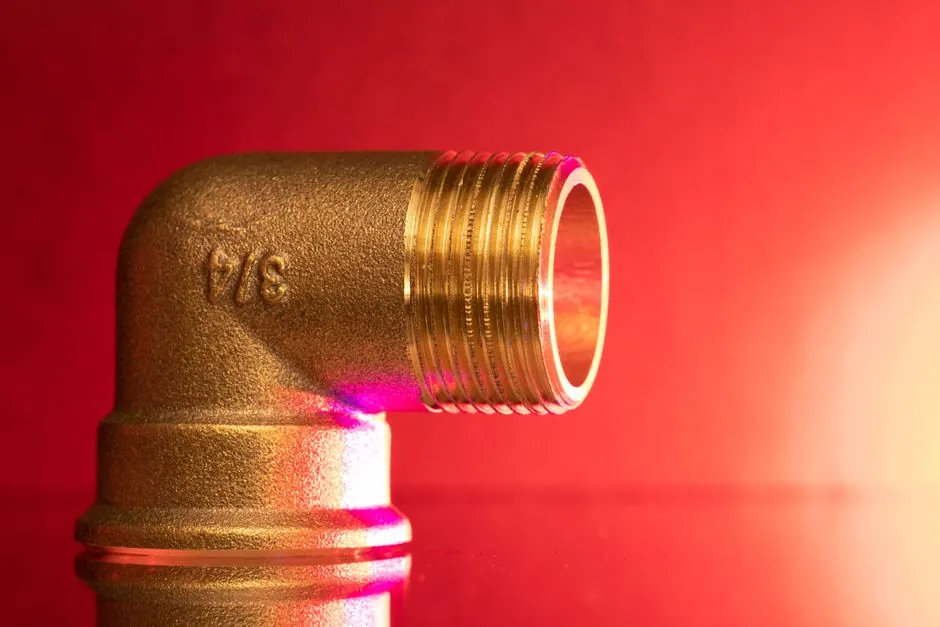
A concrete pump line converts vertical lift at 4 times its height, each 90° bend at 9 ft (2.74 m), and end hose at 3 times its length into equivalent straight pipe [S1].
The method applies to pump pressure screening, but each fluid system requires its own fitting table, elevation treatment, friction factor, and allowable pressure limits.
What Equivalent Horizontal Length Represents
Equivalent length is the length of straight reference pipe that would produce the same calculated pressure loss as the actual bend, riser, or other fitting. It does not mean that the component is physically horizontal, and it does not replace the static head calculation. [S1]
For a concrete pump line, the published screening equation is: equivalent length = horizontal steel pipe + 4 × vertical rise + 9 ft for each 90° bend + 3 × end-hose length [S1]. The calculator converts the line, lift, bends, and end hose into an equivalent length of straight pipe using ACI and ACPA figures [S1].
These are screening values, not universal constants for every pump circuit.
Choosing Coefficients for Bends and Risers
The correct equivalent length depends on the calculation method, pipe diameter, flow rate, fitting geometry, and fluid. A 90° elbow, a long-radius sweep, a tee, and a reducer do not have interchangeable resistance factors. [S2]
For concrete placement lines, the practical selection set is 4 × vertical rise for upward steel runs, 9 ft (2.74 m) per 90° sweep bend, and 3 × end-hose length [S1]. The hose multiplier represents the greater pressure demand of rubber hose compared with steel in that method.
For fire-water calculations, start with the fitting equivalent length from the applicable table, then multiply that length by the factor calculated for the pipe’s inside diameter [S2]. A July 2026 flexible-pipe design article makes the same discipline explicit: use the equivalent-length value corresponding to the actual number of bends expected in the installation [S3].
Riser Height Is Both Static and Friction Load
A riser does not create pressure loss through elevation alone. A vertical rise adds static head, while flow through the riser and its fittings adds friction loss. The equivalent-length factor represents the fitting and flow-related effect, not permission to delete the static-head term. [S1]
For water, the screening conversion is 0.433 psi per foot of elevation, based on 62.4 lb/ft³ water density [S2]. A 100 ft (30 m) elevation therefore represents 43.3 psi of static head before friction and fitting losses are added [S2]. If the same elevation is represented in a pump-line equivalent-length model, the 4 × vertical coefficient remains a separate line item for the published concrete-pump screening method [S1].
A wet or dry riser calculation can include a stated riser equivalent length of 20 m plus fittings and height [S5]. That example demonstrates why a fixed number must not be transferred blindly between systems: the 20 m assumption belongs to the documented riser model, while the fitting and height terms are added separately [S5].
Comparisons Across Calculation Methods
The main options differ in how much geometry they preserve. A simplified equivalent-length method is fast and transparent; a manufacturer-specific resistance method can be more accurate for concrete; a fire-system method may use tabulated fitting lengths and diameter-dependent multipliers. [S4]
Concrete pump screening favors speed: count 4 × rise, 9 ft (2.74 m) per 90° bend, and 3 × hose length, then compare the resulting pressure loss with the pump’s concrete-pressure rating [S1]. Fire-sprinkler calculations favor table discipline: start with the tabulated equivalent length and apply the factor for the selected pipe inside diameter [S2].
Detailed hydraulic analysis offers the best fit when flow and geometry are stable, but it still depends on defensible inputs. Pipe material and internal roughness affect friction loss, while pipe schedule changes usable inside diameter.
The choice is therefore not simply “simplified versus accurate.” Use the simplified method for preliminary sizing and comparison, then confirm critical circuits with the actual pipe diameter, flow rate, fitting data, elevation, and pump or system pressure limit.
Where the Method Is Used and Where It Fails
This method fits concrete placing lines, sprinkler networks, wet and dry risers, and other pressure networks where fittings must be converted into equivalent straight-pipe length. It is particularly useful for early routing decisions, pump screening, and comparing layouts with different numbers of bends. [S1]
It is not suitable as the sole basis for a final safety-critical design without verified component data. Concrete pump output must be checked against the pump’s maximum concrete pressure and rated horizontal distance, not hydraulic-oil pressure [S1].
Do not replace that documented behavior with the 3 × concrete end-hose factor. The fluid, hose construction, diameter, and calculation model are different.
Other errors include counting a bend that is absent from the installed route, using nominal diameter instead of inside diameter, overlooking a descending section, or adding equivalent length without adding static elevation. Each error changes the pressure result even when the total physical route looks plausible.
Building a Verifiable Pressure Calculation
A defensible calculation records at least 5 inputs: total straight-pipe length, vertical rise, bend count and type, pipe inside diameter, and fluid flow rate. It also records pipe material, internal diameter, fitting coefficients, elevation endpoints, and the pressure limit being tested. [S1]
For concrete pump screening, the published example maps each physical feature to a specific multiplier: 1 × horizontal length, 4 × vertical rise, 9 ft (2.74 m) per 90° bend, and 3 × hose length [S1]. The calculation then prices that equivalent length at the pressure per unit reach derived from rated pressure divided by rated horizontal distance [S1].
For a sprinkler calculation, begin with the equivalent-length value in the applicable table, multiply by the diameter-based factor, and use the result as part of the straight-pipe friction calculation [S2]. Include the actual number of bends rather than a nominal allowance [S3].
Track three outputs before accepting the result: equivalent length in feet or metres, calculated pressure loss in psi or bar, and percentage of the available pump or system rating. In the cited concrete example, those outputs were 196 ft, 147 psi, and 16% of a 900 psi pump rating [S1].
The next verification step is to rerun the calculation using the as-installed route and the smallest actual inside diameter, then compare the calculated demand with the lowest governing pressure limit. Any discrepancy in bend count, riser height, or hose length should be resolved before pipe or pump selection.