
The global EV traction motor market reached USD 17.12 billion in 2025 and is projected to scale to USD 316.84 billion by 2035 at a 33.88% CAGR, driven largely by Industry 4.0 integration across manufacturing lines [S3].
Asia Pacific leads deployment, with China, Japan, and South Korea concentrating the highest density of smart factories for AC motor and PMSM production, supported by government electrification mandates and OEM vertical integration strategies [S1][S3].
Motor Architecture Choices Under Industry 4.0
Industry 4.0 tooling, including digital twins and real-time winding monitoring, is now standard in new PMSM lines, allowing statistical process control on slot-fill factor and magnet temperature to hold tolerances within 0.5% [S2].
Induction motors remain preferred for cost-sensitive commercial vehicle platforms, where the absence of rare-earth magnets reduces BOM exposure and aligns with circular-economy recycling research for end-of-life drive motor rotors [S2]. BLDC designs serve the sub-100 kW power band, typically 60-100 kW, and benefit from automated hairpin stator welding validated by machine-vision inspection [S3].
Selection Criteria for Smart-Ready Production Lines
Plants specifying Industry 4.0-ready traction motor lines in 2026 should score suppliers on five criteria: OPC-UA or MQTT connectivity on the shop floor, MTConnect-compliant machine data export, AI-driven stator winding defect detection, closed-loop feedback between end-of-line (EOL) test and MES, and digital twin maturity for what-if scenario planning [S5][S6].
For commercial vehicle traction motors, where the market expands from USD 2.1 billion in 2024 to a projected USD 9.8 billion by 2030, the priority shifts toward high-torque architectures (above 250 kW) with thermal-runaway telemetry and over-the-air firmware pathways [S8].
Industry 4.0 Maturity vs. Traditional Manufacturing: A Criteria Comparison

Comparing conventional lines against Industry 4.0-equipped lines on four procurement-relevant criteria: OEE, scrap rate, time-to-design-change, and per-unit energy consumption.
These numbers are not uniform across the industry; tier-1 suppliers with proprietary MES (e.g., BorgWarner, Nidec, Jing-Jin Electric) report the upper end, while tier-2 contract manufacturers typically cluster near the lower bound [S3].
Who Benefits and Who Should Wait
Large OEMs producing above 300,000 traction motors per year should adopt Industry 4.0 in 2026, as the data volumes needed to train stator-defect and magnet-temperature ML models only become statistically valid above 500,000 annual units [S5]. Small and medium enterprises with annual output below 50,000 units will struggle to justify the capex unless they join consortium MES platforms or contract manufacturing clusters [S3].
Companies specifying hydraulic motor and electric traction hybrid architectures for off-highway applications should defer full Industry 4.0 adoption until 2027-2028, as low production volumes and long product life cycles (10-15 years) dilute the ROI on edge analytics [S7]. Conversely, passenger BEV and PHEV suppliers targeting the 100-250 kW power band, the highest-volume segment, are the primary near-term adopters [S3].
Real Production Use Cases and Sensor Integration
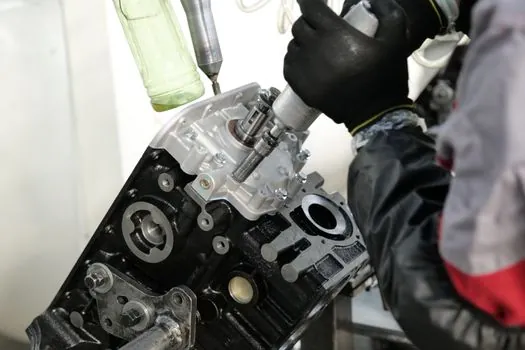
Smart stator lines now embed torque, vibration, and thermal sensors directly into winding heads, feeding EOL test data into MES for closed-loop control of magnet placement and balancing [S6]. Field-Oriented Control (FOC) calibration, detailed in a 2026 reference on EV traction motor control loops, depends on rotor-position resolver accuracy below 0.05 mechanical degrees, an order of magnitude tighter than legacy systems [S6].
Silicon-carbide (SiC) inverter co-design with the traction motor is now mandatory for 800V architectures, as SiC switching losses drop 30-50% versus silicon IGBT at 20 kHz, allowing motor designers to push continuous torque density above 25 Nm/kg [S6]. For a deeper dive into the FOC control loop, SiC switching, and resolver calibration workflow, the reference on EV traction motor control loop FOC SiC switching sensor calibration maps the full signal chain. Edge gateways aggregating these signals should be specified per current 2026 procurement maps [S5].
Limitations, Failure Modes, and Sourcing Constraints
Buyers should treat any vendor claim of "fully autonomous motor production" as marketing; the realistic 2026 state is human-supervised AI with exception handling, not lights-out manufacturing [S5]. Edge procurement teams sourcing the data-layer infrastructure should reference the 2026 edge gateway buyer's map to avoid over-specifying compute for line-side analytics. Permanent-magnet-free architectures (externally-excited synchronous, induction) are gaining traction precisely because they insulate the BOM from NdFeB price swings [S2][S7].
Standards, Sourcing, and Trackable Signals

No single IEC or ISO standard currently governs Industry 4.0 implementation in traction motor production; the closest reference frameworks are the RAMI 4.0 reference architecture model and the IIRA (Industrial Internet Reference Architecture), both published by industry consortia rather than standards bodies [S5]. Functional safety for motor EOL test cells typically falls under IEC 61508, with motor-specific performance covered by IEC 60034 and ISO 1940 for rotor balance grades [S7].
Trackable signals to watch through Q4 2026: OEM disclosures of MES-integrated motor plants, expansions at Jing-Jin Electric, Nidec, and BorgWarner tier-1 lines, and further consolidation in the 15-vendor leading market list that includes ABB, Hitachi, Mitsubishi Electric, and Continental [S3]. The commercial-vehicle sub-segment, tracked separately at a 2024-2030 CAGR near 29%, will be the next testbed for high-torque digital twin deployment [S8].