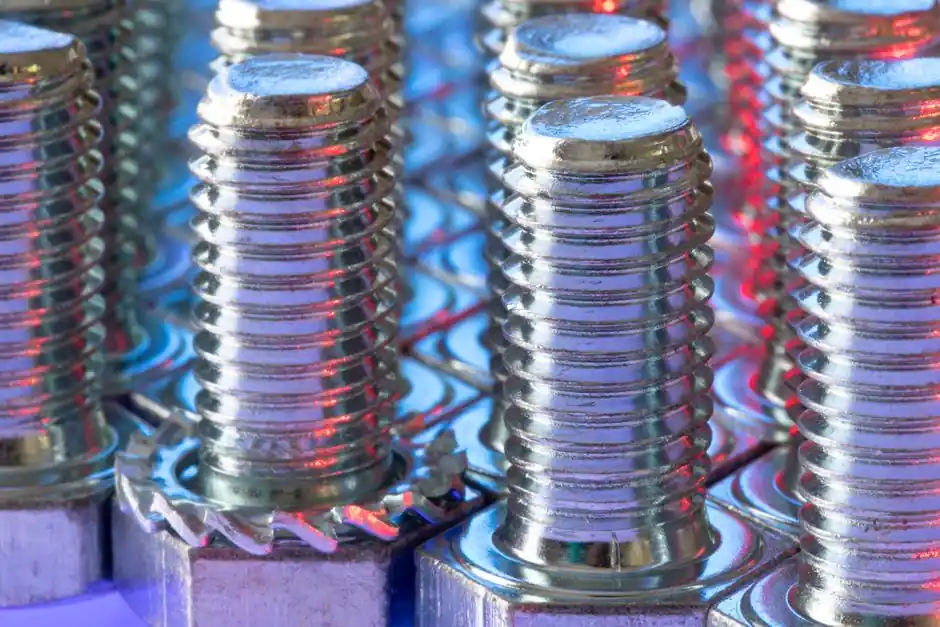
An industrial fastener production line is an end-to-end molding line-style chain of stations, but instead of shaping molten material it converts cold-drawn wire rod into headed, threaded fasteners: a typical cold-heading + thread-rolling + heat-treat flow runs 60-200 pieces per minute per machine at 8.8-12.9 grade carbon and alloy steels [S3].
Engineers sizing a new line decide first whether the plant runs bolts, nuts, screws, or anchors, because each product dictates the station list, the energy budget, and the quality-control gates [S3]. The reference architecture below uses bolt production as the canonical example, then extends to nuts and self-tapping screws where the station list diverges.
Stage Map: From Wire Rod to Bagged Fastener
A modern fastener line decomposes into seven sequential stages: (1) wire-rod pay-off and in-line drawing, (2) cold heading, (3) trimming/pointing, (4) thread rolling, (5) heat treatment, (6) surface finishing, and (7) sorting, weighing, and packing [S3].
Wire-rod diameter tolerance should be held to ±0.05 mm before the header; cold-heading machines in the 200-600 kN range are common for M6-M16 fasteners, while M20 and larger shift to multi-die headers or hot forming [S3]. The planning stage must lock material flow, station cycle time, and torque/quality target before any equipment order is placed, because layout mistakes propagate through every downstream station [S2].
Equipment Selection by Station
Cold headers come in 1-die-2-blow (parts 1-2), 2-die-3-blow (parts 2-3), and 3-die-4-blow configurations, with 2-die-3-blow being the workhorse for M5-M12 hex bolts at 80-150 SPM [S3]. Thread-rolling machines for M3-M12 use flat-die (planetary) rolling for high volume or cylindrical (through-feed) dies for longer threads, with surface finish and pitch accuracy dependent on die hardness (typically HRC 60-63) and lubricant film integrity [S3].
Heat treatment for 8.8-12.9 grade fasteners requires austenitising at 850-880 °C, quench, and temper at 400-550 °C, with continuous mesh-belt or rotary-hearth furnaces dominating mid-volume plants [S3]. Finishing is split between zinc electroplating (8-12 µm, ISO 4042), hot-dip galvanising (45-85 µm), and black oxide plus oil for indoor service. For the final visual and dimensional QC, a conveyor sorting line running optical sorting plus load-testing rejects out-of-tolerance parts at 0.5-1.5% in well-tuned facilities [S3].
Selection Criteria: What Drives Line Architecture
The three design drivers that decide architecture are: (a) fastener family, (b) annual volume, and (c) grade/strength requirement [S3]. For volumes below 500 t/year, a single header plus single thread roller plus batch furnace is the lowest-capex layout; for volumes above 2,000 t/year, parallel headers feeding a shared thread-rolling cell are the standard pattern, and above 10,000 t/year the plant shifts to integrated line-frequency furnace-linked heat treat with robotic transfer [S3].
Design for Manufacturing and Assembly rules from RPWORLD emphasise standardising on a single bolt type where possible, preferring snap joints or compressed edge folds over fasteners, and treating bolts-and-nuts as the last choice unless the joint requires it [S1]. The same logic in reverse applies to the plant: standardise on one M-grade (e.g. M3x6) and one strength grade (8.8) wherever the design allows, because each new size or grade multiplies tooling inventory, changeover time, and QC documentation by 5-10% [S1].
Comparison of Common Line Layouts
Layout choice is a trade between capex, changeover time, and floor area; the table below ranks the three standard architectures used for bolt plants shipping 500-10,000 t/year [S3].
Layout A: straight-line, single-flow, all stations in series. Lowest capex (~$0.8-1.2 M for a 1,500 t/year M6-M10 plant), simplest scheduling, but 100% stop on any single station failure [S3].
Layout B: cellular, 2-3 parallel headers feeding a shared thread-roll and heat-treat cell. Capex roughly 1.4-1.8x Layout A, but uptime climbs from 85-90% to 92-95% because the cell can be fed while a header is being tooled [S3].
Layout C: fully integrated with in-line induction heat treat, robotic transfer, and 100% automated optical + load sorting. Capex 2.5-3.5x Layout A, payback window typically 3-5 years for plants above 5,000 t/year of grade 8.8+ product, and defect rates drop to 0.1-0.3% on M6-M16 [S3].
Who the Modular Layout Is For, and Where It Fails
Modular cellular layouts suit mid-volume contract fastener makers and Tier-2 automotive suppliers because changeover to a new M-size takes 15-30 minutes instead of 2-4 hours on a hard-tooled line [S2]. Standalone, hard-tooled single-flow lines still win for very-high-volume, single-SKU runs (one M8 8.8 hex bolt at 10+ million pieces/month) where the changeover penalty is irrelevant and absolute capex minimisation matters [S3].
Modular layouts are not a good fit when the product mix demands frequent grade changes (8.8 to 10.9 to 12.9 in a single shift), because heat-treat recipe switches cost 45-90 minutes of furnace stabilisation time per change and dominate the daily schedule [S3]. Lines that mix cold-headed and hot-headed product also fail on a single cellular layout; these need a dedicated hot-form bay with its own billet preheater and trim press, separate from the cold header room [S3].
Standards, QC, and Where the Line Breaks
QC at each stage is a measurable standard, not a judgement call: dimensional tolerances per ISO 4759-1, mechanical properties per ISO 898-1 (property classes 4.6-12.9), thread geometry per ISO 965, and corrosion resistance per ISO 4042 for electroplating [S3]. Each station needs a defined cycle time, a defined in-process check frequency, and a defined torque/load target; the planning stage should specify these numerically before commissioning, because standards set after the fact rarely survive contact with production [S2].
The three failure modes that bite most often: (1) wire-rod decarburisation driving header cracks, (2) thread-rolling die wear allowing pitch errors above 0.05 mm on M8, and (3) heat-treat quench-tank temperature drift above 60 °C, which drops surface hardness below 32 HRC on grade 8.8 [S3]. For more on how spec-led procurement decisions flow into a comparable line-build exercise, see the welding robot production line workcell design note and the ABS plastic competitive landscape map for adjacent spec-driven layout thinking.
Operating Economics and Trackable Signals
Unit cost for grade 8.8 M8x30 hex bolt on a 3,000 t/year line sits in the $80-130/t range, with raw wire rod at 55-65% of conversion cost, labour at 8-12%, and energy (headers + furnace) at 10-15% [S3].
Next node to track: ISO 898-1 revision status and any tightening of property-class 10.9 and 12.9 ductility requirements, which will force header re-tooling and quench-media upgrades for plants targeting the upper grades; for a different angle on how spec discipline carries into upstream raw material buys, the ferrosilicon procurement map is a useful parallel read.