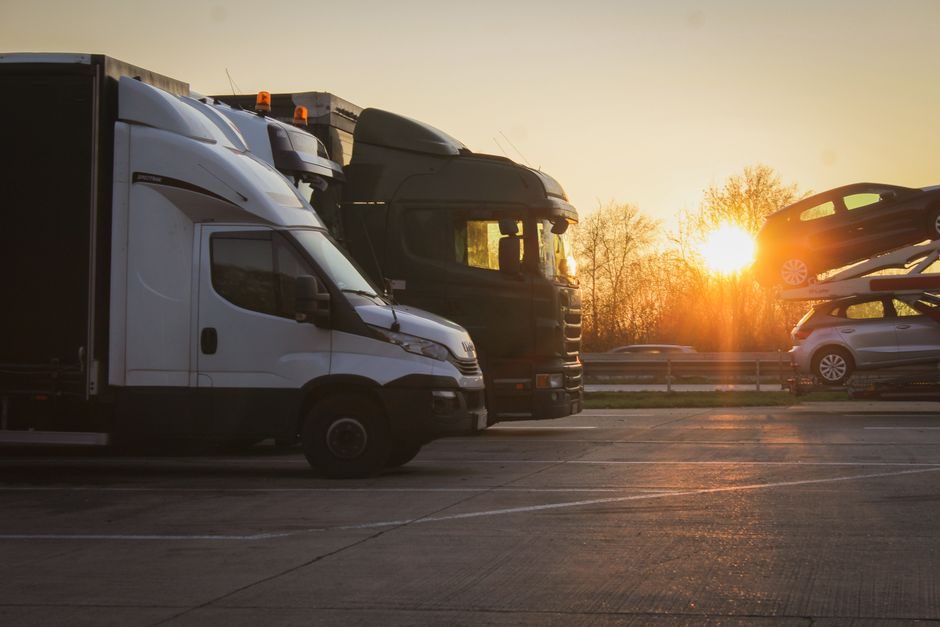
Reach trucks span 1.0–2.5 t capacity and 3,000–12,755 mm lift height in the 2026 OEM catalogues, so the first gate is matching rated load and residual capacity to the racking's highest beam [S1][S3].
Current 2026 lineups cluster into three bands: light-duty stand-up counterbalanced (1.0–1.5 t, 3–6.2 m), general-warehouse reach (1.4–2.5 t, 5–8 m), and high-rise / very-narrow-aisle (1.4–2.0 t, up to 12.75 m) — only the last one has the chassis stiffness and mast visibility for >10 m work [S1][S3].
Capacity, Load Centre and Residual Capacity Math
Rated capacity for a reach truck is declared at a 500 mm load centre — every 100 mm added to that distance cuts allowable load roughly 8–10 % on a typical 1.6 t chassis, which is why the CQD10L/15L and the Linde R-series both publish 500 mm as the reference figure [S1][S3].
Buyers who handle 1.5 t palletised goods on 1.2 m forks need a chassis rated 1.8–2.0 t, not 1.5 t, because the effective load centre has moved from 500 mm to ~700 mm and residual capacity at full lift drops sharply above 8 m mast extension [S1]. For a primer on the machine class itself, see the reach truck reference entry covering chassis, mast geometry and the counterbalanced vs straddle reach distinction.
Mast Height, Lift and Free-Lift Constraints
OEM data shows the practical envelope: CQD10L/15L tops out at 6,200 mm h3, the Linde R-series spans 5,795–11,455 mm, and the R1 X reaches 12,755 mm — the difference is mast section count, not just steel [S1][S3].
Free-lift (the distance the forks travel before the inner mast clears the outer stage) matters when loading into trailers or low-clearance mezzanines; triple-stage masts on the R1 X typically deliver 1,500–1,800 mm of free-lift versus 100–200 mm on a standard two-stage, so specifying the mast type is a hard gate before quoting a model [S1]. A second gate is collapsed mast height (h1): a 12,755 mm lift truck usually carries an h1 of ~2,950–3,200 mm and will not pass under a 3.0 m industrial door, which catches buyers upgrading from a 8 m unit [S1].
Aisle Width, Chassis Width and VNA Comparison
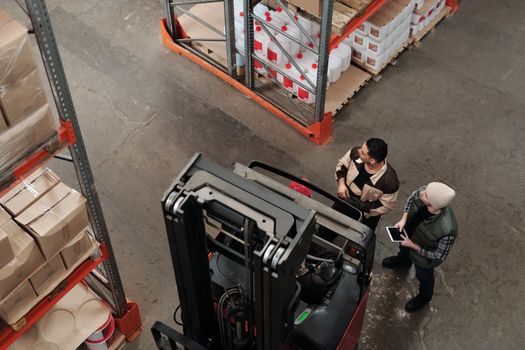
Chassis width drives the aisle: the Linde R14–R17 X ships at 1,270 mm overall width, while the 2.5 t R25 stretches to 1,670 mm — that 400 mm delta translates into roughly 500–600 mm of additional right-angle-aisle (AST) width required for equivalent pallet handling [S1].
For warehouses below 2,800 mm AST, a turret truck or articulated narrow-aisle chassis typically replaces the reach truck, because even the narrowest 1,270 mm reach chassis needs ~2,650–2,750 mm AST with a 1,000 × 1,200 mm pallet; reach trucks are not the right answer for true VNA. For higher-capacity lifting where the reach envelope still applies, a linear guide on the mast carriage is what holds deflection and repeatability together above 10 m — relevant to spec reviewers cross-checking mast suppliers.
Power Supply: Lead-Acid vs Lithium and Voltage Classes
2026 stock reach trucks remain dominated by 24 V / 48 V / 80 V DC traction packs, with the CQD10L/15L offered as DC or optional AC drive, and most R-series units using 48 V or 80 V AC controllers for regenerative lowering [S1][S3].
Lithium-ion (LFP) traction packs have largely replaced lead-acid on new EU-spec general-warehouse reach orders in the 1.6–2.5 t band, driven by opportunity charging and the absence of battery-change lifts; lead-acid still wins on absolute cost per kWh for 1.0–1.5 t light-duty units, and dual-battery lead-acid side-extraction remains the default on high-rise 80 V models where kWh per shift is high [S1][S3]. For a sister logistics-fleet decision, the AGV selection gate set covers load, guidance and duty cycle and pairs naturally with manual-reach fleet sizing.
Operator Type: Stand-Up, Sit-Down and Pantograph Reach

The CQD10L/15L is a standing operator counterbalanced reach with 1,000–1,500 kg capacity and 500 mm load centre; most R-series units are seated, and high-mast R1 X chassis are almost always sit-down because of the cabin lift (typically 1,500–2,000 mm cabin rise) needed at 10 m+ [S1][S3].
When the same site is moving bulk, not palletised loads, a dump truck selection set runs in parallel and rarely overlaps with reach-truck spec sheets.
Safety, Standards and the 2026 Specification Sheet
Reach trucks in the EU fall under EN ISO 3691-1 (safety of industrial trucks) and EN 1175 (electrical requirements); mast visibility, load-backrest, and operator-presence sensing are mandatory, while load-wheel guards are best-practice on any unit above 6 m lift [S1].
A 2026 spec sheet should fix: rated capacity at 500 mm load centre, residual capacity at maximum lift, h1 / h3 / free-lift, overall width, AST, travel speed laden/unladen, lift speed laden/unladen, battery voltage and capacity (kWh), controller type, and the EN ISO 3691-1 compliance line [S1][S3]. For comparison shopping against forklifts, telehandlers and aerial work platforms, a telehandler selection guide sits next to reach-truck sheets because the two machines are frequently cross-evaluated on construction or outdoor-yard sites.
Pricing Bands and Lead-Time Signals for 2026

DirectIndustry listings (2026-04) show 34 manufacturers and 109 reach-truck SKUs spanning 1.0 t light-duty to 2.5 t general-warehouse, with XCMG and Linde dominating the catalogue count; dealer stock (2026-07) lists a 2018 BT RRE160E Reflex at €12,950 with 5.1 m lift, a 2022 BT LWE160 Levio at €3,835, and a 2026 hand-pallet truck at €345 [S1][S2].
New-unit FOB China for a 1.0–1.5 t electric reach (CQD-class) sits in the US$4,500–7,500 range at tier-1 OEM pricing, against US$14,000–22,000 for an EU-spec 1.6–2.0 t R-series equivalent — a 2.5–3× delta that is the dominant cost gate for fleet buyers [S1][S3]. Track 2026 lead times on the Linde R14–R20 G-series (advertised as combined hall-and-yard) and the 80 V high-mast variants: both are the supply-constrained lines where 2025 order books spilled into mid-2026 deliveries [S1].
For a yard-side reach application that occasionally lifts personnel rather than pallets, the aerial work truck reference covers the regulatory boundary under EN 280 / ISO 16368 — a useful cross-check before reusing a reach-truck chassis in mixed service.