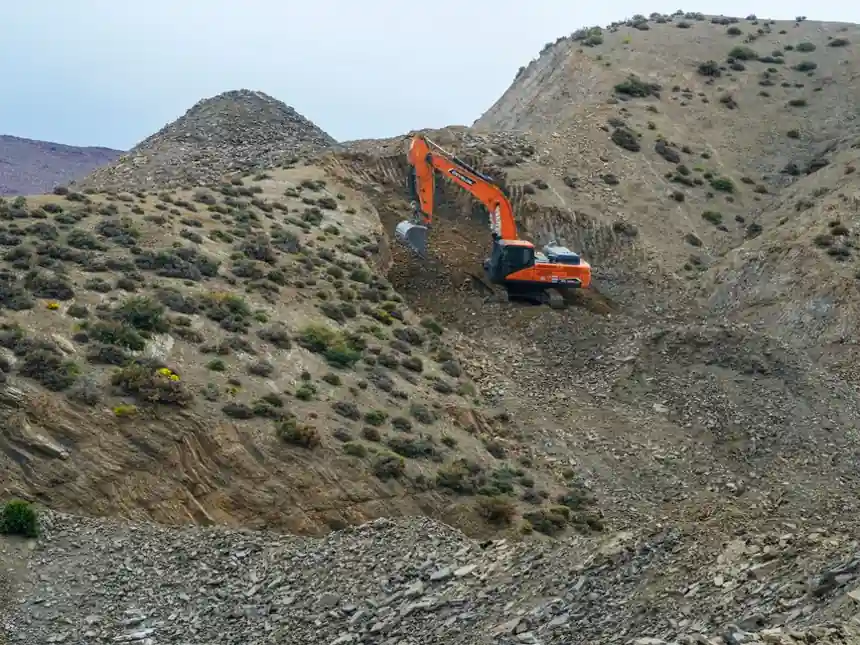
Operating weight is the single number that ties bucket capacity and dig depth together: a 1-7 t mini excavator typically pairs 0.01-0.5 m³ of bucket volume with shallow trench reach, while a 40-90 t large machine routinely runs 2.5-5.0 m³ buckets and digs well past 7 m [S3].
Pushing a bucket that is one class too large cuts breakout force per cubic meter, overloads the front lift envelope, and forces the operator to slow the swing, so the bigger bucket often moves less material per shift than a properly matched one [S1][S3].
Why the Trade-Off Exists: Weight, Hydraulics, and Lift Envelope
Heavier machines deliver higher hydraulic pressure and a larger lift envelope at any given radius, which is what allows them to swing a bigger, heavier bucket through a full dig cycle without stalling or tipping [S1]. Compact excavators in the 1-6 t band are usually bucket-rated at well under 1 yd³, while standard machines in the 7-45 t range are commonly paired with 0.5-2.5 m³ buckets, and anything above 90 t is where 5 m³-plus mass-excavation buckets start to make sense [S3][S5]. The trade-off is mechanical, not a marketing line: bucket mass sits out on the stick, so a 10-15% increase in bucket weight cuts the load the boom can lift at maximum reach by roughly the same proportion once you account for geometry.
Dig depth, in turn, is a function of boom, stick, and undercarriage geometry rather than bucket size directly, which is why two machines in the same weight class can post different max dig depths simply because one carries a longer stick [S2][S8]. A common field practice on trenching jobs is to spec the machine for a max dig depth at least 0.5-1.0 m deeper than the required trench invert, because real-world depth drops once the operator accounts for bucket heel, side clearance, and spoil pull-back [S8].
Decision Matrix: Bucket Volume vs Dig Depth by Size Class
The four-class breakdown below lines the main options up against the criteria that actually drive equipment choice: operating weight, typical bucket capacity, dig-depth band, and the kind of work the class realistically covers [S2][S3][S5].
For an excavator fleet planner this is the working shortlist: mini (under 1.5 t) handles sub-2 m trenches and 0.01-0.1 m³ buckets for landscaping and utility work; compact (1.5-6 t) covers most residential digs and 0.1-0.5 m³ trenching buckets; midi (7-10 t) reaches 4.3-5.5 m (14-18 ft) of dig depth with 0.4-0.8 m³ general-purpose buckets; standard (7-45 t) pairs 0.5-2.5 m³ buckets with 5-7+ m of dig depth for basements, ponds, and commercial work; large (45 t and up) and mass-excavation (90 t plus) move into 2.5-5.0+ m³ buckets for quarry and mining production [S2][S3][S5].
The mismatch penalty is concrete: a 5 t compact with a 1 yd³ (0.76 m³) bucket will lift it at the truck but will not develop breakout force to fill it in compacted clay, and the operator ends up half-filling each pass, which destroys the production case for going bigger [S3][S4]. The same physics shows up in the comparison data on excavator ground pressure, track width and weight: adding bucket mass without upgrading the undercarriage drops usable stability faster than the spec sheet suggests.
Who the Bigger Bucket Is For, and Who It Hurts
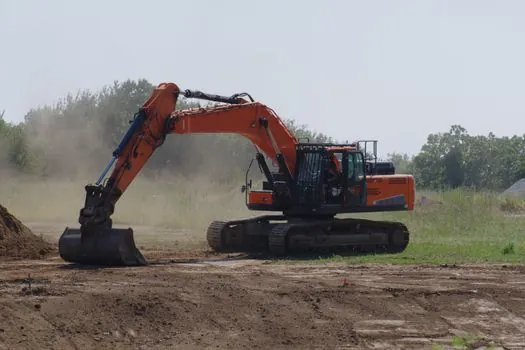
Spec a bucket at the high end of its machine class when the work is bulk material handling in soft to medium soil, when the dig depth is shallow enough that the operator is not working at maximum radius, and when the haul unit can take a heaped load in two or three passes rather than one [S1][S7]. Under those conditions, a 2.5 m³ bucket on a 30 t standard machine moves more bank cubic meters per hour than a 1.6 m³ bucket would, and the cycle time gain more than offsets the extra swing energy.
Do not push a bucket up a class for trenching, rock excavation, demolition, or grading. Trenching wants a narrow, deeper bucket to hold capacity at a small width; rock needs a severe-to-extreme-duty bucket sized to the machine's breakout force, not to the haul unit; demolition wants a heavy reinforced bucket under the machine's lift curve, not a light wide one; and grading wants a wide, low-capacity bucket to smooth rather than to dig [S1][S6]. On a 7-10 t midi, going past roughly 0.8 m³ is a productivity loss in anything other than loose topsoil, because lift capacity at full reach starts to govern before bucket volume does [S2]. The companion spec to watch on this kind of decision is bucket breakout force versus arm crowd force, covered in the excavator breakout vs crowd comparison.
Material Density and Fill Factor: The Hidden Multipliers
Bucket capacity is a struck volume; what actually ships per cycle is fill factor times material density. Wet river silt at roughly 1,600-1,800 kg/m³ bank weight will weigh a 1 yd³ (0.76 m³) bucket to about 1,200-1,400 kg, which is well within a 7-10 t machine's lift envelope; the same bucket heaped with saturated clay at 2,000+ kg/m³ can exceed the lift chart at full reach [S1][S4]. That is why a 30" bucket on a small Doosan, sized for a 1.66 cu yd standard reference, runs fine in soft previously-disturbed silt but punishes the hydraulics in undisturbed clay [S4].
For sourcing, published capacity figures from manufacturers (Caterpillar, Komatsu, Kubota, Bobcat, Hitachi, John Deere) follow SAE J296 heaped or struck conventions, and the field rule of thumb is to derate published capacity by 70-85% for cycle-time planning, with rock and demolition at the lower end of that band [S2][S7]. Material density also feeds back into bucket width selection: a narrow trenching bucket in dense soil needs the same mass at the teeth as a wider one in loose soil, which is why trenching buckets for compact machines are often only 12-24" wide even when the same machine can run 36" cleanup buckets [S3][S4].
Use Cases That Pin the Trade-Off to a Number
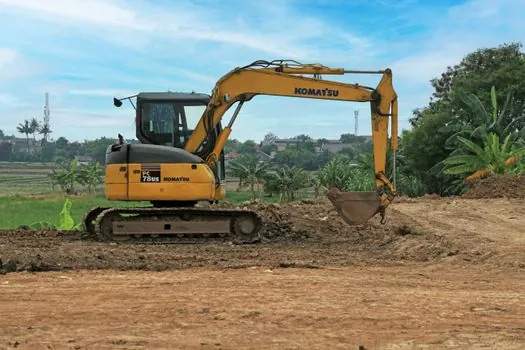
Utility trenching on a compact class machine: target 0.1-0.3 m³ bucket, dig depth 2.5-3.5 m, and spec the machine 0.5-1.0 m past the required invert so the operator does not lose depth to bucket geometry [S3][S8]. Basement dig on a standard 20 t machine: 1.0-1.6 m³ general-purpose bucket, dig depth 5.5-6.5 m, and watch lift capacity at maximum dump height more than bucket volume [S2][S5]. Quarry face loading on a 40-90 t large machine: 2.5-5.0 m³ severe-duty bucket, dig depth 7+ m, and pair the spec with a bucket elevator or feeder conveyor sized for the rated tons per hour the excavator actually produces, not the theoretical bucket volume times 60 cycles [S1][S3].
The pattern is consistent across these cases: bucket capacity scales with machine class, dig depth scales with class, and the right combination is the one that fills the haul unit in 3-5 passes at a working radius the operator can sustain, not the largest bucket the hydraulics can technically lift at the pin [S1][S7].
Failure Modes When the Trade-Off Is Ignored
Over-bucketing on a small machine shows up first as slow swing and stalling at the face, then as chronic track and swing bearing wear, and finally as a tip-over risk when the operator tries to lift at full reach over the side [S3]. Under-bucketing on a large machine shows up as poor truck-loading cycle time, excess engine hours per cubic meter moved, and the productivity loss that pushes a contractor to rent a bigger machine than the job actually needs [S1][S2].
The two failure modes bracket a usable decision rule: if a bucket cannot be filled to roughly 90% heaped in the prevailing material without exceeding the published lift chart at the working radius, it is the wrong bucket. If a bucket fills in two passes and the truck is waiting on the excavator, the next class down is probably the better buy, because it cuts mobilization cost, ground pressure on finished surfaces, and per-hour burn with no real production loss on shallow work [S2][S3][S5].
Track next: a 2026 spec map of operating weight, bucket capacity, and dig depth for the major OEM lines (Cat 302/303.5/308/320, Komatsu PC78/PC210/PC300, Kubota KX/KX080, Bobcat E20/E35/E85, Hitachi ZX30U/ZX300, John Deere 26G/35G/210G) and the lift-chart delta between heaped and struck ratings for the same bucket model. Watch for the cutting machine and trench-shield class on the same jobs, since bucket width often has to match the shoring box, not the pipe [S3][S4].