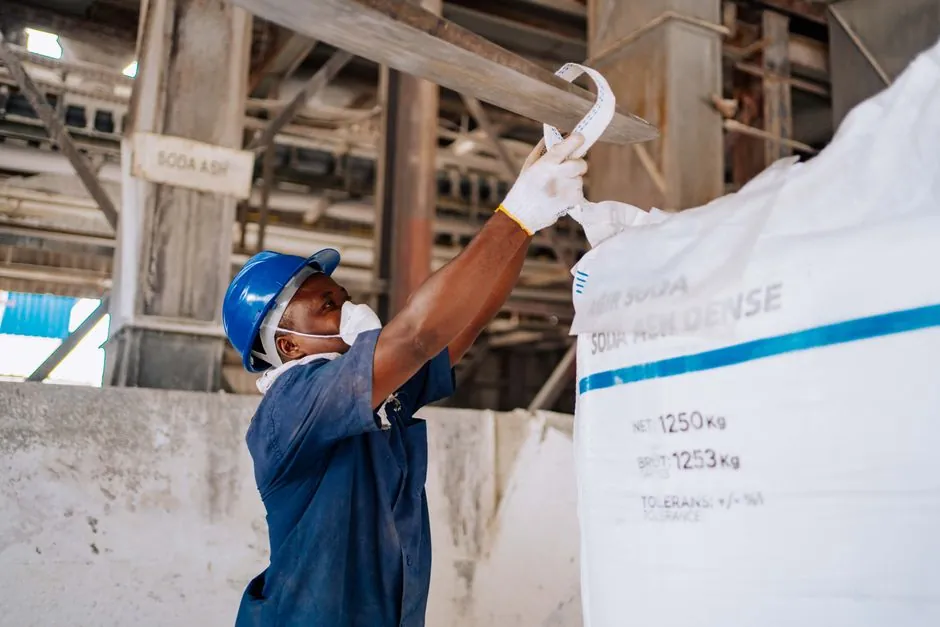
FIBC bulk bags, also called bulk bags or bulk bag Super Sacks, hold 500 to 4,000 lb of dry flowable product and are classified Types A through D by static-electricity control behaviour, with a UN 13/H2/Y certification mark required for hazardous goods [S1][S3].
E-commerce fulfillment operations, particularly those shipping fertilizers, plastic resins, mineral additives, and food ingredients in single-pallet or two-pallet quantities, increasingly specify FIBCs to consolidate unit count, cut touches, and stabilise trailer cube; the segment sits inside a global FIBC market reported at $4.2 billion in 2022 with 6.8% annual growth [S1].
Type A-D Static Control and Where Each Fits Fulfillment
Type A bags are constructed from plain woven polypropylene with no static dissipation and are only acceptable for non-flammable dry products handled in non-flammable atmospheres, ruling them out for any solvent-borne or fine-powder e-commerce line [S1][S8]. Type B bags share the same polypropylene body but withstand breakdown voltages below 6 kV to prevent propagating brush discharge, yet they remain ungrounded, so flammable vapours or dust clouds still disqualify them in fulfillment staging areas [S1]. Type C bags, also called conductive FIBCs, must be electrically grounded through a tab during fill and discharge, and they require a resistance path of typically 10^7 ohm or less end-to-end to safely bleed charge when handling flammable powders [S1][S8]. Type D bags use dissipative fabrics or quasi-conductive yarns that do not require grounding, addressing the same combustible-dust risk as Type C without the operator-grounding step, which simplifies high-throughput pick-and-pack cells [S1].
For a fulfillment centre handling only non-combustible dry goods (sand, certain fertiliser prills, plastic pellets, construction aggregate), Type A remains the lowest cost and the dominant specification; for combustible dust or flammable-vapour adjacency, the practical split in 2026 specifications is Type C where a documented grounding procedure exists and Type D where operations cannot guarantee grounding on every loop [S1].
Capacity, Safety Factor, and Loop Rating
Standard FIBC Safe Working Load (SWL) ranges from 500 kg to 2,000 kg (1,100 to 4,400 lb), with single-loop break strengths typically rated 1,500 to 2,000 lb each, and a 5:1 safety factor used for single-trip bags and a 6:1 factor for reusable or multi-trip bags per industry practice [S1][S4]. The 5:1 vs 6:1 choice directly affects fabric weight and seam construction: a 1,000 kg SWL bag at 5:1 is built to a 5,000 kg minimum breaking tensile, while the same SWL at 6:1 pushes to 6,000 kg, normally expressed through heavier denier fabric and reinforced corner stitching [S1].
E-commerce fulfillment buyers typically order 1,000 kg SWL with 5:1 safety factor for single-trip palletised outbound orders, stepping up to 1,500 kg SWL with 6:1 for returnable loops used in closed-loop supplier-to-warehouse flows; mismatched SWL versus pallet jack or forklift tine rating is one of the most common audit findings on a bag filter or FIBC dock [S1][S4].
Filling and Discharge Spout Geometry

Inlet filling spouts commonly measure 14 to 16 inches in diameter and protrude 12 to 18 inches from the bag body to interface with gravity or auger fillers, while discharge spouts range from 14 to 24 inches in diameter, sized to product flow characteristics and to downstream hopper or conveyor geometry [S1]. Open-top bags without a fill spout are the lowest cost option for non-dusty aggregate, but they generate measurable particulate at the dock; duffle-top bags with a drawcord balance air bleed and product containment for cement and fine-powder applications [S5].
Discharge selection pivots on reuse intent: a full-open base with a protection flap gives the fastest empty and lowest bag cost for single-trip fulfillment, while spout-bottom with iris protection or petal closure supports controlled discharge and supports food-grade hygienic re-use for 1 to 3 trips [S5]. For e-commerce, a 16-inch fill spout paired with a 14-inch discharge spout is the typical default on 1,000 kg SWL bags handling free-flowing resin or grain, and an inner PE liner is added whenever moisture-vapour transmission or sifting leakage is a fulfilment complaint [S4][S5].
Material, Liner, and Compliance Options
Woven polypropylene (WPP) is the baseline fabric across all four types, with virgin resin specified for food-contact and pharmaceutical-contact use, and recycled-content options available where traceability is not audit-critical [S3][S4]. Coated WPP adds a polypropylene or polyethylene film laminate to reduce dust sifting and to lift moisture-vapour resistance, and an inner liner, typically 2 to 4 mil LDPE, can be specified separately when only the product-contact side needs the barrier [S3].
Compliance marks to verify on the bag's attached document pouch (typically a 6x9 inch sleeve on the body) include UN 13/H2/Y for hazardous-material packaging groups II and III, food-grade documentation such as FDA 21 CFR or EU 10/2011 compliance statements for direct-to-consumer food shipments, and ISO 21898 for the FIBC manufacturing chain [S1]. A practical decision matrix for fulfillment buyers: choose coated WPP without liner for non-sensitive dry goods, add PE liner for moisture-sensitive powders, and switch to food-grade virgin WPP with liner and audit paperwork for any consumable shipped under a brand label [S3][S4].
Cost, Lead Time, and Total-Cost Levers

The FIBC itself is the most expensive line item in a bulk-bag-filling system, ahead of the filler, conveyor, and palletiser, so bag spec changes drive the largest cost swing in a fulfillment project [S6]. Volume purchasing yields the steepest unit-price drop: standard 1,000 kg Type A bags at pallet-of-5 quantities price markedly higher per bag than full-truckload orders, and most domestic converters quote 2 to 4 week lead times on stocked SWL/fabric combinations and 6 to 10 weeks on custom-printed or food-grade runs [S1][S6].
Freight efficiency from fewer touches is the operational ROI: replacing 40 x 50 lb paper bags (one pallet, multiple touches) with a single 2,000 lb FIBC typically removes 39 to 40 handling steps and consolidates one outbound pallet rather than two, which directly cuts pick-pack stage time and lowers freight-damage claims on long-haul lanes [S2]. For facilities staging outbound containers, consistent bag footprint and stable pallet loads also improve cube utilisation by 10 to 15% relative to mixed small-pack pallets, a figure repeatedly cited in fulfillment-transport studies [S2][S7].
Failure Modes and Spec Traps to Avoid
Overfilling above SWL is the most common safety and regulatory failure, often driven by scale drift on bagging lines and by operators chasing throughput targets; periodic scale calibration and SWL placard checks at the dock are the cheapest mitigation [S1][S4]. A second failure mode is mismatched Type and atmosphere: a Type A or B bag walked into a flammable-vapour zone during unloading has caused multiple documented flash incidents, and the corrective control is colour-coded loop straps plus a printed Type letter on the bag body so the receiver can verify before slinging [S1]. A third trap is specifying conductive Type C bags without mandating a grounded filling station; if the operator skips the grounding tab, the bag becomes a static accumulator and is functionally a Type A in a hazardous zone, defeating the spec [S1][S8].
Handling-method fit matters as much as bag spec: standard four-loop bags suit consistent forklift handling across shifts, while single-loop or cross-corner loop designs are used with specific crane or hoist setups and should not be interchanged without re-validating lift geometry [S2][S3]. A related lever for high-volume sites is the pressure transmitter used on the bag-filler weigh hopper, where 0.1% accuracy load cells paired with a stable signal conditioner are the practical baseline for hitting the SWL on every cycle without chronic underfill giveaway.
Selection Checklist for E-commerce Fulfillment Buyers
Step 1: confirm product hazard classification and dust-combustibility, then map to Type A, B, C, or D; default to Type A only when both product and atmosphere are demonstrably non-flammable [S1][S3]. Step 2: set SWL and safety factor (5:1 single-trip, 6:1 multi-trip), then validate loop break strength against your forklift or hoist rating, a step often skipped and a frequent industrial valve-spec parallel where undersized actuators get matched to oversized lines [S1][S2]. Step 3: choose fill and discharge geometry (open top vs duffle vs spout, plain bottom vs spout discharge vs full open) from your existing filler and downstream hopper interface [S5]. Step 4: specify liner and coating only where product-protection data justifies the cost, not by default [S3]. Step 5: confirm compliance marks (UN 13/H2/Y, food-grade documentation, ISO 21898) and require the certificate inside the bag's document pouch on every shipment [S1][S4].
Track the next node: revised ISO 21898 audit timing on food-grade runs (most converters now require 12-month audit cycles), and any 2026 push by major US retailers to demand recycled-content disclosure on woven-polypropylene bags shipped into their fulfillment network, both of which will reshape quote sheets within the next two quarters [S1][S7]. For deeper guidance on bag-style variants and panel construction, the bulk bag encyclopedia entry collects the canonical U-panel, four-panel, and circular-woven comparison most spec sheets reference.
The underlying component specifications are covered under bulk bag, bag filter, and pressure transmitter.
For related coverage, see Strapping Band Selection for Food and Beverage Lines.