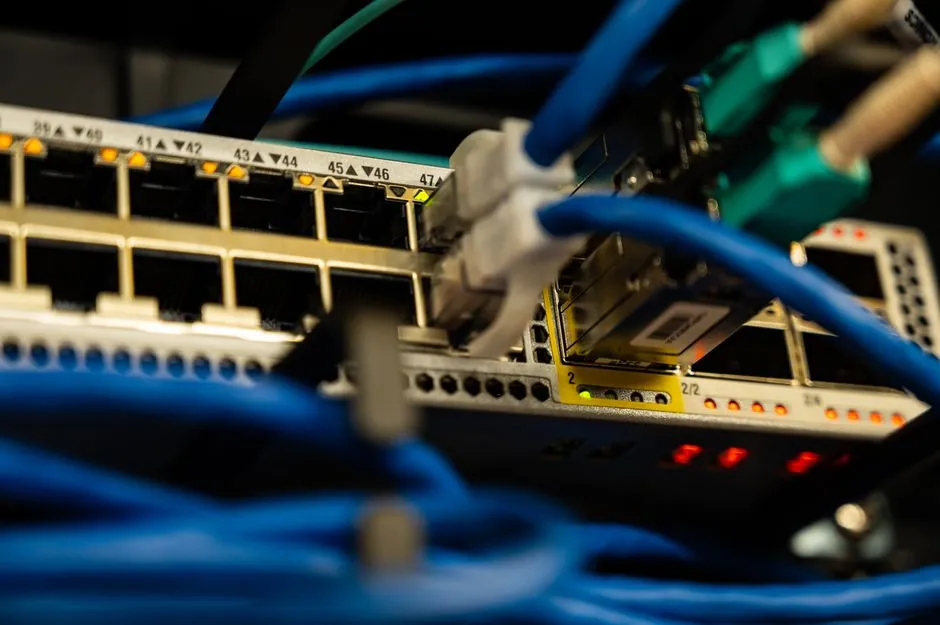
Fiber media converter selection in 2026 collapses to four binding decisions: copper reach (the 100 m limit of twisted pair), fiber mode (multimode for sub-2 km runs, single-mode beyond), port speed (10/100, 1G, 10G), and the operating environment (IP rating, temperature, mounting) [S3][S6].
Once those four are pinned down, the converter itself is largely a commodity: most industrial units now ship as copper-to-fiber bridge modules, SFP chassis cards, or hardened standalone boxes, with PoE variants in the same form factor [S2][S4].
Definition and Scope: What a Fiber Media Converter Actually Does
A fiber media converter is a Layer 1 or Layer 2 device that maps electrical Ethernet signals on copper RJ-45 to optical signals on fiber, and, in managed units, performs rate conversion, VLAN tagging, and LFPT (Link Fault Pass-Through) [S2][S5]. Most units in 2026 ship with 10/100/1000Base-T on the copper side and either a fixed SC/LC optic or a hot-swappable SFP cage on the fiber side [S2][S3].
Scope outside the Ethernet-to-fiber core: serial-to-fiber (RS-232/422/485 over fiber for legacy PLC and instrumentation links), fieldbus-to-fiber (PROFIBUS, Modbus RTU), and fiber-to-fiber wavelength conversion for WDM upgrades [S1]. These remain a small share of unit volume but a large share of installed industrial sites where copper was never an option in the first place.
Per DigiKey's product taxonomy, converters are filtered on seven primary characteristics: type (managed/unmanaged), configuration (standalone vs modular), copper ports, fiber ports, SFP/XFP ports, distance rating, and voltage input [S2]. Treat that list as a checklist during RFQ: if a vendor's datasheet does not populate all seven, the spec is incomplete.
Selection Criteria: Distance, Mode, Speed, Environment
The copper limit is the first hard number. Twisted-pair Ethernet fails the 100 m spec beyond the rack, so any link longer than that needs fiber, and once fiber is in, a media converter is usually the cheapest way to graft it onto existing copper switches [S3][S5].
Distance and mode then drive the optics. Multimode (OM3/OM4) with 850 nm VCSEL SFPs typically covers links up to about 300 m on 1G and 550 m on 10G (OM4); single-mode 1310 nm or 1550 nm SFPs cover 10 km, 40 km, and 80 km reaches depending on the optics [S3][S6]. If the link budget is unknown, assume 6-8 dB of loss per connector pair plus 3 dB/km on OM1 multimode at 850 nm, and over-spec the optics by one power class.
Speed is the second filter. Legacy 10/100 copper is still common on PLC and instrument networks and pairs naturally with 100Base-FX multimode SC converters; new builds should default to 10/100/1000 triple-speed copper with a 1G SFP cage, which accepts both 1G and (with an SFP+ adapter caveat) 10G optics [S3]. PoE passthrough (60 W PoE++ over copper, fiber uplink) is a separate variant and is the right call for any new IP-camera or wireless-AP run [S4].
Environment is the third filter and the one most often under-specified. Indoor commercial units are typically IP20 and 0-50 °C; industrial units move to IP30-IP40 and -10 to 60 °C; outdoor cabinet or substation sites need IP65/IP67 and -40 to 75 °C, often with conformal coating [S2][S4]. Per IEC 60079-style zone thinking (verify the exact zone classification on site), any converter installed in a hazardous-area cabinet must itself carry an ATEX/IECEx-rated enclosure or be mounted outside the classified boundary.
Variant Comparison: Standalone vs Chassis vs Hardened
Standalone unmanaged converters are the cheapest path: a fixed copper port, a fixed SC or LC fiber port, a 5 V or 12-48 V DC input, and a DIN-rail clip. They are appropriate for one-off links in a control cabinet where no diagnostics are required and a link failure is observable from the SCADA [S2][S5].
Chassis-based modular converters (a 12- or 16-slot rack with hot-swappable media converter cards) fit site-wide fiber rollouts with mixed speeds and fiber types. They give you per-port LFPT, SNMP, and a single managed head-end, at roughly 1.5-2.5x the per-port cost of standalone units [S2][S3].
Hardened industrial converters add wide-temperature components, conformal coating, dual 12/24/48 V DC inputs with polarity protection, and IP30+ housings. They are the right call for roadside cabinets, substations, wastewater plants, and any -40 to 75 °C site [S2][S4].
PoE media converters add 802.3af/at/bt (15.4 W / 30 W / 60-90 W) injection on the copper port, with the fiber uplink carrying only data. They eliminate a separate power drop for cameras, APs, and small access controllers and are widely used in transportation and perimeter-security builds [S4].
SFP-to-SFP fiber-to-fiber converters are a niche but real category: they change wavelength (e.g. 850 nm multimode to 1310 nm single-mode) without touching the copper side, enabling WDM upgrades on existing fiber plant [S3].
Who Should and Should NOT Pick a Media Converter
Pick a media converter when the cable plant is mixed (some copper, some fiber), the link distance exceeds 100 m, or a single device needs to be brought onto a fiber ring without replacing the upstream switch [S3][S5]. This is the default case in brownfield industrial sites and most enterprise campus expansions.
Do not pick a media converter when the entire link is copper and well under 100 m (use a regular Ethernet cable), when both ends are already fiber and the switch already has an SFP cage (use the SFP directly), or when the application requires sub-millisecond failover with ring redundancy (use an industrial Ethernet switch with ERPS or DLR, not a converter pair) [S3][S5]. Media converters do not participate in ring protocols; they break rings.
Do not pick a media converter when the spec calls for TSN (Time-Sensitive Networking), 802.1Qbv scheduling, or precise PTP timing propagation, because a converter is at best a transparent bridge and most do not preserve 802.1AS timing across the optical domain. Use a TSN-capable switch instead.
Use Cases: Where the Spec Lines Up
Substation and utility OT networks: hardened -40 to 75 °C, dual 48 V DC inputs, IEC 61850-3 conformance (where the converter is specced to it on the datasheet), and single-mode 1310 nm SFPs at 20-40 km reach between substations. This is the textbook hardened converter use case [S2][S4].
Factory floor and process plants: a 1G copper-to-multimode converter feeding an SCADA ring, with PoE passthrough for a few IP cameras at the cell. Temperature -10 to 60 °C is usually enough if the cabinet is climate-controlled; -25 to 70 °C if not [S2][S4].
Transportation and roadside: IP65/IP67 housings, surge protection on the copper and power inputs (typically 6 kV per IEC 61000-4-5 on industrial datasheets), and extended-temperature components. Single-mode 1310 nm SFPs at 10-20 km for backhaul between intersections or stations [S2][S4].
For a chemical-plant-flavored deep dive on ATEX zones, fiber routing, and ingress pairing, see Fiber Media Converters for Chemical Plants: A 2026 Spec Map.
Limitations, Failure Modes, and Sourcing Standards
Link Fault Pass-Through (LFPT) is the single feature that separates a usable managed converter from a debugging nightmare. Without LFPT, a fiber cut shows up only as a "link down" on the far end; with LFPT, the copper port on the near end also drops, so a PLC or switch sees the fault immediately [S2][S3]. Specify LFPT explicitly on the RFQ.
SFP compatibility is the second most common failure point. Not every SFP works in every converter; vendors lock optics via serial-ID checks. Either buy the SFP from the same vendor as the converter, or buy a converter that has a documented third-party optics whitelist [S3][S7]. Industrial temperature-rated SFPs (I-temp, -40 to 85 °C) cost roughly 2-3x commercial-temperature SFPs and are worth it for any outdoor or unconditioned cabinet.
Standards to anchor on: IEEE 802.3 for the Ethernet PHY, IEEE 802.3af/at/bt for PoE, IEC 61000-4-5 for surge, and (where applicable) IEC 61850-3 or IEEE 1613 for substation-grade vibration and ESD. Verify the exact conformance claim on the vendor datasheet; do not infer it from the product family name.
For a broader look at how a converter sits next to industrial routers, switches, and gateways on the same plant network, see Industrial Router Selection: A Spec-First Map for 2026 and the related Industrial Router Suppliers: 2026 Spec Map and Selection Guide. For the underlying physical-layer conversion device class, the fiber converter reference page collects the core terminology.
For most 2026 brownfield projects, a standalone or 1-slot modular 10/100/1000 copper-to-SFP converter with LFPT, a 12-48 V DC input, and an I-temp SFP is the shortlist default; deviate only when the site forces PoE++, substation hardening, or a wavelength conversion that justifies a fiber-to-fiber unit. The next signal to track is how aggressively 1G single-pair Ethernet (SPE) converters displace RJ-45 copper runs inside cabinets, since SPE changes the "copper or fiber" decision that currently defines the converter market.
Spec-level background on the components involved: linear guide, and crossed roller guide.