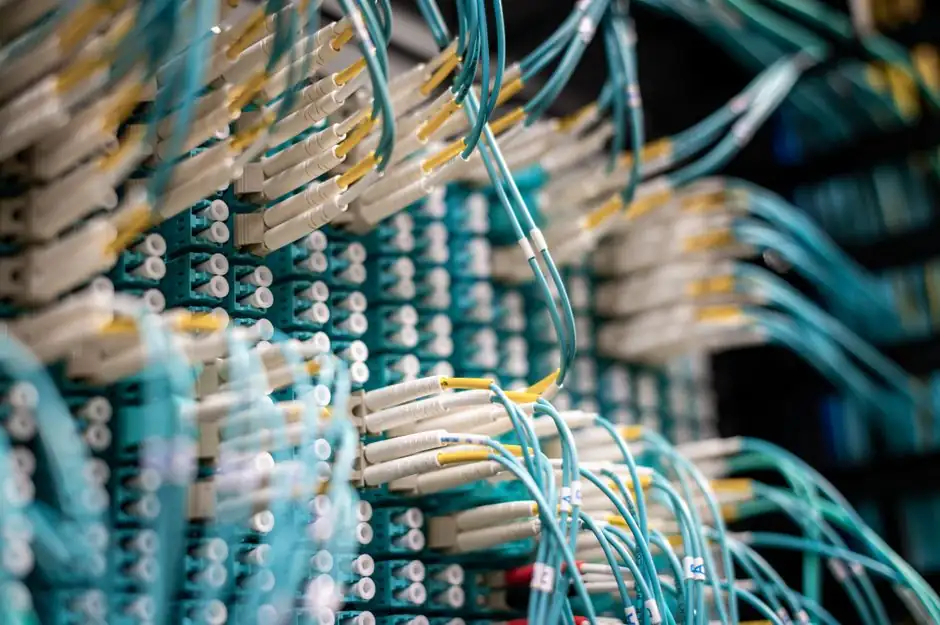
A fiber media converter is the right tool when copper Ethernet's 100 m reach limit stops being acceptable and the link budget, distance, or EMI environment of optical fiber is required, with selection gated by distance, fiber mode, speed, and connector [S1][S3].
Most enterprise, industrial, and surveillance buyers land in one of four jobs: extend a copper switch port over fiber, bridge between multimode and single-mode plant, light a single fiber strand with BiDi/WDM, or carry PoE to a remote camera or AP over fiber [S1][S2][S4].
Distance and Fiber Mode Set the First Boundary
Copper twisted-pair Ethernet is hard-capped near 100 m, so any link past that distance is the trigger to specify a fiber media converter [S2]. Multi-mode fiber (MMF, typically OM3/OM4 at 850 nm) covers roughly 200-550 m at 1 G and shorter at 10 G, while single-mode fiber (SMF, 1310 nm or 1550 nm) routinely carries 10-40 km and, with extended optics, 100+ km [S1][S5].
If the existing plant is OM3 MMF with LC connectors and the run is under 300 m, a basic 850 nm MMF SFP pair is the lowest-cost fit; if the run crosses building-to-building or exceeds 2 km, SMF at 1310 nm is the only honest answer [S1][S4]. Mode-mismatch (MMF plugged into an SMF port, or vice versa) is the single most common field failure, and a dedicated multimode to single-mode converter is needed when both plants are present in the same link [S1].
Speed, Connector, and Wavelength Must Match the Cabling
Port speed tiers line up as Fast Ethernet (100 Mbps, 100BASE-FX), 1 Gigabit (1000BASE-SX/LX), 10 Gigabit (10GBASE-SR/LR), and 25/40/100 Gigabit for data-center spine use, and the converter's electrical side has to match the host device (10/100 or 10/100/1000 auto-negotiation is the safe default) [S2][S4]. Most modern units ship as SFP / SFP+ media converters, where the optical module is hot-swappable; fixed-port converters still exist for cost-sensitive 100M and 1G links.
Connector type (LC, SC, ST) and wavelength (850 nm MMF, 1310 nm SMF, 1550 nm SMF) must be identical on both ends of the link, otherwise the optical budget will not close [S1][S3]. LC has displaced SC as the default on 1G/10G SFPs; ST is mostly legacy 100BASE-FX and OM1 62.5 µm MMF. For single-strand plants, BiDi SFPs use WDM to send 1310 nm one way and 1550 nm the other on one fiber, halving the strand count but requiring matched BiDi pairs at both ends [S4][S5].
Single-Fiber BiDi vs Dual-Fiber: A/B Pairing Logic
Single-fiber BiDi media converters cut fiber count in half by multiplexing two wavelengths over one strand, but they only work when both ends use a matched A/B pair (one side transmits at 1310 nm and receives at 1550 nm, the other does the reverse) [S4][S5]. Dual-fiber converters use one strand per direction and are far more forgiving in spares and troubleshooting, since either strand can be re-patched without wavelength pairing.
The decision rule is straightforward: if the building already has a single dark fiber strand between two points, specify a matched BiDi pair (A on one end, B on the other, same speed); if two or more strands are available, dual-fiber is cheaper per port and easier to support [S5].
PoE, Managed vs Unmanaged, and Industrial Hardening
If the remote device is an IP camera, wireless AP, or access controller, a PoE media converter delivers both data and power (IEEE 802.3af/at/bt) over the copper output port, with the 90 W 802.3bt PoH class appearing in newer industrial lines [S3][S4]. Power budget is the real spec: a 30 W 802.3at converter cannot feed a 60 W PTZ heater load, and a 60 W bt unit cannot feed a 90 W PoH load, regardless of marketing.
Unmanaged converters are plug-and-play and the right answer for fixed, simple links; managed converters add VLAN tagging, QoS prioritization, port access control, bandwidth limiting, and remote diagnostics, and they pay back on links that have to be monitored from a NOC [S2][S4]. For plant-floor, traffic, or outdoor cabinets, an industrial-rated unit (often IEC 61850-3 / IEEE 1613 for substation, or -40 to 75 °C operating range) is the correct pick; office-grade plastic chassis converters fail fast in those environments [S3].
Selection Criteria Compared: Four Realistic Options

For a 250 m office-floor link between two gigabit switches on OM3 MMF with LC connectors, a 1G SFP media converter with 850 nm SX SFPs (unmanaged, no PoE) is the cheapest correct choice, typically well under 100 USD per pair [S1][S3]. For a 15 km building-to-building campus link on SMF with LC, a 1G LX SFP converter at 1310 nm is the standard fit and the dominant pattern in enterprise dark-fiber builds [S1][S4].
For a roadside traffic cabinet powering two PoE+ cameras 3 km back to a roadside node, a hardened managed PoE+ media converter with SMF SFPs and -40 to 75 °C rating is the correct spec, and the industrial wireless module at the cabinet often shares the same fiber uplink [S3][S4]. For a data-center spine running 10G between floors, a 10G SFP+ converter pair with LR optics (1310 nm, 10 km SMF) is the baseline, and SR (850 nm MMF) only fits inside-room runs under ~300 m [S1].
When a Media Converter Is the Wrong Tool
If both ends of the link are already fiber-capable switches or routers, a media converter is an extra box, an extra power supply, and an extra failure point, and a direct SFP-to-SFP patch is the right answer [S2]. If the distance is under 100 m and EMI is not a problem, copper is cheaper and simpler.
Media converters also do not magically fix fiber plant problems: dirty connectors, mismatched polarity, or a SMF/MMF patch through a passive coupler will still break the link with a converter in line [S3]. Buyers should also avoid pairing a 100BASE-FX (1310 nm MMF) optical SFP with a 1000BASE-SX (850 nm MMF) SFP at the far end, even on the same OM3 cable; the speed and wavelength have to agree on both ends.
Sourcing, Standards, and Shortlist Logic

Compliance signals to look for on the datasheet, not just the brochure, are IEEE 802.3 / 802.3u / 802.3z / 802.3ae for the electrical and optical Ethernet PHYs, IEEE 802.3af/at/bt for PoE, and IEC 61850-3 / IEEE 1613 for substation-grade industrial sites [S3][S4]. For multisite vendor consistency, locked SFP brands (Cisco, Juniper, HP) reject third-party optics by default, so a third-party-compatible converter + third-party SFP pair saves money only if the host switch accepts it [S4].
Shortlist logic: lock the distance and fiber mode first, then the speed and connector, then PoE and management, then hardening. If the fiber plant already exists, the converter choice is essentially forced by what is in the wall; if the fiber plant is being built new, BiDi on a single strand is worth a look only when dark-fiber cost or strand count is the binding constraint [S5]. For buyers sourcing routers and switches alongside the converters, the industrial router suppliers 2026 spec map is a useful cross-reference, and the explosion-proof electrical selection guide covers the hazardous-area side of cabinet design when the converter sits in a classified zone.
The underlying component specifications are covered under dc dc converter, and vfd.