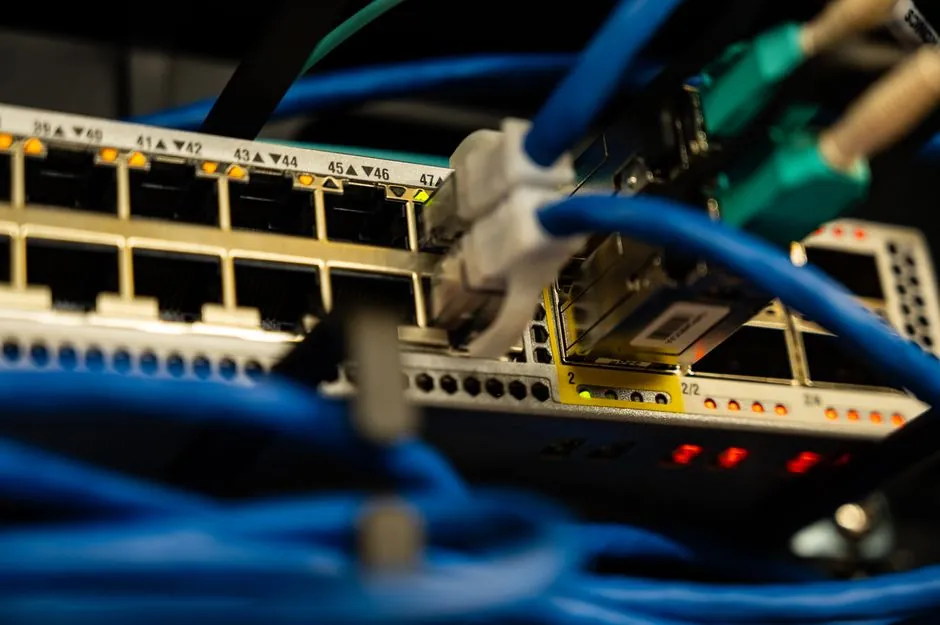
Eight specialist manufacturers supply industrial fiber media converters at 100M, 1G, and 10G data rates, including Advantech [S1], Phoenix Contact [S3], Perle [S7], Versitron [S8], Planet Technology [S2], Wintop [S5], and Fiber-Mart [S6], with Moxa, TP-Link, and NETGEAR named in a 2025-12 buyer guide [S4].
Catalogs span copper-to-fiber Ethernet, fieldbus-to-fiber (PROFIBUS, CANopen, DeviceNet), and serial RS-232-to-fiber converters, with reach figures of 15 km on single-mode 1310 nm SC [S2] and up to 80 km at 1 Gbps in the Phoenix Contact Ethernet family [S3].
Supplier landscape and what each one actually sells
Advantech positions its industrial media converter line for harsh-environment Ethernet-to-fiber conversion [S1]. Phoenix Contact splits the catalog into three functional buckets: Ethernet media converters (data rates up to 1 Gbps, distances up to 80 km), PSI-MOS PROFIBUS converters (transparent protocol, all data rates up to 12 Mbps, intrinsically safe ex op is FO interface for Zone 1), and CANopen/DeviceNet plus RS-232 serial converters, all DIN-rail mountable with integrated optical diagnostics [S3]. Perle markets the largest converter offering in its portfolio and supports copper-fiber bridging across enterprise and industrial grades [S7]. Versitron sells hardened fiber converters for industrial Ethernet, again with the harsh-environment framing [S8].
Planet Technology USA lists TAA/NDAA-compliant DIN-rail and wall-mount units including the XT-705A (10G/5G/2.5G/1G/100M copper to 10GBASE-X SFP+, 5 V DC at 2 A max, 3.75 W / 12.8 BTU per hour max) and the FST-802S15 (10/100Base-TX to 100Base-FX, single-mode, 1310 nm, 15 km, SC) [S2]. Wintop categorises its SKUs by speed tier (155M, 1.25G, 10G), PoE support, and chassis (WT-8100W 10G, WT-8110GSB series 1G, WT-8112SB series 100M), with QSFP28 and SFP+ transceivers sold alongside [S5]. Fiber-Mart supplies Ethernet, Fast Ethernet, Gigabit, and 10-Gigabit converters plus data-communication variants [S6].
Spec ranges you can compare across the eight suppliers
Across the catalogs, speed tiers cluster at 100 Mbps (10/100Base-TX to 100Base-FX), 1 Gbps (10/100/1000Base to SFP or fixed SC/LC), and 10 Gbps (10GBASE-T to 10GBASE-X SFP+) [S2][S5]. Power input is typically 5 V DC at 2 A max on the Planet XT-705A [S2], while DIN-rail industrial lines from Phoenix Contact accept the wider 24 V DC industrial bus and integrate optical link diagnostics [S3].
Fiber reach is the second differentiator: 15 km is a common single-mode 1310 nm baseline (Planet FST-802S15 SC) [S2], while Phoenix Contact publishes an 80 km ceiling for its 1 Gbps Ethernet converters when paired with the right single-mode optics [S3]. Form factors split into three camps: standalone DIN-rail/wall-mount (Planet XT series, Phoenix Contact, Advantech, Versitron), modular chassis (Planet MC-700, MC-1500, MC-1500R, MC-1500R48 [S2]; Wintop WT-814-2A and WT-816-2A media converter racks [S5]), and PoE-capable standalone units (Wintop WT-P8100G, WT-P8110GSA-20 [S5]). Hazardous-area Zone 1 fiber interface certification is explicitly carried by the Phoenix Contact PSI-MOS PROFIBUS and RS-232 lines as "ex op is" [S3].
Criteria-based comparison: industrial Ethernet vs fieldbus vs serial converters
For an Ethernet backbone lift, Advantech [S1], Planet XT-705A/XT-715A [S2], Perle [S7], Versitron [S8], and the Phoenix Contact Ethernet line [S3] cover 100M to 10G with copper-fiber and SFP options; Phoenix Contact extends reach to 80 km at 1 Gbps [S3]. For factory fieldbus retrofits (PROFIBUS, CANopen, DeviceNet), only Phoenix Contact's PSI-MOS family fits, with data rates up to 12 Mbps, automatic data-rate detection, bit retiming for cascading, and ex op is Zone 1 fiber interface [S3]. For RS-232 serial runs, Phoenix Contact again supplies the only listed option, converting serial to fiber to remove EMI and potential-difference faults, also with ex op is Zone 1 rating [S3]. Cost-effective single-mode 15 km runs at 100 Mbps are addressed by the Planet FST-802S15 at $86.00 list, while the 10G XT-705A sits at $192.00 and the 10G XT-715A at $136.00, all TAA compliant [S2].
Use cases and which form factor actually fits
Substation and distribution communications pair with DIN-rail industrial Ethernet or fieldbus converters from Phoenix Contact, Advantech, or Versitron, where 24 V DC input, optical diagnostics, and electrical isolation are mandatory [S1][S3][S8]. Security and surveillance backbones commonly use PoE media converters (Wintop WT-P8100G, WT-P8110GSA-20) to carry power and data over a single fiber run [S5]. Intelligent transportation systems (ITS) and traffic cabinets favor hardened DIN-rail units with wide-temp ratings, again a Phoenix Contact or Advantech profile [S1][S3].
Edge data centers and machine-to-machine aggregation are driving 10G adoption, and Planet's XT-705A/XT-715A 10GBASE-T to 10GBASE-X SFP+ converters, plus Wintop's WT-8100W 10G media converter, target exactly that slot [S2][S5]. For a buyer's framing of selection criteria, the 2026 spec map on how to choose a fiber media converter and the sizing and selection guide lay out the speed-distance-mounting trade space in more depth. The fundamental role these devices play inside an industrial Ethernet layer is similar to how DC-DC converters sit between voltage domains, isolating and stepping between two electrical media.
Limitations, failure modes, and what suppliers won't promise
Single-mode 1310 nm SC at 15 km is a baseline spec, not a guarantee across all fiber plants; connector cleanliness, splice loss, and total link budget still decide whether 15 km is actually achievable [S2]. Phoenix Contact's 80 km Ethernet figure depends on the matching long-haul SFP/fixed optics, not the converter alone [S3].
Ex op is Zone 1 ratings are explicitly carried on the Phoenix Contact PROFIBUS and RS-232 lines, but the same vendor's Ethernet family is described for "use in potentially explosive areas" without a quoted zone class in the public catalog text [S3]. PoE media converters add heat and power-supply stress; selecting PoE only when the powered device actually needs it avoids derating the converter's temperature spec [S5]. Standards cited in the public catalogs are IEEE 802.3bz/an/ae for multi-gigabit copper (Planet XT-715A) [S2]; ATEX/IECEx zone classifications appear only on the Phoenix Contact PROFIBUS and RS-232 serial products in this dataset [S3].
Sourcing, standards, and signals to track
IEEE 802.3bz/an/ae is the multi-gigabit copper standard referenced on Planet's XT-715A 10G converter [S2]. PROFIBUS converters from Phoenix Contact handle all data rates up to 12 Mbps transparently, with automatic data-rate detection or fixed DIP-switch selection [S3]. Hazardous-area coverage is ATEX/IECEx ex op is (optical radiation) on the Phoenix Contact PSI-MOS PROFIBUS and RS-232 families [S3]. TAA and NDAA compliance appears on Planet Technology USA's 10G and 100M converters [S2].
Watch for two signals: any vendor disclosure of IEC 60079-28 ex op is certification scope for an Ethernet (not just PROFIBUS/serial) converter, and any new 25G/100G media converter SKUs in the Wintop or Planet catalogs, since the current 10G ceiling (Planet XT-705A/XT-715A, Wintop WT-8100W) [S2][S5] is the practical upper limit in this dataset. As a baseline cross-reference, the way these devices sit inside an industrial network is comparable to how fiber converters bridge copper and optical layers in the broader industrial media conversion stack.
For component-level specifications, see vfd.