Standard balanced-copper Ethernet channels are normally designed for 100 m, while PoE extenders can support longer copper runs and fiber media converters can extend the link through optical cable [S1][S3].
The practical choice depends on distance, camera power budget, data rate, installation environment, maintenance access, and whether the project needs power transported over the same link.
100 m copper limit and power budget
The common Ethernet channel design limit is 100 m, equivalent to approximately 328 ft, under the applicable Ethernet and cabling conditions [S1][S3]. This is a channel-design boundary, not a guarantee that every camera will receive adequate power at 100 m. The source rating, cable resistance, temperature, connectors, patching, startup current, and camera load all affect the power available at the powered device [S3][S5].
PoE can carry data and power over one cable, but long copper runs lose voltage as conductor resistance rises, while signal attenuation and electromagnetic interference also increase [S5]. Use the current project standard and a qualified test procedure, because cable type, temperature, connectors, and patching can affect the permitted design and length alone neither certifies the link nor proves PoE capacity [S3].
For a new camera run longer than 100 m, do not simply select a higher-category cable. Category 6 or 23 AWG alone does not approve a 250 m link, and copper-clad aluminium cannot be substituted for the specified compliant channel without qualification [S3].
PoE extender selection
PoE extenders are suitable when the camera remains on copper and the required distance is within the extender’s published segment, data-rate, and power specifications. Typical copper extenders may reach distances below 500 m, but the actual limit is device-specific rather than a universal extender guarantee [S2].
Some extenders accept PoE input, regenerate the data signal, and provide a reduced supported output. Other architectures require local power, impose different topology requirements, or have their own enclosure and environmental limits [S3]. Confirm the complete chain: upstream PSE to extender, extender-to-extender segments, final extender-to-camera distance, data rate, PoE class, power budget, and operating temperature.
A switch with an extended mode is not automatically equivalent to a standalone extender. One listed 8-port 10/100M PoE switch specifies 100 m standard operation and 250 m extend operation, with af/at support, 30 W per port, and 100 W total. Its documentation does not establish the extend-mode data rate, supported load and route conditions, or downstream topology, so those points require project-specific approval [S3].
Fiber media converter selection
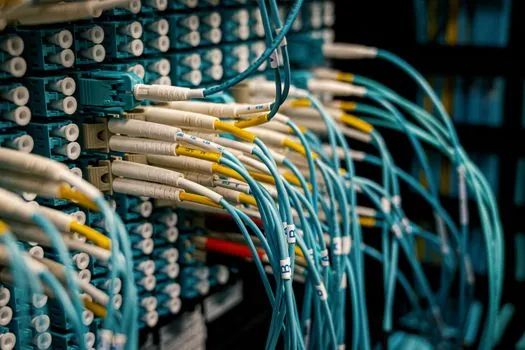
A fiber media converter is the stronger choice for long camera runs where copper distance, electrical noise, grounding differences, or future cabling infrastructure make an extender less attractive. The converter changes the link from balanced copper to optical fiber, allowing the long section to remain free of copper Ethernet’s 100 m channel constraint [S2][S4].
Do not assume that every fiber converter delivers camera power. Many designs separate data transport from power delivery, requiring either a PoE-capable converter model, local power at the remote end, a remote power device, or a separate power cable [S6]. Confirm whether the chosen product supports 10/100 or Gigabit Ethernet, the required optical interface, connector type, link budget, operating temperature, and power input.
Fiber is especially suitable where the route crosses buildings, industrial areas, exterior boundaries, or other locations where maintaining a multi-stage copper extender chain would be inconvenient. The additional equipment count and fiber termination work may increase installation effort, but the resulting link does not depend on a continuous copper channel beyond the standard segment limit [S2][S3].
Decision matrix by distance and use case
For a 100–250 m camera run, compare a copper PoE extender with a fiber media converter. The extender can retain one-cable operation and often requires less fibre infrastructure, but it may reduce supported output power or data rate. The media converter removes the continuous copper-distance constraint, but may require a second power path and two fibre terminations [S2][S3].
For a run approaching 500 m, a specifically supported copper extender may still be viable, while a generic statement that extenders reach 500 m is insufficient. Fibre becomes the cleaner architecture when the distance, noise environment, or maintenance requirement exceeds the extender model’s documented operating envelope [S2].
For routes substantially beyond 500 m, specify optical transport and verify the complete optical budget rather than extrapolating extender performance. The media-converter path is generally more suitable for long outdoor or building-to-building runs, provided the fibre type, optical distance, connectors, environmental ratings, and remote power method are confirmed [S2][S4].
Failure modes and acceptance checks
Camera failure beyond 100 m can result from either inadequate voltage at the powered device or loss of usable data transmission. A camera may boot but fail under startup, IR illumination, or motor load because the available power is below its operational requirement, while the video path may also fail independently [S5].
Do not confuse a standard 100 m channel with a proprietary extended link. Document the route, data rate, PoE load, local power, environmental conditions, and acceptance test as a separate design. For copper extension, verify every segment and connector; for fiber, verify optical type, link budget, transceiver compatibility, and the power-delivery arrangement [S3].
Where power must travel across a long run, evaluate the source and load at worst case, including cable temperature and startup demand. The camera’s acceptable input voltage, available power at the PD, and the required operating margin should be recorded rather than inferred from a nominal PoE class.
Recommended architecture by application
Choose a PoE extender for an indoor copper run when the manufacturer explicitly supports the complete distance, data rate, camera power, and environmental conditions. It is usually the simpler choice for a single camera because data and power can remain on one cable when the device’s power budget permits [S2][S5].
Choose a fiber media converter for outdoor, building-to-building, industrial, or otherwise electrically difficult routes. Use a model that explicitly supports the required camera power if power must pass through the link, or specify a separate remote-power method. This architecture is also preferable when the project requires more reach than the selected copper extender can substantiate [S2][S6].
The practical specification should identify total route length, each copper segment, camera startup and steady-state power, supported data rate, PoE class, environmental range, connector type, and the test procedure. For a PoE switch alternative, the same 100 m versus 250 m boundary and data-rate caveats apply as for any extended copper arrangement [S3].