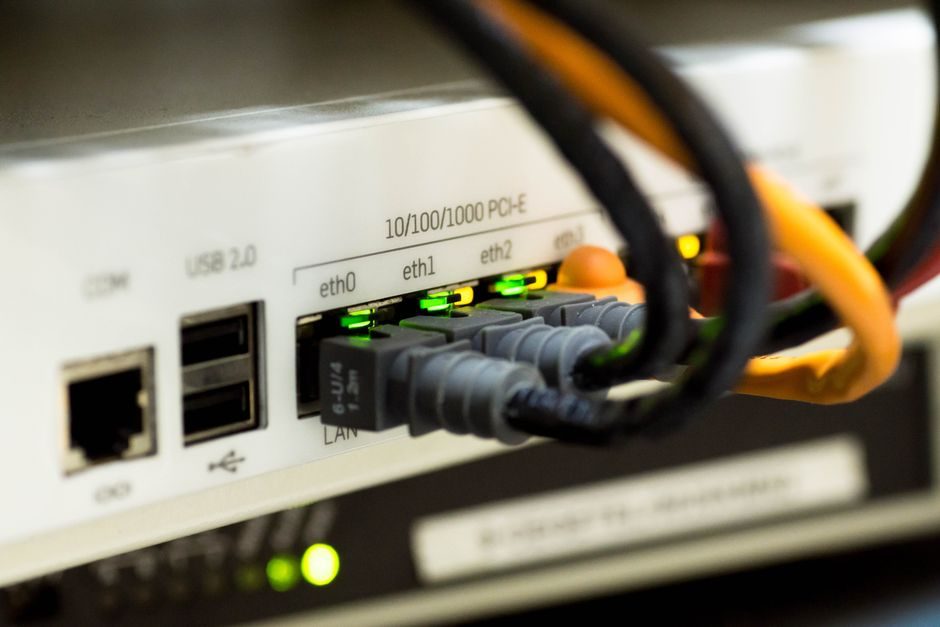
Pressure-drop (ΔP) work in compressed-air and gas lines is split between two sensor families: thermal-mass flow sensors that infer ΔP from mass flow at a fixed restriction, and fiber-optic pressure sensors that read diaphragm displacement optically. The right pick depends on whether the deliverable is a single high-fidelity pressure value or a distributed flow/pressure profile along a pipe run.
Both technologies are mature in 2026 catalogs: KEYENCE lists interchangeable fiber units and amplifier units for through-beam, retro-reflective and reflective fiber sensing across industrial environments [S3], while OMRON publishes its D6FZ-FGT200 / D6FZ-FGT500 air-flow sensors at 0.75 MPa working pressure for air or N₂ leakage and usage measurement [S9]. The same ΔP problem can be solved by either family — but their failure modes, integration effort and unit cost are very different.
Operating Principle and Where Each Sits in a ΔP Loop
Thermal-mass flow sensors (e.g. OMRON D6FZ-FGT) measure mass flow directly by tracking the cooling of a heated element; pressure drop is then inferred across a known internal restriction or reported alongside flow [S9]. They output an analog or pulse signal tied to flow rate at line pressure, so a ΔP value is reconstructed from two flow readings or from a paired differential-pressure transmitter downstream.
Fiber-optic pressure sensors, in contrast, read diaphragm deflection via light intensity, interferometric cavity length, or Fiber Bragg Grating (FBG) wavelength shift. A patent published as US6539136B1 describes a Fabry-Perot variant in which a metallized flexible diaphragm acts as the movable mirror of an extrinsic interferometer, with the diaphragm diameter deliberately exceeding the fiber outer diameter to extend dynamic range [S1]. FBG sensors belong to the wavelength-modulated subclass of fiber sensors, where external physical parameters modulate the Bragg wavelength inside the fiber [S4].
Sensitivity, Bandwidth and Resolution Numbers
Resolution is the first hard criterion. The MEMS-based reflective intensity-modulated fiber-optic pressure sensor published in Sensors (Basel) — DOI 10.3390/s20082233 — targets gas pressure measurement with a micromachined diaphragm and reflective intensity readout, with first-author affiliation at North University of China's Electronic Test and Measurement Laboratory [S2]. Earlier Fabry-Perot work in US6539136B1 targeted the same dynamic-range problem, citing prior art that used a 25.4 µm metallized Mylar diaphragm read by a 50 µm core / 120 µm cladding multimode fiber bundle [S1].
For flow-side ΔP, the OMRON D6FZ-FGT200/500 datasheet lists 0.75 MPa working pressure with a defined "withstand pressure" envelope, and is specified for air or nitrogen service only [S9]. KEYENCE fiber-optic amplifier units are described as supporting diverse fiber units in "virtually any environment" with high optical power and automatic threshold tracking [S3] — useful for displacement-derived ΔP in hazardous or EMI-loaded zones. Bandwidth of fiber-optic Fabry-Perot diaphragms is fundamentally set by diaphragm resonance (kHz to hundreds of kHz for sub-100 µm diaphragms), while thermal-mass flow sensors are bandwidth-limited to a few Hz by the thermal time constant of the sensor element.
Selection Criteria Compared Criterion by Criterion
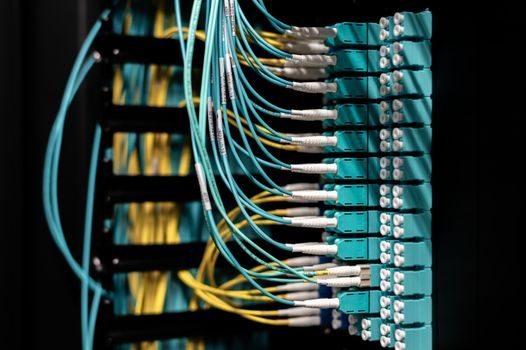
For a process engineer choosing between the two families on a ΔP job, four criteria dominate: intrinsic safety, sensitivity, integration complexity and unit cost. Fiber-optic sensors win on intrinsic safety (no electrical path into the measurement point), EMI immunity and high-bandwidth diaphragm response [S1][S3]; thermal-mass flow sensors win on installed cost, direct mass-flow output and turnkey 0.75 MPa line-pressure ratings from major automation vendors [S9].
The table below lines up the two families against typical ΔP use cases. Entries marked "qualitative" are derived from the cited source class (patent/Sensors paper/vendor datasheet) rather than from a single quantitative claim.
| Criterion | Fiber-optic pressure sensor (MEMS / FBG) | Thermal-mass flow sensor (e.g. D6FZ-FGT) |
|---|---|---|
| Intrinsic safety in hazardous area | All-dielectric, no spark risk [S1] | Requires Ex-rated variant or remote mounting [S9] |
| Bandwidth | kHz to hundreds of kHz (diaphragm-limited) [S1] | Low Hz (thermal time constant) [S9] |
| Direct ΔP output | Via diaphragm displacement / FBG wavelength [S4] | Indirect, derived from flow at known restriction [S9] |
| Working pressure envelope | Process-side; limited by capillary/ferrule design [S1] | 0.75 MPa datasheet value (D6FZ-FGT) [S9] |
| EMI / RFI immunity | Total (optical only) [S3] | Sensor head susceptible; amplifier needs shielding |
| Integration effort | Higher (interrogator, fiber routing) [S3] | Lower (analog/pulse to PLC) [S9] |
Failure Modes and Process-Limit Constraints
Thermal-mass flow sensors fail in three characteristic ways: condensation on the heated element at high humidity, drift after particulate fouling, and over-range damage if line pressure exceeds the datasheet withstand figure. The D6FZ-FGT specification explicitly bounds applicable fluid to "air or nitrogen (N₂)" and working pressure to 0.75 MPa, with a separate "withstand pressure" rating printed on the same datasheet row [S9]. Outside that envelope, the device datasheet disclaims responsibility for compatibility and safety system verification [S9].
Fiber-optic pressure sensors fail differently. The reflective-intensity variant loses linearity if the fiber-to-diaphragm gap drifts; the Fabry-Perot variant loses fringe contrast if the cavity Q degrades. The US6539136B1 patent specifically targets both: extending dynamic range by using a diaphragm whose diameter "considerably exceeds the external diameter of the optical fiber," and improving temperature/vibration stability over the single-mode Fabry-Perot prior art [S1]. For long-term FBG installations, wavelength drift with temperature must be compensated with a strain-isolated reference grating [S4].
Who Each Family Is For (and Who Should Avoid It)
Fiber-optic pressure sensors are the right tool for hazardous-area, high-bandwidth or high-EMI installations, for FBG multiplexing along a pipe run, and for sub-kPa pressure resolution in medical, aerospace and downhole monitoring. They are the wrong tool for a maintenance team that needs a screw-in, 24 V loop-powered gauge on a compressed-air manifold — the interrogator alone is a capital purchase. [S1]
Thermal-mass flow sensors are the right tool for compressed-air leakage surveys, machine-level usage tracking and HVAC ΔP work where the line pressure stays below 0.75 MPa and the fluid is dry air or N₂ [S9]. They are the wrong tool for flammable-gas service without an Ex-rated variant, for liquid flow, and for any application needing kHz dynamic response. Industrial buyers sourcing replacement boiler flow-switch spares (e.g. 125–250 V AC water-flow switches for Beretta-class boiler spares) sit in a different pricing tier and are not in scope of this comparison [S8].
Standards, Sourcing and Integration Notes
For process-grade ΔP work, the two relevant standard families are ISO 5167 (orifice / Venturi / nozzle) for differential-producing flow elements, and IEC 60079-series / ATEX 2014/34/EU for hazardous-area sensor selection. Vendor datasheets — such as the OMRON D6FZ-FGT200/500 page — carry the binding environmental envelope (fluid, pressure, temperature) and explicitly defer safety-system verification to the integrator [S9]. KEYENCE publishes fiber-unit selection around amplifier gain, fiber length and detection mode (through-beam vs reflective) for amplifier-unit pairing [S3].
On the fiber-optic side, sourcing an FBG-based ΔP chain means choosing an FBG sensor maker, an interrogator (sweep laser or spectrometer) and a mounting hardware set; the wavelength-modulation principle and the requirement for a Bragg-grating wavelength-shift demodulator are documented in Chinese-language sensor references [S4][S5]. The single-mode Fabry-Perot patent family provides the older, interferometric alternative for higher-precision single-point readings [S1]. Sourcing decisions should weigh the FBG multiplexing benefit (many gratings on one fiber) against the reflective-intensity / Fabry-Perot benefit (lower-cost per point, higher bandwidth per point). For a related reference on discrete sensor choice, the chain conveyor selection criteria for material handling lines page applies a similar decision-matrix method to a different asset class.
For distributed-network ΔP on brownfield sites, a fiber backbone feeding multiple FBG gratings is typically preferred; for greenfield single-machine compressed-air monitoring, a thermal-mass flow sensor at the machine header is the lower-effort path. The industrial Ethernet switch selection for robotic workcells reference uses an analogous five-criterion gate and is worth pairing with the fiber-sensor question when the interrogator and the cell network must be specced together.
The trackable next signal is a vendor datasheet revision: OMRON has flagged that pre-end-of-production specification pages may differ from the current build, and asks integrators to "check the compatibility and safety system" before deployment [S9]. A second signal is FBG-interrogator cost — if 2026 catalog prices for 1 kHz sweep lasers drop below the ~USD 5,000 mark, the fiber-optic ΔP case on retrofit lines strengthens materially.
Spec-level background on the components involved: pressure sensor.