
A robotic workcell switch must deliver managed L2 switching with PTPv2 grandmaster or transparent clock support, gigabit-class non-blocking backplane, -40 °C to +70 °C operating range, IP30-rated metal enclosure, and IEEE 802.3bt PoE++ for vision and end-effector power delivery on a single Cat6A run [S1][S3].
The selection problem is not "how many ports" — it is whether the switch can hold the deterministic motion and safety I/O traffic inside a 1 ms cycle while sitting next to variable frequency drives, servo amplifiers, and welding inverters [S2][S7].
Managed L2 with TSN/PTPv2 — the Motion Bus Floor
PROFINET IRT, EtherCAT, and CC-Link IE TSN all require switch-level time synchronization, and PTPv2 transparent-clock or boundary-clock behaviour is now the default expectation on cells carrying 6-axis robot controllers, linear motor stages, and vision-guided tracking [S1]. The NIST collaborative-robot workcell reference uses two Cisco IE-4000 managed switches with 12 gigabit ports each, reserving one gigabit port for trunk-mode inter-switch bridging to give a 22-port working pool [S1].
Choose a switch that explicitly publishes PTPv2 (IEEE 1588v2) and TSN profile support in its datasheet, not a generic "supports NTP" line — NTP keeps clocks within milliseconds, which is three orders of magnitude too loose for coordinated motion [S1][S3]. Unmanaged switches are acceptable only on the vision or MES uplink side, never on the motion bus.
Hardening — Temperature, Shock, EMI, and the Cabinet Reality
Industrial downtime is environmental, not packet-level: switches fail when they cannot keep forwarding under thermal, vibration, and EMI stress around VFDs, servo amplifiers, and welders [S7]. Emerson's PACSystems line publishes -40 °C to +70 °C operating and -40 °C to +85 °C storage across all five part numbers (IC086SLN050/080/240/042MM/042SS) with redundant power inputs and reverse-polarity protection on every model [S2].
Inside a robot base or end-of-arm tooling junction box, vibration and heat soak are continuous; pair the switch with a failsafe wiring pattern for emergency-stop chains so a switch hang cannot mask an E-stop event [S6]. For cells sharing a cabinet with motor drives, specify at least 8 kV contact / 15 kV air ESD on the RJ-45 ports and confirm the vendor's EMI immunity test report, not just a CE mark on the label [S7].
Power over Ethernet — Driving Cameras, Lights, and Grippers
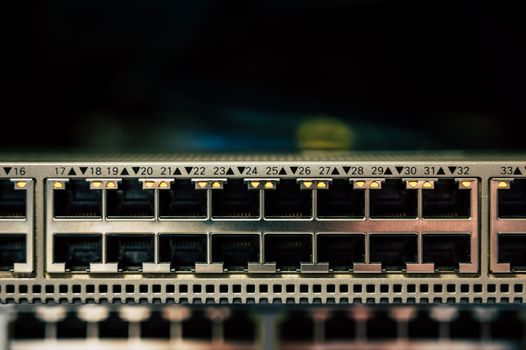
Modern vision-guided robots pull 60 W to 100 W per camera/light port under IEEE 802.3bt (PoE++), and Omnitron's RuggedNet GHPoEBT/Mi explicitly lists 60 W and 100 W per-port modes with two 10/100/1000 copper or 100M/1G fiber uplinks and four PoE/PoE+ RJ-45 user ports (part 3319B-0-24-2Z) [S9]. That single-switch profile replaces a separate 24 V power supply, fuse block, and cable tray run for each 2D/3D camera.
For robotic cells, budget PoE++ budget at 1.5× the worst-case connected load so a single failed port does not brown out the others; managed switches expose per-port current and PD class, which is the only way to detect a degrading camera before it drops frames at 1 ms cycle time [S3][S9].
Port Mix, Bandwidth, and Forwarding Rate — the Math Behind the SFP Slot
Aggregate bandwidth must exceed worst-case burst, not average load: a single 4K vision stream at 30 fps runs ~850 Mbit/s, and a 6-axis robot at 1 kHz control plus 16 safety I/O plus dual 3D cameras can push 3 Gbit/s sustained per workcell [S1][S3]. Extreme Networks' ISW 8GBP+4SFP datasheet shows 24 Gbps aggregate bandwidth and 17.85 Mpps forwarding rate for a gigabit-class DIN-rail switch, the right order of magnitude for a vision-heavy cell [S8].
Use SFP uplinks (1000BASE-LX or 10GBASE-LR fiber) to bridge cells across a long robot aisle, and keep copper ports for short-reach edge devices to control cost; multimode fiber is fine to 550 m at 1 G and 82 m at 10 G over OM3, which covers most cells from one robot to the next [S2][S8]. A useful sanity check: 1 Gbps × number of full-rate ports must be strictly less than the published aggregate switching bandwidth, otherwise the switch is oversubscribed and will drop frames under burst [S8].
Topology and Redundancy — Ring, PRP, or Just a Trunk?
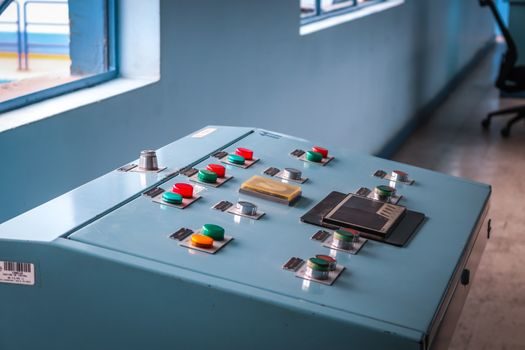
Most workcells run a single trunked ring with MRP or DLR sub-50 ms recovery; the Emerson PACSystems family advertises "Fast Network Recovery" and redundant ring technology aimed at pipeline, transportation, and water/wastewater duty cycles, the same recovery profile that suits a 24/7 robotic line [S2]. For collaborative-robot cells where stop-time is safety-critical, dual-homing the master controller to two separate switches is cheaper insurance than chasing a 20 ms ring-recovery event through a risk assessment [S1][S2].
PROFINET-managed switches expose themselves to the controller as a PROFINET device, which lets the same engineering tool that programs the robot see the switch as a named node — this matters more than raw port count for OT personnel troubleshooting a stopped line [S2].
Selection Matrix — What to Buy for Each Cell Tier
Tier-1 single-robot cells (one 6-axis + one vision camera, no safety PLC on the network): an unmanaged 5- or 8-port gigabit switch at -40 °C to +70 °C with at least one PoE+ port is enough, and the IC086SLN050 (5 ports, 3 W, 205 g) or IC086SLN080 (8 ports, 4 W, 391 g) both fit [S2]. Tier-2 multi-robot workcells with motion control and 3D vision need a managed L2 switch with PTPv2 transparent clock, IEEE 802.3bt ports, and gigabit fiber uplinks — the RuggedNet GHPoEBT/Mi or SCALANCE XC-200 family is the right class [S3][S9]. Tier-3 line-scale cells with 10+ robots and a safety PLC require a managed L2/L3 switch with PROFINET device visibility, redundant ring, and PRP/HSR — the SCALANCE X-400/X-500 tier or Cisco IE-4000-class [S1][S3].
For cells with high EMI from adjacent welding or VFD cabinets, look beyond the datasheet headline and request the IEC 61000-4-2/4-3/4-4/4-6 test report; also confirm the EMI gasket and enclosure seam treatment on any cabinet the switch mounts into, since IP30 alone does not stop radiated ingress at servo-switching frequencies [S7].
What Not to Specify — and Where the Wrong Choice Bites
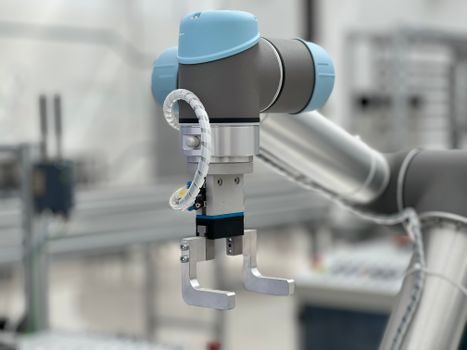
Do not specify a commercial office switch in a workcell: office switches lack conformal coating, have a 0 °C to +40 °C operating window, and drop PTPv2 transparent-clock packets under load, which surfaces as random robot tracking faults that maintenance blames on the robot [S2][S7]. Do not specify an unmanaged switch on the motion bus, even a "rugged" one — without PTPv2 and managed QoS, a single multicast storm from a misconfigured vision camera will stall every joint on the ring [S1][S7].
For cells in hazardous-area-adjacent cabinets, confirm that the switch itself does not void the Ex certificate of the enclosure — many ATEX/IECEx certifications are tested with specific cable glands and barrier accessories, and a third-party switch swap invalidates the assembly [S2].
Shortlist Logic — Five Questions Before Issue
Confirm the switch publishes PTPv2 transparent-clock or boundary-clock support in writing, not as a marketing bullet. Confirm -40 °C to +70 °C minimum operating range with redundant 24 VDC inputs and reverse-polarity protection. Confirm PoE class matches the highest-power vision or light bar in the cell, with at least 1.5× headroom on the switch's PoE budget. Confirm managed L2 with PROFINET device visibility for cells running Siemens or Emerson controllers. Confirm at least gigabit SFP fiber uplinks for any cell-to-cell bridge longer than 80 m of Cat6A, and verify aggregate switching bandwidth strictly exceeds the sum of full-rate ports [S1][S2][S3][S8].
Track two signals through the rest of 2026: TSN-profile (IEEE 802.1Qcc / 802.1CB) adoption in PROFINET and EtherCAT controller firmware, and IEEE 802.3bt Type 3/Type 4 PoE++ deployments in 6-axis and cobot gripper designs — both shift switch port count and power-budget assumptions for new workcells [S3][S9].
Component reference pages worth checking: industrial adhesive, and industrial borescope.