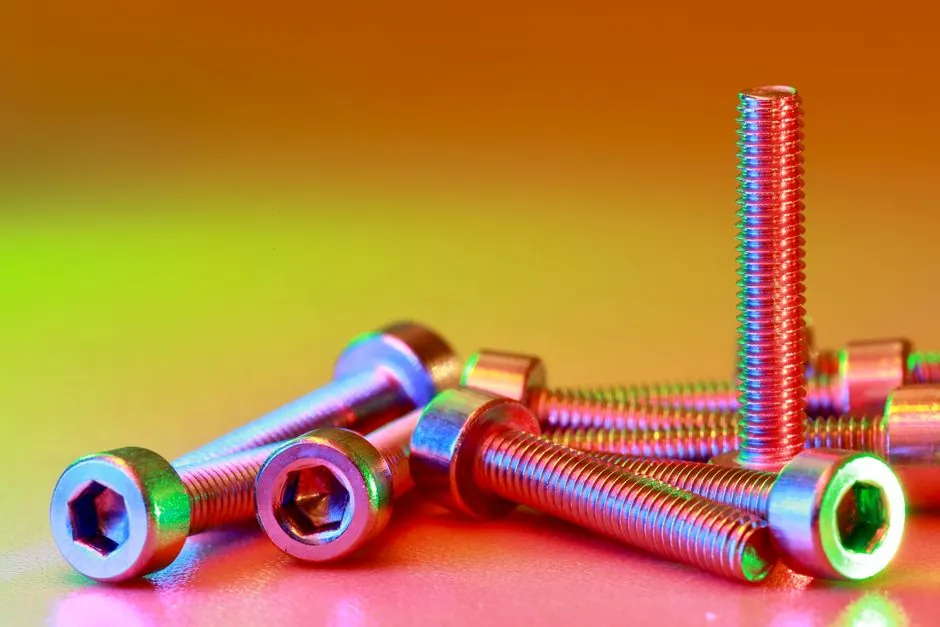
Fiber laser markers operating at 1064 nm deliver the strongest coupling into stainless steel, aluminum, brass, copper and titanium, which is why they are the default for metal part traceability and nameplate work [S1][S3].
CO2 markers emit at 10.6 μm, a wavelength that organics and non-metals absorb readily but bare metals reflect; CO2 can mark metal only after a marking spray or similar pretreatment is applied [S6].
Wavelength and Material Absorption: Why One Cannot Substitute for the Other
Fiber laser markers operating at 1,064 nm couple efficiently into most engineering metals, producing clean, high-contrast, permanent marks at high speed [S3][S4]. CO2 laser markers operating near 10.6 μm couple efficiently into wood, leather, acrylic, paper, cardboard, fabric, rubber and ceramics, but reflect off bare metal surfaces, which is the physical reason a CO2 source cannot directly mark uncoated steel or aluminum [S2][S6]. The two source families are therefore not interchangeable on a metal-parts line; choosing the wrong wavelength will yield either no mark or a mark that wipes off with solvent [S6].
Operationally this means the wavelength decision is locked in at the time of purchase, not at the workstation. A shop running mixed work (for example, a nameplate line that also engraves wood gift boxes) typically buys one of each source rather than tries to force a single laser marker to cover both material families [S5].
Decision Matrix: Fiber vs CO2 on the Criteria That Matter for Metal
For metal-part buyers the comparison reduces to six criteria with a clear ordering: wavelength/material fit, mark permanence, mark speed, contrast options, upfront cost, and maintenance burden [S1][S3]. On wavelength, fiber at 1064 nm wins outright because the metals absorb it; CO2 at 10.6 μm requires spray pretreatment and is still slower and lower contrast on steel [S6]. On permanence, fiber produces a permanent mark by surface interaction on the metal itself, while CO2 with spray leaves a coating-bound mark that can be removed chemically [S2][S6].
On speed, fiber sources at 20-50 W are common in industrial marking cells and complete 2D codes in well under a second on stainless; CO2 marking on pre-sprayed metal is roughly half that throughput in published comparisons [S2][S4]. On contrast options, fiber supports annealing (no surface removal, dark mark on certain stainless grades) and ablation modes, while CO2 on pre-sprayed metal is limited to a foamed white mark [S3]. On upfront cost, a 30 W fiber galvo marker sits noticeably above an entry-level CO2 galvo marker of comparable work area; on maintenance, fiber sources are largely consumable-free for tens of thousands of hours, while CO2 tubes and alignment optics need periodic service [S1][S3][S5].
Use-Case Recommendations: Which Source Fits Each Metal Job
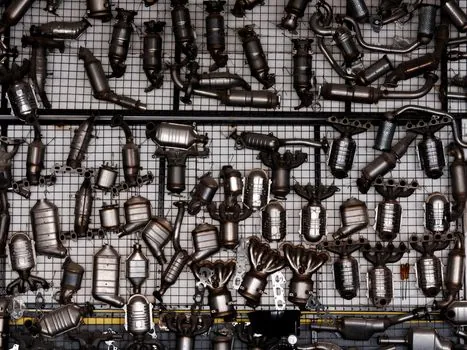
Stainless steel nameplates, data plates, and instrument housings take fiber at 20-30 W with MOPA control, which yields both dark anneal marks and crisp white ablation marks from the same laser marker [S1][S2]. Hardened tool steel cutting inserts and punches typically need a 50 W fiber or higher to keep cycle time inside one-second-per-character windows on production cells [S4].
Anodized aluminum, bare aluminum and brass electronics housings mark well with 20-30 W fiber and tolerate the higher pulse energy needed to cut through anodized layers; copper and titanium also fall inside the fiber envelope but warrant the wider pulse-width control of a MOPA source to avoid surface micro-cracking [S1][S3]. CO2 on metal is only worth specifying when the buyer also has a steady non-metal workload (for example, a job shop doing both anodized aluminum tags and leather patches) and accepts the extra spray-prep step for any metal job [S6].
Adjacent Comparison: Where Fiber and CO2 Sit Against Other Marking Routes
Inside the laser family, fiber 1064 nm and CO2 10.6 μm should be treated as complementary tools, not as a single product category, because the metal material absorption curves they target do not overlap in any practical way [S2][S4].
For mixed-throughput shops the practical split is a fiber galvo cell on the metal line and a CO2 galvo cell on the packaging or signage line, sharing only the upstream part-handling fixture pattern. A second useful split is fiber for direct part marking (DPM) under traceability rules, and CO2 for label or substrate engraving where mark permanence on metal is not required [S3][S6].
Failure Modes and Constraints Buyers Should Plan For
Fiber markers on highly reflective metals such as polished copper and mirror-finish aluminum can return enough back-reflection to damage the source if the scanner and isolator stack are not specified for it; this is the single most common field failure and is solved at purchase, not in service [S2]. CO2 on bare metal will simply not mark, and buyers who skip the spray step end up replacing a CO2 system with a fiber system inside a year [S6].
CO2 tubes degrade faster than fiber sources and need periodic alignment of the beam path through the scanning mirrors, which adds a maintenance line item that fiber buyers do not carry [S3][S5]. On the regulatory side, both Class 4 laser products require interlocks, key control and operator PPE, and any metal-marking cell integrated into a production line falls under the same machine-safety risk assessment regardless of source type; specific laser-product classifications are set by IEC 60825-1, while general machinery integration falls under ISO 12100 and the regional equivalents buyers must apply locally.
Sourcing Notes and Selection Signals for 2026 Builds
For 2026 procurement cycles the most useful sourcing signals are MOPA fiber availability at 20-50 W with verified pulse-width tuning, supplier-published lifetime figures for the metal material grades in your part mix, and a clear service path for CO2 tube replacement if a CO2 line is being added for non-metal work [S1][S3]. Buyers comparing quotes should pin the test coupon to the same stainless grade (commonly 304 or 316) and the same 2D code (commonly Data Matrix ECC200) to keep vendor claims comparable.
Trackable next signals: vendors publishing MOPA pulse-width options above 200 ns for fine mark control on copper, and shop-floor case studies on CO2-on-spray versus fiber direct part marking cycle times on the same stainless nameplate. For a deeper dive on the fiber-side price/spec trade at 20 W versus 50 W versus MOPA, see the Fiber Laser Marker Price 20W vs 50W vs MOPA Source: Spec-Based Buyer's Guide.
Component reference pages worth checking: metal powder.