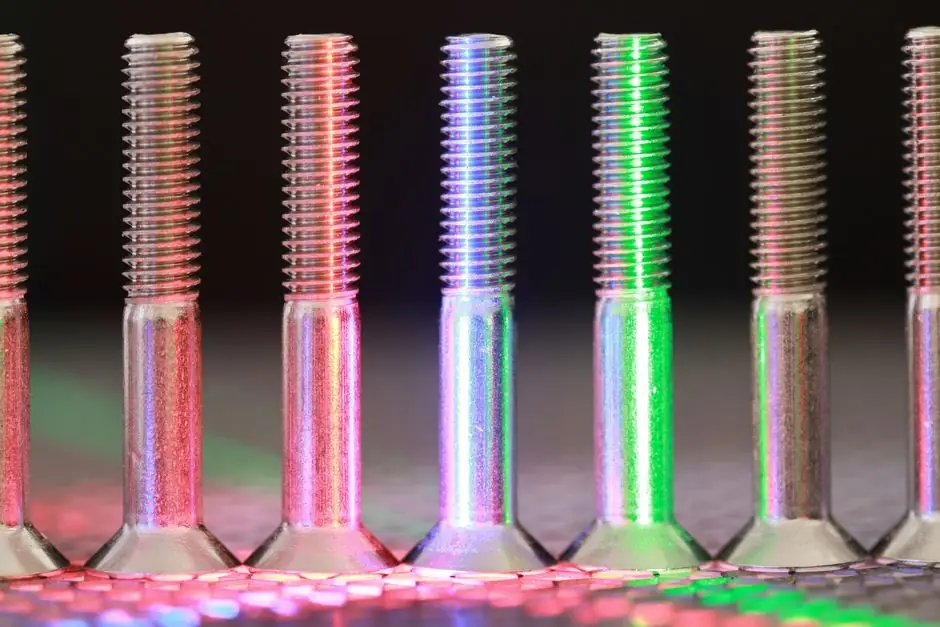
Standard inductive proximity sensors lose up to 70% of their nominal sensing distance on non-ferrous metals, while factor 1 (K1) all-metal sensors hold a flat 1.0 correction factor across steel, stainless steel, aluminum, copper and brass [S1][S3].
The trade is concrete: a typical 12 mm standard sensor reads 2 mm on steel but only 0.44 mm on copper and roughly 0.5–0.8 mm on aluminum, whereas a 12 mm K1 unit holds the same 2 mm (or close to it) for every common industrial target metal [S6][S5].
How the reduction factor is defined and measured
IEC 60947-5-2 defines the nominal sensing distance (Sn) of an inductive proximity sensor on a standardized mild-steel square test target of defined thickness and edge length; that steel reference is assigned a correction factor (k-factor) of 1.0, and every other target metal is reported as a ratio of its actual operating distance to Sn [S2][S9].
For standard ferrite-core designs, published correction factors cluster around 0.3–0.5 for aluminum, 0.25–0.45 for copper, and 0.55–0.85 for 304/316 stainless steel, which is why the same part number can drop from a 4 mm range to 1.2 mm when the target swaps from steel to aluminum [S6][S3].
Factor 1 sensors are specified so that the same 1.0 factor applies to all listed metals: any deviation across steel, stainless steel, aluminum, brass and copper is held inside a tight tolerance band, eliminating the need to recalculate range when the line changes target material [S1][S7].
Why standard sensors derate on non-ferrous metals
A conventional inductive proximity sensor uses a single wound coil on a ferrite core that generates a fluctuating magnetic field; eddy currents induced in the target absorb energy and damp the oscillation, with ferrous steel producing the strongest coupling per unit area [S4][S9].
Non-ferrous metals like aluminum, copper and brass have higher electrical conductivity but no magnetic permeability contribution, so eddy-current coupling is weaker and the effective sensing distance shrinks; stainless steel sits between the two because its permeability drops sharply with cold-worked 300-series grades [S2][S4].
How K1 / all-metal designs achieve flat response
What separates non-ferrous and all-metal sensors from general-purpose inductive proximity sensors is the number of separate inductive coils included in the housing, combined with a more complex oscillator and evaluation circuit that compares amplitudes across coils to identify the target [S4].
In practice, K1 devices use either multiple overlapping coils or a single coil with an additional compensation winding that is tuned to flatten the response curve across conductivity and permeability, so the detection threshold sees roughly equal amplitude drop for steel, stainless steel, aluminum and copper at the same physical distance [S3][S5].
This is the same fundamental oscillator-and-eddy-current physics as a standard unit, so K1 devices still cannot detect non-metallic targets; for plastics, wood, paper or liquid level the right tool is a capacitive sensor, not a factor 1 inductive [S5][S7].
Trade-offs: range, speed, cost, environment
Factor 1 sensors achieve the unified correction factor at the price of some disadvantages: they generally offer a slightly shorter maximum range than a standard sensor of the same barrel size, and their more complex oscillator typically caps the maximum switching frequency below a general-purpose equivalent [S3][S5].
On cylindrical threaded-barrel sizes, the practical rule of thumb is that a K1 unit at a given diameter delivers a sensing range comparable to a standard 1X or extended 2X sensor of the same diameter but with metal-agnostic response, while a 3X or 4X extended-range standard sensor can still outrange it on steel only [S5][S6].
Cost and stocking also matter: cylindrical threaded-barrel inductive sensors are roughly 70% of the inductive market and benefit from CENELEC-standardized body sizes and sensing distances, but stocking a separate K1 SKU simplifies part numbers when the line runs mixed alloy targets (common in aluminum-bodied automotive or copper-rich electrical assembly) [S4][S6].
Decision matrix: when to pick K1 vs standard
Pick a K1 factor 1 sensor when the application sees mixed target metals (steel, stainless steel, aluminum, brass, copper) on the same machine, when the line is frequently changed over between alloys, or when spec simplicity (one part, one range value, no derating math) outweighs the small range penalty [S1][S3][S7].
Pick a standard shielded inductive sensor when the target is consistently mild steel, the application demands the absolute longest range at a given barrel size, the switching frequency is in the multi-kHz range, or the budget per point is tight and the engineer is willing to derate manually for any non-ferrous target [S3][S4][S6].
For a typical 12 mm shielded M12 build, a standard unit publishes Sn around 2 mm on steel, while a K1 unit at the same barrel typically publishes Sn around 1.5–2 mm flat across all metals; the choice therefore comes down to whether you value range on steel or uniformity across the alloy mix [S6][S3].
Integration and standards context
Inductive sensors in industrial control panels and machines fall under IEC 60947-5-2 for low-voltage switching devices, with the k-factor and test target definitions already cited in that standard; ATEX/IECEx-certified K1 versions exist for Zone 1 and Zone 21 hazardous areas, but the sensing physics is unchanged from the standard unit [S2][S9].
Wiring is also unchanged: 3-wire DC PNP/NPN, 2-wire DC, and 4-wire NO/NC variants are all available in K1 form factors, and IO-Link versions now report the actual k-factor per detected target in process data, which lets a PLC compensate for the small residual variation if the application is marginal [S1][S3].
Maintenance technicians should remember the original family of the technology: inductive proximity sensors detect metallic objects only, are immune to dust and water on the sensing face, and remain the best-selling non-contact sensing technology in industrial automation because of that robustness [S4][S7].
For plants that already standardize on M8, M12, M18 and M30 threaded barrels, K1 parts are drop-in replacements at the same thread size, so the migration cost is essentially zero once a cross-reference is built between the existing standard inductive proximity sensor part numbers and their K1 equivalents [S4][S6].
Trackable signals to watch over the next two quarters: wider release of IO-Link factor 1 sensors that publish per-target k-factor diagnostics, ATEX/IECEx-certified K1 mini-sensors below 4 mm barrel for compact hazardous-area tooling, and growing SKU coverage in 3-wire DC PNP from major lines such as Baumer, Balluff, Pepperl+Fuchs, Sick and AutomationDirect.
For component-level specifications, see inductive sensor, proximity sensor, and proximity probe.
See also our earlier report, Foamed Cement Core vs EPS Bead Cement Core: Partition Panel Spec Tradeoffs.