Function is the dividing line: a flameproof junction enclosure terminates and routes conductors through DIN-rail terminal blocks without ever interrupting load current, whereas a flameproof distribution enclosure houses MCBs, MCCBs, contactors, thermal overloads, and busbars that switch and feed downstream circuits. Both sit on the same hazardous-area layout and share the Ex d IIB/IIC and Ex tb IIIC marking families, but their internal chassis, certification strings, and price-per-amp curves diverge sharply once current rating climbs above 32 A [S1][S2].
2026 OEM catalogues (Shenhai, Feipu, OKorder, Wire-Boxes) consistently list the two as discrete equipment families. Shenhai's SJB-A-IIB junction line is rated for terminal blocks "normally higher than 32 A" with Ex d IIB T6 Gb and Ex tb IIIC T80°C Db markings; Feipu's BXM(D)51, BXD51, and BXQ distribution families split into illumination, power-maintenance, and electromagnetic-starter sub-classes with IIB, IIC, or dual DIP marks and busbars sized for several hundred amps [S1][S2].
Function, Internal Layout, and Current Rating
A junction box is essentially a passive wiring chamber: an Ex d or Ex e housing, a DIN-rail terminal strip, an optional earth bar, and a gland plate sized to the conduit entries, with no switching element of any kind. Feipu's BXX8050 socket-box variant extends the function by integrating industrial receptacles inside the same IIC/DIP-certified shell, which blurs the line into a hybrid junction-and-outlet unit for Zone 1 socket drops [S2].
A distribution box is an active panel: a main incoming isolator, outgoing MCBs or fused switches, neutral and earth bars, and frequently contactors or starters wired through internal busbars, with the "D" suffix denoting motor-rated thermal/overload combinations and the "Q" suffix denoting electromagnetic contactor assemblies for direct-on-line motor start. The PXK positive-pressure distribution board layers a purged controller on top of that layout, used to repackage a non-Ex panel as a fully Ex-rated unit for analyzer houses and control rooms [S1][S2]. Specifying a junction box where a distribution function is required is one of the most common hazardous-area BOM errors, and it usually surfaces at inspection when an Ex d enclosure is found wired as if it were an Ex e panel.
Housing Material, IP Rating, and Mechanical Endurance
IP65 is the de-facto minimum for both product types in outdoor hazardous areas, and IP66 is now the baseline expectation on premium junction-box SKUs, equivalent to NEMA Type 4X in NEC terms as confirmed by the SJB-A-IIB datasheet that pairs Ex d IIB T6 Gb with IP66 [S1][S2]. Cast aluminium alloy dominates the junction-box category because it machines cleanly, dissipates flamepath heat, and accepts powder coating for offshore use, with the SJB-A-IIB die-cast aluminium body as the default reference in this class.
Galvanised iron is the budget alternative for conduit-fed indoor junction work (OKorder lists this shipping from Tianjin at a 1000-set MOQ at 1000-set/month capacity), while stainless steel, typically 304 or 316, is specified for chemical, pharma, and coastal CIP areas where aluminium oxidises [S1][S2]. Distribution enclosures step up in mechanical robustness: fabricated steel cabinets with hinged doors, internal mounting plates, and gasket grooves become common above 100 A, with epoxy or PU surface treatments for acid/alkali exposure as seen in the FXM(D)-series corrosion-resistant illumination/power distribution box. For higher enclosure categories and the broader explosion-proof equipment family, material and gasket selection follow the same decision logic applied across the entire Ex product range.
Gas Group, Temperature Class, and Zone Mapping
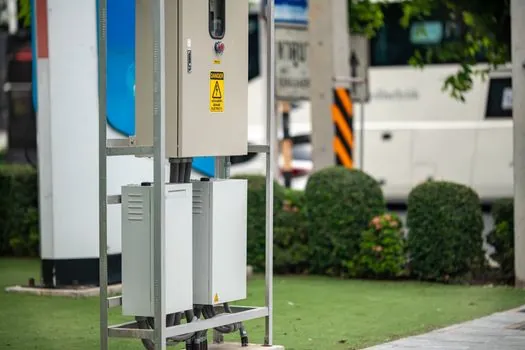
Both products carry the same Ex-mark family, Ex d IIB T4 Gb or Ex d IIC T6 Gb for hydrogen-rich service, but the gas group drives enclosure volume and flamepath length. The cast aluminium AH-series junction line covers IIA/IIB/IIC groups and T1–T6 temperature classes across Zone 1, Zone 2 (gas) and Zone 20–22 (dust), and the Feipu distribution line explicitly carries the IIC + DIP dual-mark, meaning dust-by-protection is layered on top of gas [S1].
Zone 1 areas (continuous hazard) almost always force a cast aluminium or stainless body with flameproof Ex d chambers, while Zone 2 can accept Ex e or Ex tb at lower cost. Buyers routinely over-spec IIC when IIB suffices, because IIC-certified enclosures add 20–40% on casting and machining as the flamepath gap tolerance tightens. For control stations and operator interfaces that sit alongside either box type, explosion-proof button and control stations follow the same IIB/IIC decision and are typically sourced from the same vendor line.
Certification Strings and Compliance Mapping
Junction boxes typically carry a single gas+dust mark (Ex d IIB T6 Gb / Ex tb IIIC T80°C Db) with CCC and CE documentation and ATEX/IECEx-aligned certification from a single notified body. Distribution boxes, because they switch live loads, additionally fall under the breaker and contactor certification chain, so the Ex d enclosure certificate and the internal component certificates (MCB, MCCB, contactor) are listed separately on the nameplate and on the IECEx/ATEX certificate annex. [S2]
Shenhai groups 130+ series and 500+ specifications of explosion-proof products including junction boxes and conduit fittings under a single ATEX/IECEx-aligned programme, which simplifies the multi-line compliance file. Conduit-type junction variants carry galvanised iron round bodies with CCC 9000 and CE certification, while 304/316 stainless variants add NACE MR0175 compliance for sour-service hydrocarbon service [S1][S2]. The wider explosion-proof electrical equipment category covers both families, and the certification logic applies consistently to all enclosures, plugs, sockets, and control stations within that scope.
Decision Matrix: Junction vs Distribution by Use Case
Spec the junction box when the job is cable-to-cable termination, instrument signal routing (4-20 mA loops, Foundation Fieldbus spur protection), or a Zone 1 splice point with no make/break duty; it is cheaper, lighter, and ships faster because the certification chain covers only the enclosure and terminals. Spec the explosion-proof power distribution panel when circuits must be individually protected, switched, or motor-started, because only the distribution layout accommodates MCBs, contactors, and busbars within an Ex d flamepath. [S2]
By cost-per-amp, small Ex d cast-aluminium junction enclosures cluster around a 55 USD/set FOB price point with 1000-set/month supply as a useful floor reference, while IIC-certified distribution cabinets climb 20–40% above IIB equivalents purely on flamepath machining. For hybrid Zone 1 socket-outlet drops, the BXX8050 line covers a junction-plus-receptacle function in a single certification, avoiding the cost of a separate distribution panel. Sourcing clusters for both product types concentrate in Zhejiang and Jiangsu, with 15.0% of revenue flowing to the Middle East and 10.0% to Western Europe, so price alone is a poor differentiator between the two [S1].
Failure Modes and Common Spec Errors
Three errors dominate field returns on these enclosures: (1) specifying a junction box where a distribution function is required and then field-installing a breaker inside it, which voids the enclosure certificate because the flamepath was not designed for switching arcs; (2) over-rating the gas group to IIC when the actual gas is ethylene or propane, which doubles casting cost unnecessarily; and (3) selecting IP65 where the site actually requires IP66 plus Type 4X corrosion resistance, leading to water ingress within 12–18 months on offshore decks [S1][S2].
For motor circuits, using a junction box in place of a BXM(D)51 or BXD51 distribution box removes overload protection from the circuit, and that single omission is the root cause of most Ex d enclosure rework orders at inspection. Always match the product family to the function: passive termination routes through a junction box; protected and switched feeds route through a distribution box; operator controls route through an explosion-proof control station; the general explosion-proof enclosure category covers all of the above under the same ATEX/IECEx test logic. Related coverage on motor-side protection for these panels sits in the Eutectic Melting Alloy vs Bimetallic Thermal Overload Relay selection map and the Explosion-Proof Stepper Motor Ratings for Hazardous Locations spec sheet.
Trackable signal: the next revision of IEC 60079-0 and the ATEX 2014/34/EU alignment cycle are the two regulatory nodes to watch for changes in IIC flamepath tolerance and dust-by-protection marking string format, both of which will force a re-cert on existing junction and distribution SKUs.
Background reading: CE marking documentation for machine builders: the 2026 file set and what 2023/1230.