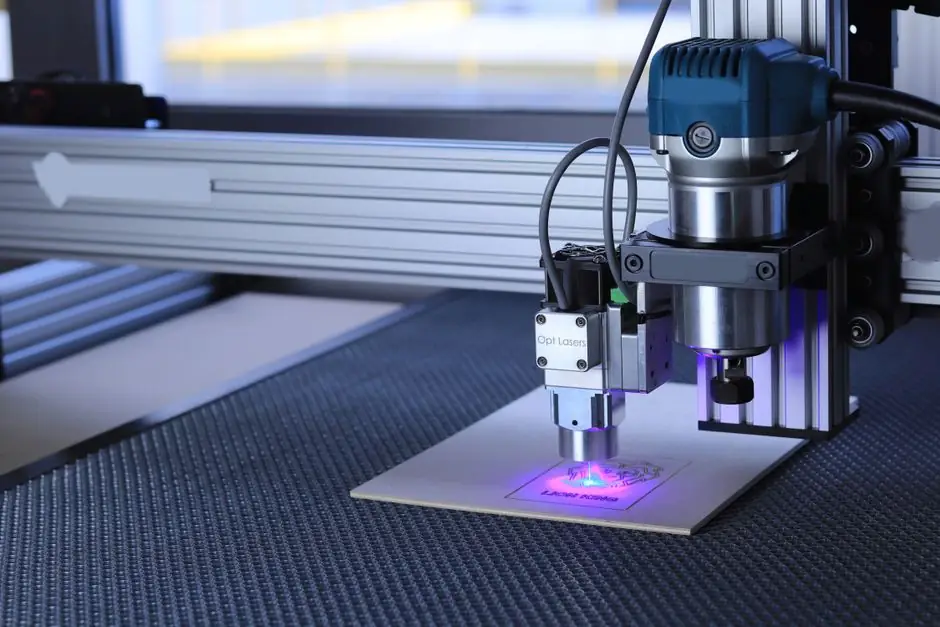
A 20 W pulsed fiber laser marker typically lists between $2,500 and $4,500 for an import-grade benchtop unit, while a 50 W pulsed fiber marker lands in the $5,000-9,000 band depending on galvanometer, lens and control board options [S1].
MOPA-fiber sources with adjustable pulse duration (typically 2-500 ns) sit in a $6,000-12,000 window at 20-60 W because the MOPA architecture adds a separate modulator stage and a wider-pulse driver board over a fixed-Q-switched unit [S1].
How Output Power Changes Marking Speed and Material Range
A 20 W fiber marker produces a clearly readable mark on bare stainless steel at roughly 200-400 mm/s with a 110 mm F-theta lens, while a 50 W unit sustains 600-1,200 mm/s on the same 304 stainless coupon under equivalent optics, because higher pump power raises the peak pulse energy available per marking pass [S1]. On anodized aluminum, 20 W dark-marks cleanly below about 0.05 mm anodized layer thickness, while 50 W is the practical floor for stripping anodization on 0.1-0.2 mm layers at production line speeds.
Cutting depth (light-duty scribing) is another order-of-magnitude step: a 20 W source can part-cut 0.5 mm stainless at single-pass kerf widths near 0.1 mm, while 50 W reaches 1.0-1.5 mm stainless in one pass, useful for sheet-metal date-code and through-cut traceability tags. Neither power class is a substitute for a dedicated laser cutter on plate; the marker head is optimized for marking, not for heavy section cutting.
Q-Switched vs MOPA: When Pulse Width Control Pays for Itself
Fixed-Q-switched fiber sources emit pulses of roughly 80-120 ns at a fixed width, which is fine for annealing, deep engraving and most black-on-white industrial UID marks. MOPA sources add an independently driven modulator that lets the user stretch pulses from about 2 ns up to 500 ns, which is the parameter that creates contrast on metals rather than simple ablation [S1].
Stainless steel color marking is the canonical MOPA use case: tuning pulse width to the 20-200 ns range with repetition rates of 30-200 kHz yields gold, blue, purple, green and red oxide tints without removing material, a result a fixed-Q-switch source cannot reproduce reliably. Anodized aluminum white-marking is the second MOPA application, since short pulses (under 20 ns) crack the anodized layer cleanly while longer pulses melt the underlying aluminum and discolour the mark. For a general-purpose shop running mostly black marks on bare metal, a fixed-Q-switched 30 W or 50 W unit is usually the better value per watt, and the price gap (roughly $2,000-4,000) is hard to justify if color marking is not on the work order [S1].
Decision Matrix: 20W, 50W and MOPA at 2-4 Criteria
Price band (import tier, 2025-2026): 20 W fixed-Q at $2,500-4,500; 50 W fixed-Q at $5,000-9,000; 20-60 W MOPA at $6,000-12,000. Marking speed on 304 stainless: 20 W reaches 200-400 mm/s, 50 W reaches 600-1,200 mm/s, MOPA 30 W reaches 300-600 mm/s because the MOPA modulator trades a small amount of peak power for pulse-shape control. Material coverage: 20 W covers bare metals and many plastics; 50 W extends to thicker anodized layers and light-duty cutting; MOPA adds stainless color, anodized white, and fine plastic marking without carbonisation. Integration cost (chiller, fume extraction, Z-axis): budget 30-60% on top of bare marker price, fairly uniform across the three classes, so MOPA total cost of ownership trends higher even at equivalent wattage [S1].
For a job shop running mostly serial-number UID marks on stainless and aluminum, a 30 W fixed-Q-switched unit at roughly $3,500-5,500 hits the best price-per-watt. For a tier-1 supplier needing color logos on stainless consumer parts, a MOPA 50 W at $8,000-11,000 is the smallest source that holds color consistency at production line speeds above 500 mm/s.
What the Price Band Does and Does Not Include
The bare-marker price covers the laser source, a galvanometer scan head (typically 110 mm aperture with an F-theta lens), a control board (commonly JCZ or BJJCZ with EZCAD or similar software), a foot pedal or remote interlock, and a basic worktable. It does not normally include a CW (recirculating) chiller sized to the source; a 20 W unit is happy with a 0.5-1.0 kW chiller at roughly $300-600, while a 50 W MOPA wants a 1.5-2.5 kW chiller at $700-1,500 to hold the laser diode junction temperature within spec [S1].
Warranty, installation and training are also commonly excluded. Buyers in regulated sectors (medical device, automotive IATF 16949, aerospace) should also budget for a Class 1 enclosure with interlocked doors, exhaust ducting, and a risk assessment aligned to ISO 11553-1 and the regional laser-product standard (FDA 21 CFR 1040.10 in the US, IEC 60825-1 elsewhere). Skipping the enclosure is the single most common source of operator eye-injury reports and the single most common reason buyers get pushback from EHS audits on a new marker install.
Total-Cost Levers Beyond the Headline Price

Three line items move total price more than the choice between 20 W and 50 W. First, the scan head: a Sino-Galvo or equivalent 110 mm head at $400-700 is fine for 20-30 W marking; a higher-stability head with digital servo drive and <0.01 ms step response adds $1,000-2,500 and becomes worth it above 50 W to hold small-character legibility at full speed. Second, vision light source integration for auto-focus on curved or non-flat parts: a coaxial red-pointer + camera package adds $1,200-3,000, useful for medical and aerospace parts where a manual Z-set is a cycle-time killer. Third, fume extraction sized to the substrate: stainless and titanium fume carries hexavalent chromium and nickel respectively, so a HEPA-grade extractor at $1,500-4,000 is non-optional for an indoor shop running more than one shift. [S1]
A related read for buyers balancing cabinet and process integration cost is the Explosion-Proof Junction Box vs Distribution Box comparison, which applies when a marker is being installed in a Class I Div 2 or ATEX Zone 2 cell alongside solvent-bearing adhesives or coating lines. Another relevant reference is the UL vs CE certification primer, since a marker sold into North America is normally cTUVus or cULus listed for the cabinet while a European install will need CE under the Machinery Directive 2006/42/EC and a separate IEC 60825-1 laser-product report.
Who 20W, 50W and MOPA Are Actually For
A 20 W fixed-Q unit is the right pick for small shops doing 1D/2D code marking on bare stainless, mild steel, brass and most engineering plastics, with cycle times below roughly 6 seconds per part and batch sizes where throughput is not the bottleneck. A 50 W fixed-Q unit is the right pick for higher-volume metal shops, automotive tier suppliers, and extruders who need to mark on rough hot-rolled surface or thicker anodized layers in 1-3 seconds per mark. A MOPA 20-60 W is the right pick only if the work order explicitly calls for stainless color, anodized aluminum white, or fine engraving on plastic without carbonisation, which are the three applications a fixed-Q source genuinely cannot do. [S2]
Buyers who do not have color marking or anodized white on the work order should not pay the MOPA premium: the same $8,000-10,000 spent on a fixed-Q 50 W plus a better scan head and chiller typically produces cleaner deep marks at higher throughput, because peak power per pulse is what drives mark depth and a MOPA modulator eats some of that headroom to gain pulse-width control [S1].
Selection Checklist Before Quote Release

Confirm substrate and required mark type (deep engrave, anneal, color, anodized white) before picking a source class, because that single decision sets the price band. Confirm minimum character height and required throughput, because 2 mm characters at 200 mm/s on bare metal are within any 20 W spec, but 0.5 mm Data Matrix codes on curved stainless at 800 mm/s is a 50 W problem. Confirm duty cycle: a 1-shift job shop is fine with a 20 W source's typical 8,000-12,000 hour MTBF on the pump diode, while a 3-shift cell needs a 50 W source with a longer-rated diode and a properly sized chiller, because diode lifetime falls sharply above 35 degC coolant. [S2]
For buyers comparing 20 W and 50 W on the same work order, the practical rule of thumb is: if the existing 20 W cell meets throughput at one mark per 4 seconds, the upgrade to 50 W pays for itself only if cycle time is the constraint and the 50 W cuts the mark to under 2 seconds. If throughput is already fine, hold the budget and put the savings into a laser profiler for in-line inspection of the marks you already have, which closes the quality loop more cost-effectively than a faster laser.