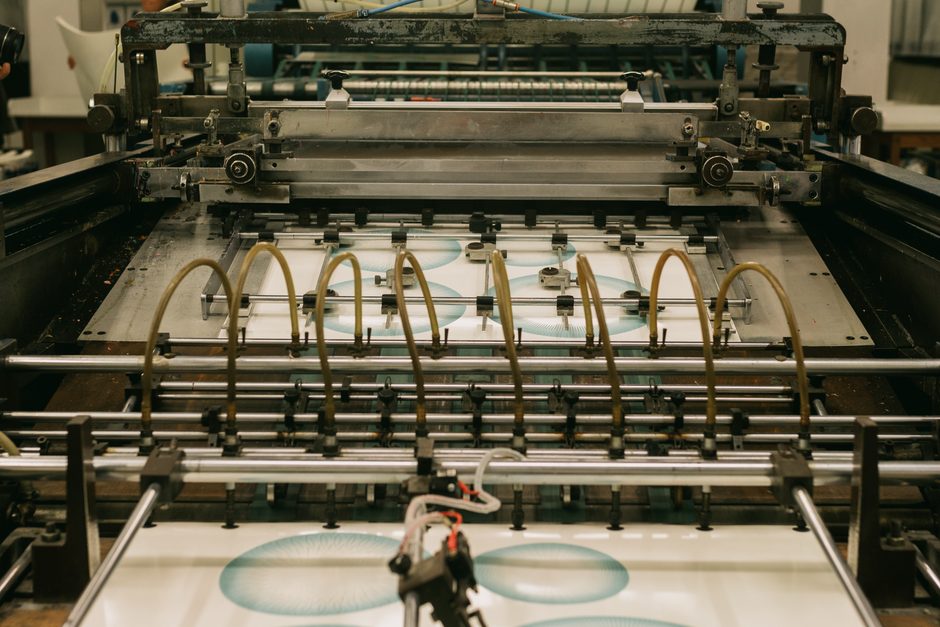
A filling machine doses a defined volume or mass of product into a pre-made container; a carton erecting machine takes flat blanks and forms the empty carton that the filler (or a downstream packer) then loads. They are sequential, not competing, units on a primary or secondary packaging line, and most 2026 line-builds from Turkish, Chinese and Indian OEMs are quoted together as a matched pair rather than as alternatives [S1][S2].
The two machines also draw on very different duty cycles. Filling heads are routinely quoted from 4-nozzle desktop magnetic-pump units for craft sauce lines up to multi-head gear-pump and piston lines for lubricating oil and chemical drums [S3]; erectors are typically quoted by carton-per-minute throughput and by blank format, with current Alibaba supplier listings showing 1832 active case-erecting-machine vendors and references like the DPK-40H18 high-speed automatic cardboard box erecting platform as common 2026 model codes [S4].
What each machine actually does on the line
A filling machine is the dosing station: liquid, viscous, paste, granular or powder product is measured by piston, gear pump, peristaltic, magnetic, mass-flow or auger, then discharged through 1 to 12+ nozzles into a waiting bottle, jar, pouch, drum or can. 2026 OEM catalogues split the range clearly: Hanlar positions its range from semi-automatic liquid fillers and capping machines upwards; Dongtai lists dedicated lubricating-oil fillers and tube-filling-and-sealing units; King Pack lists 4-nozzle magnetic-pump desktop units, U-type sauce/paste fillers with mixer, and spout-pouch gear-pump fillers on a single product page [S1][S2][S3]. The filler's job ends when the container is sealed, capped or heat-sealed.
A carton erecting machine, by contrast, does no dosing. It pulls a flat corrugated or solid-board blank from a magazine, folds the side flaps, squares the body, seals the base with hot-melt glue or tape, and discharges an open, square carton onto a conveyor where a pick-and-place loader, a manual packer, or a downstream coding machine and case-packer take over. Format change on most 2026 erectors is handled by servo-driven crank adjustment rather than change parts, but the spec that matters is still blank size range, output in cartons per minute, and glue versus tape closure [S4].
Throughput, footprint and the realistic speed ratio
Filling throughput is dominated by the number of nozzles, the fill volume, and the dosing principle; erector throughput is dominated by blank pickup reliability and glue-set time. As a rule of thumb that any line-integrator will confirm in 2026, an erector must be sized to feed the filler's downstream section plus the loader, not the filler head itself. The filler's 4-12 nozzle head is almost always the slowest single station on the line, with output figures quoted per nozzle rather than per machine [S3].
Speed ratios in published 2026 model codes cluster around 1 erector feeding 1 filler at ratios of 1.0:1.0 to 1.0:1.4 when the downstream packer is hand-fed, and 1 erector feeding 2 fillers when small-format retail cartons run on dual-lane fillers [S4]. A DPK-class high-speed automatic erector is typically quoted in the 30-60 cartons-per-minute band; a 4-nozzle magnetic-pump desktop filler from King Pack's 2026 catalogue is sized for craft and lab-scale output, well below that envelope, so the erector is intentionally oversized and runs part-loaded [S3][S4].
Decision criteria: which one you actually need to specify
For a filling machine, the four hard spec gates in 2026 are: (1) product state (free-flowing liquid, viscous, paste, particulate, powder), (2) fill volume range and accuracy tolerance, (3) container format and material (PET, glass, pouch, drum, tube), and (4) cleanability class (CIP, SIP, or wash-down only). These four determine the dosing principle, and the dosing principle determines price and lead time far more than brand [S1][S2][S3].
For a carton erecting machine, the four matching gates are: (1) blank material and flute (E-flute, B-flute, B/C, solid board), (2) blank size range in L x W x H, (3) output in cartons per minute at the dominant SKU, and (4) closure method (hot-melt glue, tape, or lock-tab). The blank format and the closure method drive tooling cost and changeover time, and the cpm figure must be quoted with the specific blank size used to test it, not a marketing maximum [S4].
Side-by-side comparison on the same four criteria
On dosing accuracy, the filling machine is specified in ±0.5-1.5% volumetric or ±0.1-0.3% gravimetric bands, while the erector has no dosing spec at all. On changeover, the filler typically needs 15-45 minutes for nozzle and format-part changes; the erector needs 5-20 minutes for servo crank adjustment on a 2026 servo-driven model. On operator skill, the filler requires a process-trained operator who understands CIP and product viscosity; the erector needs a mechanical operator who can fault-find blank pickup and glue temperature. On line integration, the filler is the wet-product station and is usually placed after the rinser/filler/capper block; the erector is the dry station and is usually placed upstream of the loader, downstream of the carton box magazine, and is paired with a coding machine and a case packer for the full secondary pack [S1][S3][S4].
The two machines are simply not comparable on throughput, because they measure different things. A 4-nozzle desktop magnetic-pump filler from King Pack's 2026 range handles tens to low hundreds of bottles per minute depending on fill volume [S3]; a DPK-40H18-class high-speed erector on Alibaba's 2026 supplier list handles 30-60 cartons per minute at the dominant SKU [S4]. Sizing the line is about matching the filler's per-nozzle output to the erector's per-carton output, not picking the higher cpm number.
Who should specify a filling machine, and who should not
Specify a filling machine if you are dosing a defined volume of product into a finished container, you care about fill accuracy, you run a wet or sanitary process, and you need CIP/SIP validation. Liquid, viscous, paste, oil, sauce, tube and pouch lines are all filler-led. 2026 OEM data from Hanlar, Dongtai and King Pack confirms that filling remains the core product category for all three, with capping and labeling treated as upstream/downstream accessories rather than standalone lines [S1][S2][S3].
Do not specify a standalone filling machine if your output is below 10-20 containers per minute and your containers are pre-formed cartons; in that case a hand-fed or semi-auto cartoning station may be enough, and a full erector-filler pair is over-specified. Do not specify a piston or gear-pump filler for abrasive or shear-sensitive products without a vendor-confirmed compatibility check, and do not size a magnetic-pump filler for high-viscosity paste without confirming the pump's viscosity ceiling on the OEM data sheet [S3].
Who should specify a carton erecting machine, and who should not
Specify a carton erecting machine if you ship in RSC or HSC corrugated or solid-board cartons, you run more than 5-10 SKUs through a single pack station, and you want servo-driven format changeover rather than manual change parts. E-commerce, FMCG, pharmaceutical secondary pack and appliance-pack lines in 2026 are almost universally erector-led at the secondary-pack stage, and the 1832 active Alibaba suppliers as of mid-2026 confirm the depth of the market [S4].
Do not specify an erector if your product ships in a tray, shrink-wrap bundle, or a custom moulded pack; the erector adds cost and floor space with no value. Do not specify a high-speed automatic erector if your blank supply is inconsistent in dimension or flute, because blank variability is the number-one cause of erector jams regardless of cpm rating. Do not specify a tape-closure erector for food or pharma lines where glue migration or open-flap ingress is a HACMA or GMP concern without validating the closure method against your audit standard [S4].
Standards, sourcing and 2026 supplier signals
Neither machine is governed by a single binding international standard the way a pressure vessel or a hazardous-area instrument is; instead, compliance is built from the relevant food-contact, electrical and mechanical-safety standards in the destination market. For 2026 line-builds, the practical sourcing pattern is to quote a Chinese, Turkish or Indian OEM for the mechanical core, then add Western (German, Italian, Japanese) controls and servo drives for the line integration, with the OEM handling CE, UL or equivalent electrical compliance as a package [S1][S2][S3][S4].
For related downstream kit, the standard line layout pairs the filler and erector with a coding machine for batch and date marking, a filling-weighing scale for in-process checkweighing, and a core machine or carton erecting machine upstream for tray forming. Cross-vendor verification is straightforward in 2026 because each OEM publishes a single product page covering the full machine family: Hanlar's site groups filling, capping and labeling under one catalogue [S1], Dongtai's mobile site does the same for oil and tube filling [S2], King Pack lists DSC-4N, U-type sauce, spout-pouch and gear-pump models on one page [S3], and Alibaba's case-erecting supplier index exposes 1832 vendors with model codes like DPK-40H18 visible in the listing metadata [S4].
For related coverage, see AAC Block vs Lightweight Partition Panel: 2026 Spec Cut for Interior Wall Specifiers.