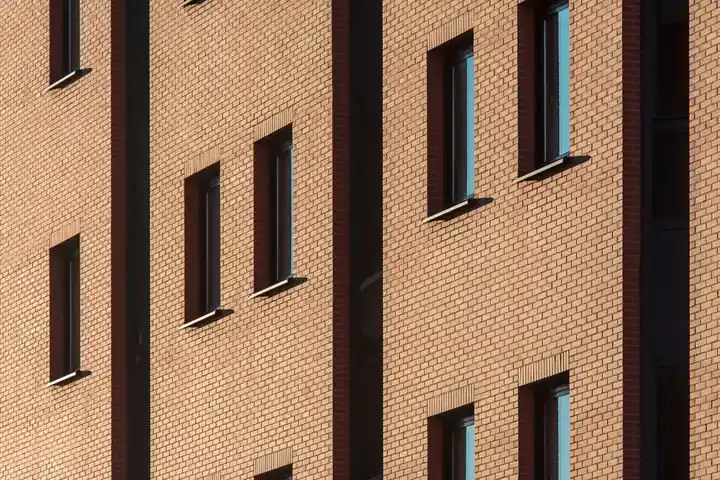
Hospitals do not require a single, uniform fired-clay-brick grade. The correct specification depends entirely on the assembly's temperature exposure, load demand, and hygiene requirement, with non-refractory stock brick (compressive strength 15–100 MPa, density 1.8–2.2 g/cm³, water absorption 10–20%) suitable for most interior and envelope work, and fire-clay or high-alumina refractory grades reserved for boiler rooms, incinerators, and central sterile supply zones that cycle above 800°C [S1][S2][S3].
The fastest way to fail a hospital spec is to treat "fired brick" as one product. Standard fired brick is kiln-fired at 900–1200°C and tolerates only moderate heat, making it adequate for partitions, façades, and landscaping but underspecified for high-temperature plant rooms [S2]. Refractory lines such as fire clay brick and high alumina brick sit on a different cost and performance curve, and a procurement officer who does not separate them will either overpay for partitions or underspecify a boiler hearth.
Define the service zone before choosing a brick grade
Hospital projects break into four distinct masonry environments, and each drives a different brick selection. Patient wings, corridors, and façades run ambient (around 20–35°C) and only need a stock fired brick with stable dimensions, low water absorption, and adequate compressive strength for multi-storey load. Service cores such as laundry, kitchen exhaust shafts, and generator enclosures cycle between 200°C and 600°C, pushing toward a denser, lower-porosity stock. Central boiler plants, medical-waste incinerators, and autoclave backup lines hit 800–1300°C continuously, which is the threshold where standard fired brick fails and a refractory grade becomes mandatory [S2][S3].
For boiler hearths and incinerator linings, the limiting figure is not peak temperature but refractoriness under load (RUL). Fire-clay grades (SK32–SK34) carry 30–48% Al₂O₃ and an RUL of 1250–1300°C, while high-alumina grades (SK36–SK38, 48–90% Al₂O₃) push RUL to 1420–1550°C+, a 170–250°C margin that translates into months of extra campaign life on a hospital incinerator lining [S3]. Specifying by "fired brick" without naming the Al₂O₃ window is a known path to early lining failure.
Comparison: stock fired brick vs fire clay vs high alumina for hospital assemblies
Three brick families compete for hospital line items, and the decision criteria are temperature, load, slag/chemical exposure, and unit cost [S1][S3]. The table below summarises the published envelopes; numbers are vendor-published and should be revalidated against the project's specific duty cycle.
For hospital partitions and façades, the stock column is the rational pick: density in the 1.8–2.2 g/cm³ band and water absorption in the 10–20% range are well-documented, and the 1.2–2.0 W/m·K thermal conductivity gives useful envelope insulation without driving the wall thickness past a corridor dimension [S1]. For boiler rooms and incinerators, fire clay is the default below 1350°C, and high alumina takes over above 1400°C or where slag from medical waste (alkaline, high-CaO ash streams) would attack an acidic fire-clay lining [S3].
Where stock fired brick is the right call in a hospital
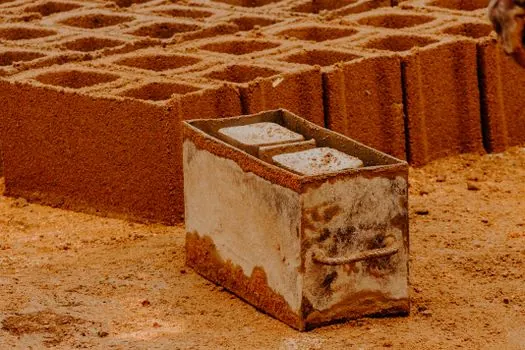
Patient-room partitions, lift shafts, and external cavity walls all sit well inside stock-fired-brick duty. The published envelope of 1.8–2.2 g/cm³ density and 15–100 MPa compressive strength covers multi-storey load, while the 10–20% water absorption band is acceptable for protected exterior envelopes, provided the brick is stored dry and laid with a controlled mortar joint [S1]. For façades exposed to freeze-thaw cycling, target the lower end of the absorption range, since reduced absorption is the published lever for freeze-thaw durability [S1].
Reception halls, corridors, and loading-bay walls are similarly stock-brick territory. A related guide on fired clay brick selection for commercial façades walks through the same absorption and tolerance levers for above-grade envelope work, and the same logic applies on a hospital façade. Where partition walls abut plant rooms, however, the spec should step up to a denser, lower-porosity stock or a fire-rated block to handle incidental heat and acoustic load.
Where fire-clay and high-alumina brick are mandatory in a hospital
Any masonry that sees continuous surface temperature above 800°C must leave the stock family. Hospital incinerators burning pathological waste typically run 850–1100°C in the secondary chamber, which puts them above the safe working limit of standard fired brick and inside the fire-clay (SK32–34) duty band, with a safe working ceiling at 1350°C [S2][S3]. Steam-boiler hearths and economiser sections are similar: 900–1200°C flue-gas contact is a textbook fire-clay application, with a 1250–1300°C RUL envelope that is sufficient when the boiler is well-managed and the slag chemistry is neutral [S3].
For higher-duty service, including medical-waste vitrification units and any lining that handles alkaline ash or basic slags, high-alumina SK36–38 is the published upgrade. The 48–90% Al₂O₃ content shifts the lining from acidic toward neutral, which reduces chemical attack from CaO- and MgO-rich slags, and the 1420–1550°C+ RUL figure removes the "softening under load" failure mode that collapses a fire-clay crown [S3]. Cold crushing strength also climbs from 20–30 MPa in fire-clay to 45–80 MPa in high-alumina, which matters for any hearth section that supports rammed charge or ash build-up. The trade-off is unit cost, since high-alumina is consistently priced at a premium to fire-clay [S3].
What hospitals do NOT need from a fired-clay-brick spec

Three common mis-specs drive unnecessary cost on hospital projects. First, lining a standard partition with refractory fire-clay or high-alumina brick. The wall will never see 200°C, so the 1580–1790°C refractoriness is dead capacity and the premium price buys nothing. Second, specifying a single brick SKU across the whole building, which forces a refractory line item into the partition BOQ. Third, ignoring the 1.2–2.0 W/m·K thermal-conductivity range: where partitions double as thermal envelope, a denser, lower-porosity stock at the upper conductivity end can be paired with cavity insulation, and a higher-porosity stock at the lower end saves cladding thickness [S1].
The other recurring mistake is to spec by "heat resistance" instead of Al₂O₃ content. Stock fired brick is not refractory, and a 900–1200°C firing history does not make a stock brick safe at 900–1200°C in service; the kiln firing sets the chemistry, the service temperature sets the duty [S2]. If a specifier wants one number to anchor the line item, the published ceiling for stock fired brick is around 1200°C, well below the 1350°C fire-clay safe-working limit and the 1400–1700°C high-alumina band [S2][S3].
Installation, sourcing, and standards to anchor a hospital spec
For any refractory section, the spec should call out the forming method (extrusion, soft-mud, or dry pressing), the firing range, the Al₂O₃ band, the bulk density, and the cold crushing strength, rather than a single brand name. Highland Refractory's published envelope is a useful baseline: kaolin and ball clay for plasticity, bauxite for alumina, silica for thermal-shock resistance, with firing around 1200–1300°C to develop the final density and strength [S1]. The same envelope is referenced in the related fired clay brick selection for cold storage warehouses guide, where low absorption and tight dimensional tolerance are also the headline levers, although the duty cycle is the inverse of a hospital boiler.
For hospital façades, the published tolerance lever is uniform size and shape at the forming stage, which directly controls the thermal gaps in a refractory lining and the mortar-joint consistency in a partition. On the data sheet, the actionable numbers are density 1.8–2.2 g/cm³, water absorption 10–20%, thermal conductivity 1.2–2.0 W/m·K, and compressive strength 15–100 MPa for stock; for fire-clay, 30–48% Al₂O₃, RUL 1250–1300°C, cold crushing 20–30 MPa; for high-alumina, 48–90% Al₂O₃, RUL 1420–1550°C+, cold crushing 45–80 MPa [S1][S3]. Cross-check these against the project-specific temperature map, and reject any line item that does not name its Al₂O₃ band, RUL, and cold crushing strength on the data sheet.
Track the next revision of the boiler-room and incinerator lining data sheets for RUL values stated at the SK series, not just peak refractoriness, and watch for any published movement in the 1250–1300°C vs 1420–1550°C+ gap, which is the single biggest lever on refractory campaign life in hospital waste-service equipment [S3].
The underlying component specifications are covered under block brick, and pressure transmitter.