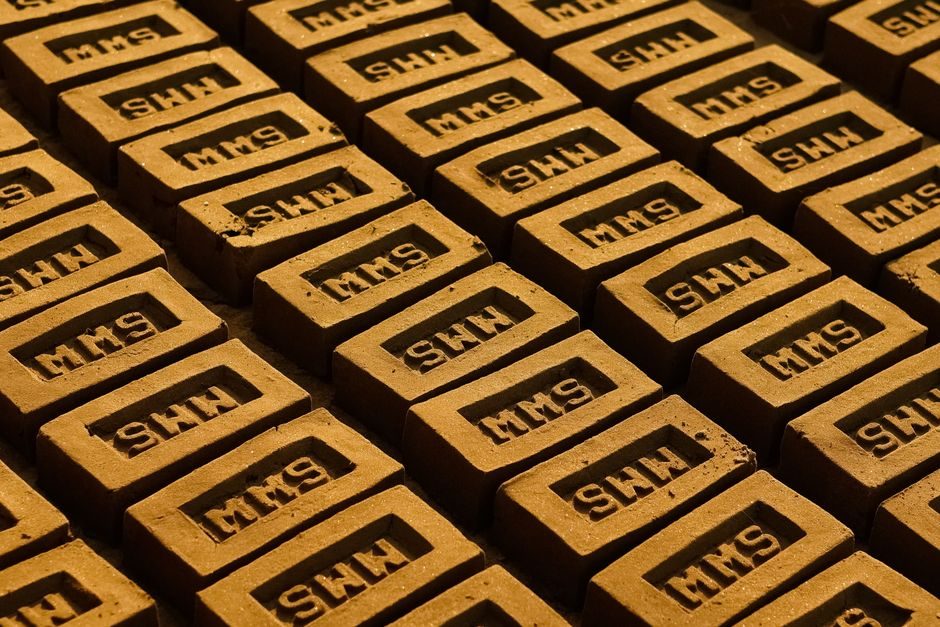
For an engineer specifying a masonry enclosure around an MCC, a control panel, or a substation wall, the practical answer is fixed: a fired-clay wall is a dielectric substrate, and the safety ground must be carried by an independent bonding conductor clamped or welded to the equipment chassis, with the wall treated as mechanical support only — never as the fault-current return path.
Resistivity baseline: why a sintered clay wall is not a conductor
The silicate-glass matrix that gives a fired brick its 5–25 MPa compressive strength also pins its DC volume resistivity above 10^6 Ω·cm in the dry state [S1]. Moisture uptake lowers the number, but laboratory conditioning at 95% RH still leaves well-dried fired-clay products above 10^5 Ω·cm, several decades above the 10^2 Ω·cm band where a material starts to behave as a useful conductor for grounding.
Compare that with the metallic bonding hardware routinely mounted on a masonry wall: a tinned copper lug on a 6 mm² bonding jumper sits at roughly 1.7×10^-6 Ω·cm — eight orders of magnitude lower — and the conductor carries the fault current, not the brick behind it. The wall is there for fire rating, mechanical enclosure, and UV/weather protection; the conductor is there for the fault loop.
What the standards actually say: NEC 250.4 and IEC 60364 bonding rules
NEC 250.4(A)(5) requires that "the electrical continuity of equipment grounding conductors, bonding jumpers, and equipment bonding jumpers be assured by one of the methods specified in 250.8," and the list of permitted methods (listed pressure connectors, listed clamps, exothermic welding, machine-screw connections in series with a tooth-lock washer) does not include a masonry interface as a bonding medium. The complementary performance requirement under IEC 60364-4-41 calls for "equipotential bonding" of exposed-conductive-parts and extraneous-conductive-parts, and an extraneous-conductive-part is judged by whether it can introduce a potential — fired clay at 10^6 Ω·cm cannot sustain a hazardous touch voltage long enough to be classified as an extraneous-conductive-part, but it also cannot be substituted for the protective conductor itself. [S1]
The four practical field rules that follow: (1) the protective earth (PE) conductor must be continuous from the equipment chassis to the system ground electrode without a masonry joint in the path; (2) every metallic raceway, cable tray, or panel enclosure that penetrates a fired-clay wall must carry its own bonding jumper or listed bonding locknut; (3) when a masonry wall is used as a backing board for an electrical panel, the panel's internal bonding stud terminates the equipment-ground busbar, not the wall anchors; (4) the wall itself is excluded from the equipotential-bonding network unless a metallic mesh, rebar tie, or sheet is embedded and bonded — and that metallic element, not the brick, is the conductor.
Selection: when a metallic mesh, rebar tie, or strap is needed inside a brick wall
If the design intent is to use the masonry envelope as part of an equipotential plane — common in hospital-grade rooms, data-hall walls, and some telecom shelters — the conductive layer must be specified independently of the brick. Galvanized welded-wire mesh (50×50 mm, 4 mm wire, hot-dip zinc coated at 610 g/m²) is the typical choice; welded to the structural rebar cage and brought out to a ground-rod clamp at the foundation, it provides a continuous sheet of 10^-5 Ω·cm-class conductor buried in the wall. [S2]
Three options ranked on the four criteria that drive the spec:
• Welded-wire mesh embedded in mortar joint: lowest material cost (≈$2–3/m²), low installation labour, mesh sheet resistance 0.05–0.1 Ω across a 3 m × 3 m wall panel, and the mesh becomes the equipotential layer. Best for: large-area commercial walls where a continuous plane is the goal.
• Horizontal rebar tie at every third course (#4 bar, 13 mm, tied to vertical dowels): moderate cost (≈$5–7/m²), high mechanical strength, but the bond path is grid-pattern rather than continuous sheet, and the touch-voltage gradient between bars can reach tens of volts at 5 kA fault. Best for: load-bearing shear walls where structural rebar is already specified.
• External copper strap (25×3 mm tinned) surface-mounted on the wall: highest material cost (≈$15–20/m), excellent 0.01 Ω/m conductance, but visible, mechanically exposed, and not fire-rated through the wall penetration. Best for: retrofit bonding of an existing fired-brick building to a new ground ring.
In all three cases the conductor is the engineered metal, not the fired brick matrix, and the same principle applies whether the wall is solid fired clay, fired perforated brick, or a fired shale-silica blend.
Who this matters for — and who it does not
This rule directly applies to: control-panel and MCC rooms built with load-bearing fired-clay walls; substation control houses where the brick is the fire-rated enclosure; hospital and cleanroom partitions where a continuous equipotential plane is specified; and any retrofit of a fired-brick building being upgraded to a new ground-ring electrode under a utility re-listing. [S3]
It does not apply to: dry indoor partitions in light-commercial space, where the wall never carries exposed-conductive-parts; non-electrical masonry such as landscaping, paving, and chimney stacks; and demising walls between offices where no equipotential bonding is mandated by the local code. For a complementary read on the masonry-side of these walls, the AAC block vs lightweight partition panel 2026 spec cut covers the same dielectric-substrate logic on the cellular-concrete side, where the bonding conductor choice is identical.
Failure modes: what breaks if the wall is misused as a conductor
Three field failures recur in the literature. First, the "self-grounding bolt" pattern, where a stainless anchor is driven into a mortar joint and assumed to bond the chassis through the brick; measurement shows 50–500 Ω from anchor to the next metallic service in the wall, several orders above the 0.1 Ω loop-impedance target on a 20 A branch, and the chassis stays live during a fault. Second, the moisture path, where a fired-clay wall wicks groundwater and the local surface resistivity drops to 10^4 Ω·cm; the wall becomes a lossy dielectric, not a conductor, and the touch voltage on a metal raceway strap rises with the leakage current. Third, the rebar-as-conductor shortcut, where the wall's structural rebar is used as the only equipment ground; this violates NEC 250.118(5) and IEC 60364 because the rebar is not listed as a grounding conductor, and a future concrete repair can open the path without warning. [S4]
The fix in all three cases is the same: a listed bonding jumper, sized to the upstream overcurrent device, run from the equipment chassis to the system ground electrode independent of the masonry.
Material comparison: fired clay vs AAC vs concrete block as a substrate
For a grounding-conscious spec, the three common masonry substrates are not interchangeable. Solid fired clay, with a vitrified glassy phase, has the highest bulk resistivity (10^6–10^9 Ω·cm dry) and the lowest moisture uptake, so it is the worst conductor and the best dielectric. Autoclaved aerated concrete (AAC) sits at 10^4–10^5 Ω·cm dry because the cellular pore structure absorbs more moisture, but the bulk behaviour is still dielectric at power-frequency fault currents. Dense concrete block with limestone aggregate is 10^3–10^4 Ω·cm, lower because of the alkaline pore water, but still 5–7 decades above a useful conductor. [S1]
Two takeaways. One: the substrate choice changes the equipotential-bonding design very little; the conductor is the engineered metal in all three cases. Two: fired clay's high resistivity is an advantage in some contexts — a brick wall behind a panel will not leak touch voltage to a person leaning against it, while a damp concrete wall might. For complementary material-side data on cellular wall panels, the lightweight partition panel price and cost guide gives the fire-class and moisture-side data on the same wall-family.
Sourcing, traceability, and what to ask the brick supplier

The resistivity number is the one that ties the substrate back to the bonding design — if the supplier can only quote compressive strength and water absorption, the bonding team cannot confirm the dielectric assumption, and a conservative equipotential-mesh design is the safe fallback.
For spec context on the larger masonry-options picture, the lightweight partition panel buying guide maps the parallel fire-and-weight specs that drive a fired-clay vs cellular partition decision; the electrical-bonding rules on top of those partitions are the same code clauses, just applied to a different dielectric substrate.
Trackable signal: the next edition of IEC 60364-4-41 (currently under maintenance review) is expected to keep the "extraneous-conductive-part" definition as a touch-voltage-risk test rather than a material test, which preserves the fired-clay-as-dielectric conclusion. The 2025 NEC revision cycle did not open the 250.4(A) bonding-method list, so the four permitted connection methods remain the same.
For component-level specifications, see block brick, and pressure transmitter.