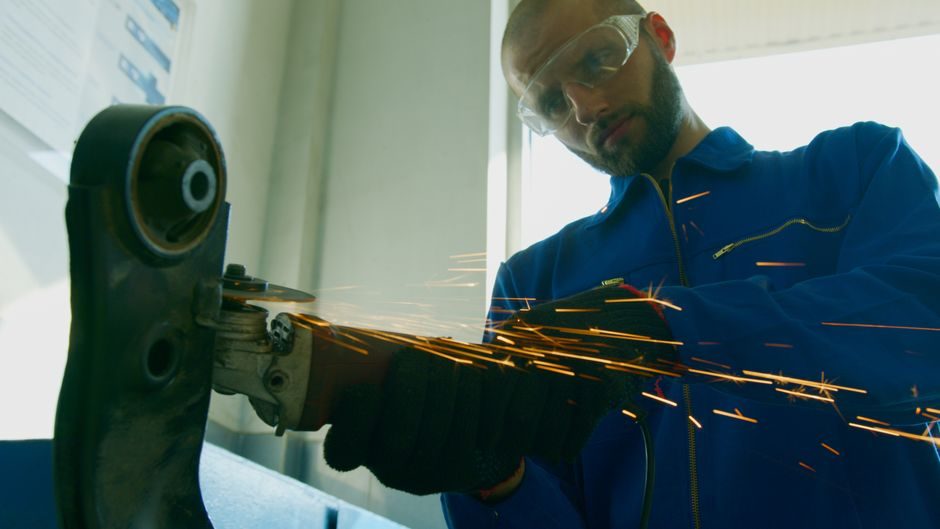
Walk onto any 2026 job-site tender and a floor grinder spec is judged on four numbers first: motor kW, working width, head geometry, and dust-port diameter — everything else is negotiation [S1][S2].
Entry-tier plug-in units ship in the 1.5-2.2 kW / 220 V band with replaceable plates for grinding, polishing, rust and paint removal, and integrated dust suction [S1]. Mid- and heavy-tier planetary and HTC-style machines dominate the commercial polishing channel on Alibaba, with multi-disc plate geometry for concrete and terrazzo [S2][S3].
Power Class and Voltage: 220 V Single-Phase vs 380 V Three-Phase
Light-duty 220 V single-phase units at roughly 1.5-2.2 kW cover small rooms, edge work and DIY epoxy prep, with replaceable plate-and-head geometry that handles grinding, polishing, rust and paint removal in one chassis [S1]. Three-phase 380 V industrial units start around 4-7.5 kW and climb past 11-15 kW for production grinding of large slab pours, where 50/60 Hz compatibility and soft-start inverters become part of the spec sheet rather than optional extras [S2]. Single-phase 220 V machines are bound by 16 A breaker limits, so a real 2.2 kW continuous draw sits right at the socket ceiling and pushes buyers toward 3-phase once daily output exceeds ~80-100 m² of coarse grind [S1].
Disc Geometry: Single-Disc, Planetary and HTC-Style Heads
Single-disc plate grinders are the lowest-cost entry — one rotating plate, replaceable diamond tooling, suited to small rooms and edge finishing [S1]. Planetary systems use a central drive gear spinning 3-4 satellite heads against the floor, which gives a flatter scratch pattern and faster cut rate on concrete polishing and terrazzo restoration [S2][S3]. HTC-style 4-head walk-behind platforms dominate the commercial polishing channel on Alibaba in 2026, sized for 480-800 mm working width with counter-rotating satellites for hologram-free finishes [S2]. For a sourcing engineer, the geometry choice drives tooling cost more than machine cost — a planetary head can swallow 3-4× the diamond segments per square metre versus a single disc.
Dust Port, Vacuum Integration and HEPA Sourcing
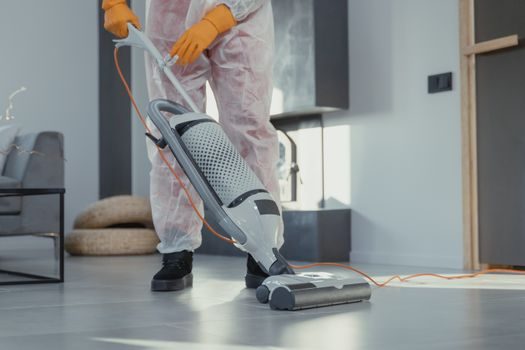
Dust port diameter is the easiest spec to get wrong: 50 mm ports are the de-facto standard on entry units and pair with single-motor shop vacs, while 75-100 mm commercial ports feed three-phase dust extractors with auto-pulse filter cleaning [S1][S2]. Entry units such as the Intbuying 220 V model integrate a dust suction fan into the chassis, but production buyers should plan for a separate M-class or HEPA extractor and budget the second line item explicitly [S1]. In 2026, more Made-in-China listings bundle the grinder and extractor as a paired kit with matched port diameter and shared power lead, which simplifies export documentation [S3].
Application Bands: Epoxy Prep, Polishing, Glue/Coating Removal
Buyers split into three bands. Epoxy and coating-removal crews need aggressive PCD or carbide tooling, high down-pressure, and a grinder rated for paint and rust removal — the entry 220 V segment is explicitly marketed for this [S1]. Concrete polishing contractors want planetary or HTC-style 4-head geometry, water-feed or dry resin-bond tooling, and a 75-100 mm dust port to feed a HEPA extractor [S2][S3]. Light commercial maintenance — small retail floors, basements, bamboo overlay prep — sits in the single-disc 1.5-2.2 kW band, where a linear guide on the height-adjust handle is more relevant than the motor spec.
Comparison: Entry vs Mid vs Heavy Floor Grinder on Four Decision Criteria
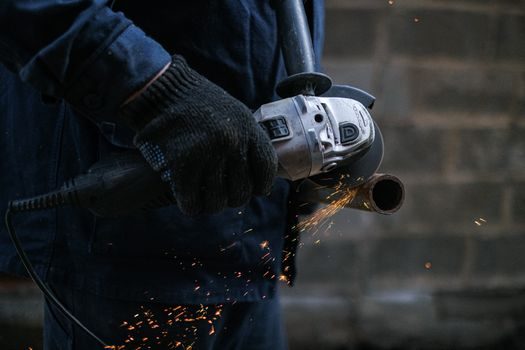
Lining the three bands up against the four spec gates: (1) Motor / voltage — Entry 1.5-2.2 kW / 220 V single-phase, Mid 4-7.5 kW / 380 V three-phase, Heavy 11-15 kW / 380 V three-phase with VFD [S1][S2]. (2) Disc geometry — Entry single disc, Mid 3-head planetary, Heavy 4-head HTC-style counter-rotating planetary [S2][S3]. (3) Dust port — Entry 50 mm integrated fan, Mid 75 mm separate extractor, Heavy 100 mm pulsed auto-clean extractor [S1][S2]. (4) Price band on 2026 Alibaba listings — Entry roughly USD 1,500-2,500, Mid USD 3,500-7,000, Heavy USD 8,000-18,000+ for HTC-class units, with FOB variance driven by motor brand, inverter and dust-extractor inclusion [S2][S3].
Standards, Safety and Common Failure Modes
First-paragraph technical claim: dust-extraction pairing on concrete grinders is governed by OSHA silica-rule engineering-control guidance in the US and equivalent EU workplace exposure limits, which is why the M-class / HEPA extractor line item is non-negotiable on production sites rather than an upsell [S1]. Common failure modes walk straight off the spec sheet: undersized dust ports choke the motor and burn out brushes on 220 V single-phase units [S1]; running a planetary head on a single-phase socket without a soft-start trips breakers; missing inverter on 380 V three-phase units causes torch-start torque that cracks diamond tooling [S2]. A fettling grinder shares the foundry-floor dust profile but is built for higher-impact steel-grinding duty, so cross-spec'ing it into a concrete crew is a tooling-cost mistake.
Sourcing Reality 2026: Alibaba, Made-in-China, eBay and Brand Channels
Three sourcing lanes matter in 2026. Alibaba HTC-style listings cluster the commercial polishing tier with 4-head planetary geometry and 380 V three-phase supply, with FOB pricing that scales sharply with motor kW and inverter inclusion [S2]. Made-in-China epoxy-prep listings focus on multiple-disc and plate-configurable units, often bundled with extractors and PCD tool packs for coating removal [S3]. eBay remains a viable lane for 220 V single-phase entry units such as the Intbuying 220 V model, useful for overseas contractors who need a plug-and-go unit without container-load MOQ [S1]. For buyers comparing selection logic across equipment classes, the four-gate spec framework used in Floor Grinder Selection: Four Spec Gates That Decide the Build maps cleanly to adjacent decisions like a crossed roller guide spec, where geometry, load class, accuracy grade and source channel are the equivalent gates. Trackable 2026 signals: dust-port standardisation around 50/75/100 mm, inverter VFD becoming default on 380 V planetary units above 7.5 kW, and more Alibaba listings bundling matched extractor + grinder kits to clear single-line customs entries [S2][S3].