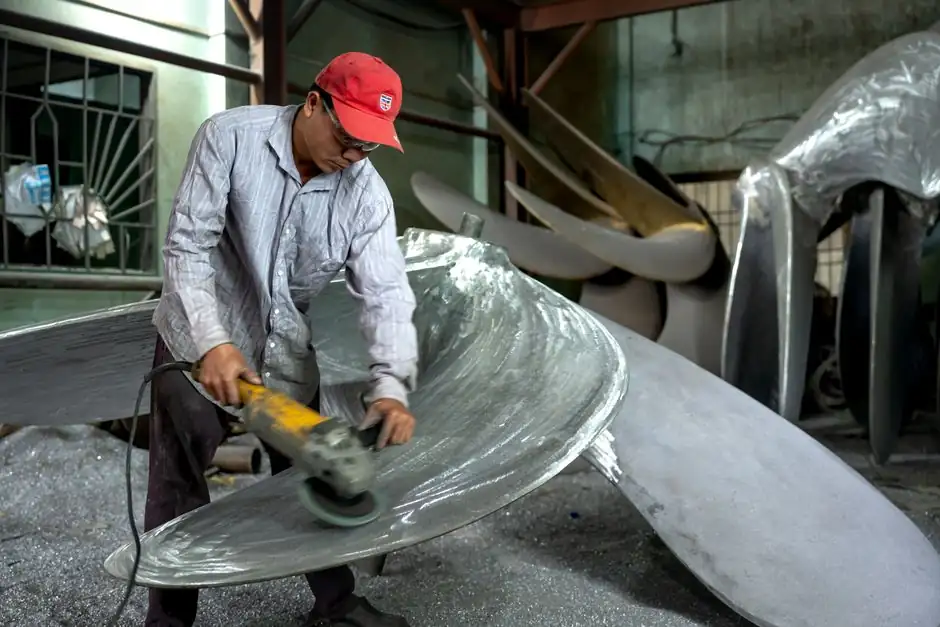
A 10-inch single-disc floor grinder processes about 200–250 square feet per hour, while a 22-inch heavy-duty dual-disc model reaches 800–1,000 square feet per hour [S1].
Production depends on working width, machine configuration, concrete hardness, diamond-tool design, grit size, coating thickness, operator skill and whether the work is grinding, contaminant removal or polishing [S2].
Production Rates by Working Width
Published EDCO figures establish three useful planning bands for floor grinders: 10-inch single-disc machines at 200–250 ft²/h, 22-inch dual-disc machines at 400–500 ft²/h, and 22-inch heavy-duty dual-disc machines at 800–1,000 ft²/h [S1]. The nominal disc sizes are not enough to calculate output by themselves because machine weight, drive power and tooling can change the result.
An older EDCO specification offers a useful cross-check. A machine with an 11-inch working width was rated at approximately 200–250 ft²/h when removing material at 1/32 inch with Dyma-Sert tools, while a 9-inch working-width machine was rated at about 350–400 ft²/h with a Dyma-Seg tool [S5][S7]. These figures are model and tooling conditions, not universal constants, which is why a bid estimate should preserve the stated grit, removal depth and tool type.
For planning purposes, a standard floor grinder should be specified by working width, expected application and a documented output range rather than by nominal disc diameter alone.
Single Disc, Dual Disc and Heavy-Duty Output
Single-disc grinders are the compact option for edges, small rooms and repair areas where maneuverability outweighs hourly throughput. The 10-inch configuration at 200–250 ft²/h covers roughly 1,600–2,000 ft² in one 8-hour shift before allowing time for setup, tooling changes, vacuum handling and finish work [S1].
Dual-disc equipment trades more operating mass for broader coverage. The 22-inch dual-disc class is rated at 400–500 ft²/h, equivalent to 3,200–4,000 ft² per nominal 8-hour shift, while the heavy-duty version reaches 6,400–8,000 ft² under the same simple time multiplication [S1]. Those are arithmetic shift equivalents, not guarantees of completed-floor output.
Husqvarna’s PG-series table lists production-rate bands for four applications, but the excerpt does not identify the model associated with each column: thin surface-contaminate removal is 550–1,100, 440–880, 220–440, and 110–275 ft²/h; thick surface-contaminant removal is 330–880, 275–660, 165–330, and 88–275 ft²/h; smoothing rain-damaged concrete is 880–1,320, 660–1,100, 330–550, and 220–440 ft²/h; and flattening exposed aggregate is 440–880, 330–715, 165–385, and 110–275 ft²/h [S2].
Application-Based Rate Comparison
Diameter or working width provides a first filter, but application rate determines the equipment class. A 22-inch dual disc removes more area per pass than a 10-inch single disc, yet a wider machine may still lose productivity if it is assigned to a confined space, a thin coating or a small repair area.
Concrete Hardness and Finish Requirements
Concrete hardness is one of the seven variables Husqvarna identifies as capable of changing production rates significantly, alongside diamond quality, grit size, tool type, segment count, operator skill and application [S2]. A hard slab, an aggressive removal depth or a fine polished finish can reduce the nominal rate even when the working width remains unchanged.
Husqvarna identifies the type of diamond tool, including metal versus Piranha, as one factor that can influence production rates [S2]. Tool choice also affects finish quality, so speed should not be evaluated independently from the specified coating thickness or required profile.
A concrete buyer’s guide published on 2025-11-20 gives another planning benchmark of 100–300 square metres per 8-hour shift, or approximately 1,076–3,228 ft² per shift, depending on concrete hardness and finish-quality requirements [S8]. The range reinforces the need to state both substrate condition and acceptance criteria in any production estimate.
Coating Removal, Preparation and Polishing

Thin and thick contaminant removal produce different output ranges. In the Husqvarna PG 820, thin contaminant removal is rated at 550–1,100 ft²/h, compared with 330–880 ft²/h for thick contaminant removal. The PG 680 ranges are 440–880 ft²/h and 275–660 ft²/h, respectively [S2].
For floor-grinder productivity, working width, removable-coverage rate and finish quality must be specified separately. A contractor seeking additional process detail can also compare Metal Bond vs Resin Bond Diamond Floor Tooling, because bond chemistry and segment design influence cutting action, profile and usable life.
Dust Control, Edges and Project Constraints
Vacuum connection is a practical constraint on sustained output. The EDCO Magna-Trap range uses integrated dust control with compatible vacuum equipment, while the PG-series comparison includes applications from coating removal to polishing and does not present vacuum capacity as interchangeable across all machines [S1][S2]. A crew can therefore lose planned production time if collection capacity, hose reach or filter replacement does not match the grinder.
Edge work requires another equipment decision. For floors below 500 ft², a 7-inch to 10-inch single-disc grinder is considered sufficient; for areas from 500 to 5,000 ft², a dual-disc or small planetary machine can save time, while larger areas justify larger production equipment [S10]. Smaller perimeter areas are commonly finished with hand tools or an edge-specific machine, so full-width machine rates should not be applied to every square foot.
The operator still controls the actual cutting rate. The Husqvarna guidance identifies operator skill and the number of diamond segments under the machine as separate rate variables [S2]. Traverse speed, overlap, head pressure and number of passes therefore belong in the estimate, not just equipment width.
Converting Rates into Project Estimates

Convert the published square-foot rate into working hours with a transparent formula: area divided by rated rate, then add time for mobilization, setup, coarse removal, grit changes, detail work, vacuum service and inspection. For example, a 5,000 ft² slab at 400 ft²/h contains 12.5 machine-hours of nominal removal, but it is not a 12.5-hour completed-project promise [S1].
Use the low end of the rate band for conservative bids when concrete hardness or removal depth is uncertain. Use the upper end only where the manufacturer or supplier has matched the tool, grit, application and operating condition. A 22-inch heavy-duty dual disc at 800–1,000 ft²/h and a 22-inch standard dual disc at 400–500 ft²/h differ by as much as 2.5 times at their published extremes, while both share the same nominal working width [S1].
Before purchase, ask for three references in square feet per hour: one for the actual coating or concrete condition, one at the specified grit and removal depth, and one for the required final finish. Track actual crew hours per 1,000 ft² against those references; that comparison exposes whether the bottleneck is machine width, tooling, dust collection or operator technique.