For concrete, terrazzo, and stone floor work, use 550–650 RPM for coarse metal-bond removal, 650–750 RPM for resin grinding, and 800–1,100 RPM for fine polishing with resin or felt pads [S5].
Speeds above 750 RPM belong mainly to the finishing sequence, while the 550–750 RPM bands cover aggressive removal and intermediate honing. Machine capability, abrasive construction, floor material, and disc diameter still govern the final setting [S4][S5].
Coarse and Fine RPM Compared
The operating range should be matched to the abrasive and process stage. A coarse metal-bond disc removes substantial material at 550–650 RPM, whereas wet resin-bond pads used for 220 and 400 grit honing run at 650–750 RPM [S5].
This comparison separates abrasive capability from machine capability. The concrete floor grinder must deliver the selected band without exceeding its rated spindle or accessory speed, and the abrasive manufacturer must approve that operating condition.
Choose RPM by Removal Target
Coarse concrete removal starts with a 550–650 RPM setting for metal-bond discs. A 30-grit stage exposes large aggregate, 70 grit exposes medium aggregate, and 120 grit targets a salt-and-pepper finish [S5].
For concrete polishing, the guide recommends quick-change metal-bond discs at 550–650 RPM, starting with 30 grit to expose large aggregate, 70 grit to expose medium aggregate, or 120 grit for a salt-and-pepper finish, and applying densifier if needed [S5].
Coating and adhesive removal is also assigned to the 550–650 RPM band. Carbide scrapers are suitable for thick glue, while PCD tools with metal buttons or sacrificial bars are intended for coating removal [S5].
Coarse work demands more abrasive bite, but RPM is not the only control variable. Grit, bond type, diamond grade, segment or pad design, machine weight, and applied pressure determine removal rate. Use the lowest speed within the approved range that produces the required cut, then increase it only if the abrasive manufacturer permits it.
Match RPM to the Floor Material
Marble and limestone respond quickly to abrasives, while granite and quartzite are harder and need a more aggressive progression before the finish stage. Terrazzo also requires separate attention to the cement or epoxy matrix because that matrix may not behave like the stone chips [S4].
Deep scratches generally need a lower starting grit, while surface scratches can be addressed with mid-range grits. Lippage above 1–2 mm calls for flattening before polishing begins, so the floor condition can justify coarse work even when the final target is a polished finish [S4].
Coarse metal-bond discs for concrete and terrazzo are normally used wet at 550–650 RPM. The guide specifies wet resin-bond work at 650–750 RPM for 220- and 400-grit spiral resin pads and 800–1,100 RPM for 800- and 1800-grit waffel or NATO resin pads [S5].
No abrasive specification overrides the substrate. Marble, limestone, granite, quartzite, terrazzo, and concrete have different hardness, reactivity, and finishing requirements, so a single RPM target cannot apply to every floor [S4].
Machine Limits Can Override the Process Target
The floor grinder rating must be checked before selecting an operating speed. One 22-amp floor grinder has a stated load speed of 6,000 RPM, but that figure describes its own wheel rating rather than the correct speed for every diamond attachment [S3].
Planetary grinders provide a useful scale of comparison.
The abrasive limit, machine limit, and process target must all overlap.
Variable-speed control also matters at low speed.
Planetary, Rotary, and Handheld Selection
Planetary grinders are generally lighter and easier to maneuver in straight lines. Their multiple rotating discs distribute work across the working face, making them suitable for smoothing floors and preparing surfaces for sealing [S2].
Rotary grinders are heavier and use geared construction. One or two large discs or several smaller discs contact the floor directly, giving them greater aggressive-removal capability but requiring more operator control [S2]. A rotary machine is the more logical choice when high material-removal rate is the priority.
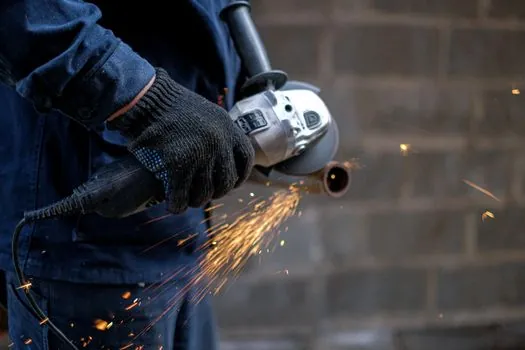
Handheld grinders suit confined areas, edge work, and small sections. Their lower portability cost is offset by kneeling or crouching, less even weight distribution, greater labor input, and a wider margin for finish variation [S2].
For production floor polishing, the floor grinder cost tied to disc size and planetary head count becomes relevant, but head count alone does not determine suitability. Confirm working width, permitted RPM, power supply, dust extraction, and the tooling system before purchase.
Build the RPM Sequence into the Work Plan
A controlled sequence is: coarse metal-bond grinding at 550–650 RPM, resin grinding or honing at 650–750 RPM, and fine resin or felt polishing at 800–1,100 RPM [S5]. For variable-speed stone equipment, the usable bands may sit lower, so use the approved tool setting while preserving adequate torque.
Start at the lower end of the approved band, verify the scratch pattern and cut rate, and increase RPM cautiously. Excessive speed can produce swirl marks, poor finish consistency, or a surface that does not polish cleanly, while insufficient speed can cause stalling or uneven removal [S4].
Record the machine model, disc diameter, abrasive code, bond type, grit, wet or dry condition, and selected RPM on the job sheet. Recheck the angle grinder rating separately for edge work, because a handheld tool is not a substitute for the published floor-machine speed plan.